5 Book Reviews You Need to Read This Week
“Dog Days lends itself to exactly this kind of paranoid reading, not only describing but enacting the magical thinking of trauma survivors.”
Our feast of fabulous reviews this week includes Niela Orr on Colson Whitehead’s Cool Machine, Lily Meyer on Valeria Luiselli’s Beginning Middle End, Jonathan Derbyshire on Emily Eakin’s The Frenchmen, Jamie Quatro on Emilee Hackney’s All That’s Unseen, and Meghan Racklin on Emily Labarge’s Dog Days.
Brought to you by Book Marks, Lit Hub’s home for book reviews.
*
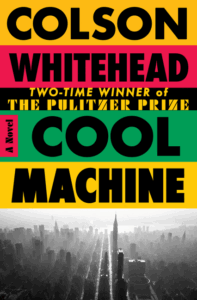
“At the start, he deployed humor as a cudgel against sentimentality or contrivance, but in recent years, he’s relented to sincerity, embracing deep feeling and even tenderness. Whitehead tends to use familiar narrative mechanisms (especially those belonging to genres like noir, horror, crime, and adventure) to chart unforeseen sensations or realities. He takes tropes and uses them to rope-a-dope the reader; he springs the traps laid by convention and the strictures of form in order to dictate his own course, to establish new norms. In particular, Whitehead repurposes ready-made narratives to explore underrepresented areas of Black experience; he consistently commits to the bit and then twists it, finding emotional resonances where you’d least expect them.
…
“Cool Machine, out tomorrow, is the final novel in his Harlem Trilogy, and it seems to take the spirit of that sixth writing rule about leaving things unsaid seriously. Along the way, Whitehead celebrates, in deliberately unsentimental fashion, the variety of Black ingenuity and splendor on offer in marginalized circles.
…
“In place of standardized hardboiled crime fiction, with its emphasis on formula and procedure, Cool Machine is a sophisticated meditation on Black masculinity, aging, and unsanctioned political resistance (Du Bois defines crime as ‘the open rebellion of an individual against his social environment,’ which could apply to revolutionaries or gangsters). Rather than standard thievery, this novel considers another kind of seizure—what it means to lose time, and thus the potential to change, even as everything around you is being constantly reframed. Witnessing their development is the gift of getting to know characters on layaway over nine easy installments. But the insurance afforded by a series can also expose its inherent flaws. As in the first two novels, Carney and Pepper are put through the wringer, but I never felt like they were truly in trouble. The tropes of the crime novel wear thin, with its grim foreshadowing and prodigious exposition. The three-novella structure is sometimes predictable, with its movie-of-the-week rhythm, which requires resolution every hundred pages or so. But these are misdemeanors, easy to overlook.
…
“Although it’s a novel, I’m beginning to think of Cool Machine as a counterhistory of Harlem’s underworld, one that surprises because it prioritizes human frailty and imagination. Regarding the fate of one mislaid item on the move in this final novel, we learn that there is a crucial two-week period that goes unaccounted for between what happens to the object and the revelation of its fate. The mystery of what exactly occurs in the interim belongs to one character alone—not even the reader knows what went down with real detail, though we can imagine. Here, Whitehead’s joking writing instruction comes in handy. Indeed, what isn’t said is important. In this case, some of the really good stuff happens off the page, in the minds of readers and in the hearts of rogue personalities we can’t quite pin down.”
–Niela Orr on Colson Whitehead’s Cool Machine (Vulture)
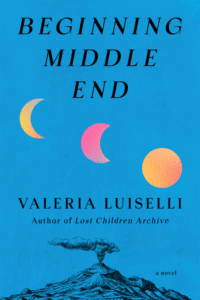
“But for those alarmed by the turbulence of midlife, the writer Valeria Luiselli’s novels offer a refreshingly different perspective. ‘I once read in a book by Saul Bellow that the difference between being alive and dead is just a matter of viewpoint,’ the narrator of Luiselli’s debut novel, Faces in the Crowd, recalls. She goes on to explain that the ‘living look from the center outward, the dead from the periphery to some kind of center.’ According to this worldview, the middle of life, far from a time to reset yourself, is the crux of human existence. And in Luiselli’s new novel, Beginning Middle End, it’s also where the messiest, most interesting, and most exciting parts of a story occur.
…
“Luiselli has long been intrigued by literary boredom. Beginning Middle End, like all of her novels, goes without what its protagonist calls the ‘corset of plot.’ By no means does it lack drama—see: impending lover, maybe-sick mother; because this is Sicily, there’s also a looming volcano—but traditional story does not drive the novel forward. As it winds down, Luiselli does not resolve any of its questions (Is the mom all right? Will the narrator be able to write again?) but instead hands the narrative from the protagonist to her daughter. The novel’s final section takes on the daughter’s voice, and in its last lines, the daughter arbitrarily declares her mother’s book over: ‘This is the story,’ she says. ‘It has a beginning, a middle, and an end, and this is the end.’ By rejecting the myth of beginning again and the idea that endings are inherently meaningful, Luiselli highlights the fascination of the middle.
It’s a bold approach to life, more than literature. In the traditional arc of a book, of course, the ending can come only once. A beginning, meanwhile, sets a story’s tone and stakes. It tells the audience whom and what to care about, and creates, ideally, a sense of expectation and intrigue. Beginnings, in short, exist to make you want to read middles. In life, this can be tougher to accept; it’s hard to be in the middle, twisting between life and death.
Still, as my grandfather used to say, it beats the alternative. He was talking about dying, but also, I wouldn’t want to be (or have) a newborn forever, or ditch my husband after the honeymoon, or quit my job as soon as a challenge arises. Forging onward can sound duller and bleaker than launching a new life—hence, I think, the appeal of stories about multiverses—but in fact, it leads directly to the interesting stuff. Beginning Middle End knows that the first and last words in its title are just necessities. It’s the center, where life flails on, that counts.
–Lily Meyer on Valeria Luiselli’s Beginning Middle End (The Atlantic)
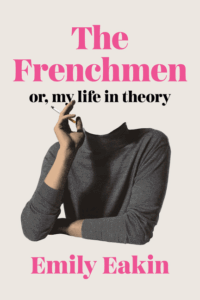
“…for students like Eakin, ‘deconstructing’ the fundamental assumptions of western metaphysics was heady stuff, even if you had only a ‘glancing familiarity’ with the great works of the philosophical tradition. So why, having fallen so comprehensively for theory, did she come to regard it as a ‘dangerous substance’ to be renounced or forsworn?
The Frenchmen attempts to answer this question. And in doing so invites us to see Eakin’s own story as somehow symptomatic of the experience of what the critic Nicholas Dames has called the ‘Theory Generation.’ (It is ironic, incidentally, that this cohort should have seen its college years frequently depicted in a form—the realist novel—that theory did so much to ‘denaturalize and demystify,’ as Dames puts it. Think of books such as Jeffrey Eugenides’ The Marriage Plot, Jonathan Franzen’s The Corrections or Lorrie Moore’s A Gate at the Stairs.)
…
“In 1987, a Belgian researcher discovered more than a hundred articles that de Man, who died in 1983, had written for a collaborationist newspaper during the Nazi occupation of Belgium. At least one of the pieces was explicitly antisemitic.This discovery stunned de Man’s colleagues and students, and was particularly traumatic for Derrida, who attempted a tortured but ultimately unconvincing reckoning with what his friend had written as a young man. For theory’s enemies, the revelations simply confirmed everything they’d thought all along about the pathologies of deconstruction. ‘The timing of the de Man revelations,’ Eakin observes, ‘could not have been less auspicious for theory’s advocates—or better orchestrated by America’s newly ascendant political right.’
It must have been tempting, in the face of all that, to write a repentant latter-day version of the cold war communist apostasy memoir. But it is to Eakin’s credit that she doesn’t really go in for what Erdur calls ‘theory bashing.’ Her book ends not with an obituary for a ‘god that failed’ but with a provocation—that, for all its excesses and its broken political promises, theory’s legacy of ‘vigilant questioning, of scrupulous attentiveness to language’s complexities and contradictions’ might not be as ‘antithetical to the common good’ as many of its critics have charged.”
–Jonathan Derbyshire on Emily Eakin’s The Frenchmen: Or, My Life in Theory (The Financial Times)
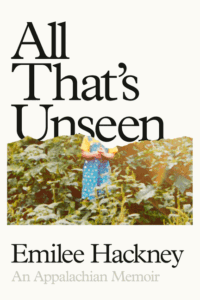
“This migration between landscapes spiritual and topographical, as Hackney disentangles the oppressive mores of her church and culture from a family and region she cannot help loving, is the dialectic within which her singular story unfolds. As she recounts growing up in the literal shadow of the Appalachians and in the figurative shadow of the Pentecostal church, she asks: Is salvation in ministry or mountains, pulpit or place? Do I belong to one or the other? To both or neither?
It’s been 10 years since the publication of Hillbilly Elegy, by Vice President JD Vance, and we finally have an Appalachian memoir worthy of its origins, by a Gen Z writer—an eighth-generation Appalachian—who is too smart, and too authentically of her place, to reinscribe stereotypes.
…
“Flannery O’Connor’s Catholic critics found her work insufficiently religious, while her liberal critics thought she wrote too obsessively about ‘religious freaks.’ O’Connor’s life and work took place in the no man’s land between these poles. That no man’s land is Hackney’s aesthetic terrain. She understands, with prescient insight, that beauty and truth inhere in the gray-toned middle spaces between blacks and whites.
In Hackney’s telling, there are no welfare-state villains or hard-working heroes. There are only individuals: living, breathing humans with all their nuance and complexity. When it comes to writing about rural Appalachia, Hackney’s memoir proves that an elegy is the last thing we need.”
–Jamie Quatro on Emilee Hackney’s All That’s Unseen: An Appalachian Memoir (The New York Times Book Review)

“Trauma estranges LaBarge, or me, or you, or any person from oneself; it makes grammar, syntax, and form strange. Dog Days, a fusion of memoir, criticism, psychoanalysis, and even scientific theory, makes this stuttering sensation its structuring principle, as the book changes forms and perspectives, doubles back. It is less about what happened to her than how she might tell it; about the mysterious, alchemical process of writing, the transubstantiation of living into language.
…
“LaBarge is a stunningly talented critic and a gifted close reader, a practice that becomes central to her life in the years after That Awful Thing That Happened. She seeks comfort in stories ‘in which it seems as though something undefinable is missing, has been lost, in which there is some shapeless hole to be filled,’ but she also searches the world for portents, a way of fending off fear. The trees scold her, and birds follow her, screeching ominously. She inexplicably hears classical music on the escalator down to the tube station and thinks it is trying to tell her something. She sees people she knows on the street, spying on her, but they dissolve into unknown faces on a second look.
Dog Days lends itself to exactly this kind of paranoid reading, not only describing but enacting the magical thinking of trauma survivors. In an extended analysis of Nabakov’s short story ‘Signs and Symbols,’ about exactly this tendency to search for meaning, she asks, ‘What does it mean that the mother accidentally drops three specific playing cards to the floor, the knave of hearts, the nine of spades, the ace of spades?’ A handful of pages earlier, she has recounted a tarot card reading someone did for her. ‘The card turned up for me—was it the Page of Wands? The Two of Coins? The Fool?’ These are cards that speak to change and chaos, chance and possibility, innocence and exposure. What does it mean?
…
“The movement to You reflects the distortions of traumatic memory that LaBarge describes, and it also reflects what she comes to see as the collective, interpersonal nature of trauma. While trauma feels profoundly isolating, in attempting to make sense of it, she finds herself always in association with other people, both as she searches for ways to understand her experience through the stories of others and because, when she does tell this story, it is always being told to someone else. This move into the second person, then, is an extension of her method of processing trauma through art, literature, and film. ‘If you’—yes, you!—’can’t see, for instance, that you’re already dead, that you died with six-year-old Hind Rajab, shot to death with 335 bullets as she waited hours in a car, surrounded by dead family members, for the paramedics to arrive,’ LaBarge writes, ‘then you have to stay here, in the old world,’ the world of linear time, of a knowable self, of a good story.”
–Meghan Racklin on Emily Labarge’s Dog Days (The New Republic)

Book Marks
Visit Book Marks, Lit Hub's home for book reviews, at https://bookmarks.reviews/ or on social media at @bookmarksreads.