
We Have Too Little Time (and This Makes Us All Too Human)
Rivka Weinberg on the Brevity of Our Beautiful Little Lives
Thirty isn’t old if you’re a tree. It’s not even old if you’re a person, but it still means you’re probably more than a third of the way through your life. Human life is too short for our reasonable aims and purposes. Having too little time makes achieving meaning—doing significant, valuable things, having an impact, making sense of things, and pursuing or engaging with ends of value—an exhausting, demoralizing race we are not quite built to win because we don’t have the time it takes.
Let’s start with the basics: love and work—is that too much to ask? Unfortunately, yes it is. By the time you know what kind of work you might do well and find meaningful, it may be too late to do it, and forget about doing a great job of it. Many kinds of fulfilling work take many years of training, leaving you little time to do the work at all, let alone do it well, and forget about doing it as a second or third career attempt. It takes about fourteen years of post-high-school training to become a doctor, about half that to become a lawyer (but then you have to be a lawyer), and you can spend your whole life trying and failing to be a writer or any sort of artist.
It doesn’t help that by the time we figure anything out, we are already losing our minds.
Many careers that require peak physical conditioning demand a great deal of grueling training and don’t last past your years of peak physical condition, leaving you with the rest of your life to do something you have had little time to train for. Jobs that take less time to learn tend to be less rewarding; less meaningful both experientially and financially. So much for work.
Love takes time too, both to find and to get good at, if you’re fortunate enough to manage either. By the time you have some clue as to who and how you might love without making everyone miserable, your life might be more than halfway done. By the time you develop the patience, wisdom, and understanding that makes for a suitable parent, your children will probably be long grown and off doing a bad job raising children of their own.
It doesn’t help that by the time we figure anything out, we are already losing our minds. Age-related cognitive decline begins in our twenties (!), just as our prefrontal cortex, which is responsible for judgment, is finally completing its lengthy maturation process. The rate of cognitive decline increases as we age, with a steep increase after age sixty. Our learning curve is at cross purposes with meaning (though we may make up for some lost acuity with age-accrued wisdom).
We also waste a lot of time, which is a waste. But who among us manages to avoid that? Lots of wasted time is externally imposed, e.g., sitting in traffic, waiting in line at the DMV, waiting for the plane to board (I can feel myself getting irritated just listing these examples!). But we also waste plenty of time all on our own.
Wasting time can seem built into the laws of the universe; the Conservation of Wasted Time: waste less time one way and you just end up wasting more time some other way. (Swear off mindless TV and you might find yourself playing mindless video games; swear off mindless video games and you might find yourself gazing at all the odd spots in the ceiling or mindlessly scrubbing the bathroom tile grout to pointless whiteness, etc.). The struggle and self-flagellation devoted to the doomed attempt to stop wasting time is likely merely another way to waste your time.
No wonder we don’t do things very well. We don’t have the time to become skilled, and we have to do too much at once.
However, perhaps by making sure to devote a significant amount of time to meaningful pursuits, we can forgive ourselves for not being efficiency machines. That might be a more productive approach to being meaningfully productive than aiming outright at eliminating time waste. Regardless, the fact remains that we have too little time and, with some spectacular exceptions of immense achievement in a short time (e.g., Mozart who died at 35, Lord Byron who died at 36, or Keats who died at 25), we seem condemned to waste a considerable part of that paltry, sad allotment.
Even worse, because we have so little time to begin with, we have to do everything at once during our short period of pseudocompetent adulthood. We have to work, raise children, rustle up some food and try to render it palatable, make sure we aren’t breeding mold or attracting rats, pay the bills, get the teeth cleaned, the gutters cleaned, the snow shoveled, the toilet unclogged. Oh, and spend many hours of every single day sleeping. No wonder we don’t do things very well. We don’t have the time to become skilled, and we have to do too much at once. Meaning will not come easy.
Nor will it come cheap, considering that getting the most meaning out of our short lives requires paying attention, changing things, and suffering (more on that in a bit). We have not managed to make human life actually last much longer over the course of human history, though we have managed to give many more people a shot at a full human life span, which is a phenomenal accomplishment that puts meaning more within reach for many more people.
There are some things we can do to make life feel longer, which might also serve to make life feel more significant, valuable, impactful, and purposeful. That might translate into life actually being more significant, impactful, valuable, and purposeful to the degree to which subjectively slowing time down allows for deeper or more significant engagement with meaningful pursuits, and/ or enables us to more accurately perceive and remember the meaning we have attained over the years. To slow down the subjective experience of time over the course of our lives so that, to the extent possible, we can more fully engage in and appreciate the meaning in our lives and not feel like it passes us by in a flash, we will have to pay attention, change, and suffer.
To make the most meaning of your time, you have to live full out: engage with meaningful pursuits and accept the suffering of time’s wounds that is inevitably part of living a full, meaningful life.
Because our brains are wired to learn from the past, predict the future, and attend to danger, when nothing particularly novel is going on, the brain registers the situation as “same-old, same-old,” and does not waste energy paying attention. Thus we hardly notice or remember what becomes usual to us, and the passing of familiar time hardly registers. That’s one reason why time seems to pass more quickly as we get older. To avoid feeling like your life has passed you by, it pays to pay attention and to give yourself something to pay attention to. Change demands attention, so changing things up might make your life feel longer, though whether that is a meaning enhancer depends on the nature of the change.
Moving residences, for example, is a change that usually demands attention. It can delineate one time of life from another, as in, “that happened in our old house,” or “that was before we moved to this country,” etc., and, in that way, pause the blur of your life into a more attended-to clearer picture. But it’s very stressful, reportedly on-par with traumatic events such as the death of a spouse or divorce, and, in itself, not necessarily meaningful.
However, happily, most meaningful efforts, engagements, and pursuits involve profoundly more fulfilling and less harrowing change than moving. Learning, creating, loving, growing things, taking care of living things or beautiful things, working toward valuable ends—all of these pursuits involve change, and all involve regular, everyday life and engagements with Everyday Meaning. There is no need to change things in your life merely to slow time down; no need to move to the next town just to mix it up.
Change is built into Everyday Meaning and the more you engage with it, the more meaning you pursue, the less your life will seem to fly by without your noticing and the more meaningful it will be, both objectively and subjectively. To make the most meaning of your time, you have to live full out: engage with meaningful pursuits and accept the suffering of time’s wounds that is inevitably part of living a full, meaningful life.
__________________________________
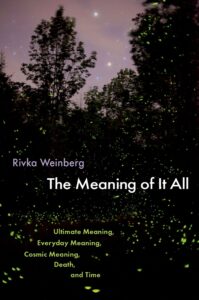
This article includes excerpts from The Meaning of It All by Rivka Weinberg and published by Oxford University Press in the US © Weinberg 2026. Used by permission. All rights reserved. Footnotes have been removed to ease reading.

Rivka Weinberg
Rivka Weinberg is Professor of Philosophy and Mary W. and J. Stanley Johnson Chair in the Humanities at Scripps College. She is the author of The Risk of A Lifetime: How, When, and Why Procreation May Be Permissible (OUP 2016). Weinberg specializes in ethical and metaphysical issues regarding procreation, birth, death, and meaning.