We Are Our Stories: On Heritage, Family and the Importance of Oral History
“Collect stories as though your life depends on it... And then share them, preserve and nurture them any way you can.”
On September 11, 1992, the most powerful hurricane in Hawaii’s recorded history smashed into Kauai. There had been no warning. Seven people died. Billions of dollars in damages. But the morning after, the article published by The New York Times dedicated only a single paragraph to the death and destruction. The rest of the article? Interviews with tourists upset over their ruined vacation. Assurances that every effort was being made to help them stay comfortable until they could be whisked from the arms of danger. Then, an update on Jurassic Park. We’re told to take comfort. The film set was damaged but no dinosaurs were injured.
It’s not the glibness I find most appalling. I’m used to the chronic way tourists have traditionally been centered when it comes to all things Hawai’i. But this article underscored something I’ve come up against repeatedly since becoming a writer of historical fiction: history, the thing that has already happened and therefore cannot be changed, is not written in ink. It’s written on a chalkboard. To be erased and edited, rewritten, and reinterpreted, repeatedly.
Oral histories are the inner chambers of official records, the antidote to the historical amnesia that continues to plague us.
To the victor go the spoils, the adage tells us. To the victor also goes the pen that declares the broad-stroke version of what has happened. But if what was held to be fact fifty years ago isn’t necessarily true today, when can we rely on a fact being a fact? What can we take as information, not interpretation?
The horrors of current events have moved this question from the rhetorical to one that will be the deciding force in the direction our country is headed. We wake up to a daily deluge of violence, chaos, uncertainty, and upheaval. Even the most innocuous areas of our everyday lives have become political and divisive. And yet, we are told: you are not seeing what you are seeing. What is happening in front of your eyes is not happening. Photographs, video, eyewitness testimony all contain the possibility of reinvention.
If my camera is not weapon enough, what is? If I cannot trust my eyes, what am I to trust?
*
If there is knowledge, it lies in the fusion of the book and the street. So said Studs Terkel, an American writer best remembered for the oral histories he collected of everyday Americans. He believed oral histories can be messy and contradictory, but context is provided, and somewhere within that context exists a truth. Oral histories are the inner chambers of official records, the antidote to the historical amnesia that continues to plague us.
When I was a child, dinnertime marked when my mom asked for a report on what had happened at school that day. Regardless of any social drama or lessons learned, I only ever had one answer.
Nothing.
This is how I’ve come to think of the history textbooks collecting dust on shelves in classrooms and libraries across America. This war happened on this date. This country started or ended on this date. This kingdom became a state on this date. No context, no connection, no acknowledged injustice. Entire subjects washed clean of their inequities, their racism and sexism, their imperialism. And yet every feat of human creation—every stone of every pyramid, every inch of the Great Wall of China, every seat of the Colosseum—bears an invisible name, hundreds of thousands of them, of all the millions of individuals to whom credit goes for putting those things there.
Growing up in Hawai’i in the eighties and nineties, our textbooks were federally issued. Math word problems included scenarios with zero relatability. History covered peoples in lands an ocean away. Even geography had no ties to the world existing directly outside our classroom. Rather, Hawai’i’s collective wisdom was contained within chants, mythology, family lore, and ancient stories passed down orally from one generation to the next. My teachers were my hula halau, community elders, and family.
There were, of course, large global events mentioned within my textbooks that overlapped with these inherited oral stories. When my maternal grandfather was in eighth grade, he spent weekends working on the sugar plantation where his grandfather was the manager. One morning, he was on the roof helping with repairs when everything started to shake. He assumed it was an earthquake. Then he looked across the sky. Bombs were dropping on Pearl Harbor. He immediately quit school and joined the military. When he would tell this story, he’d always pause here to emphasize the fact that he didn’t sign up out of any feeling of loyalty to America (Hawai’i was a territory at the time) but rather out a protective loyalty to Hawai’i.
My paternal grandfather held his WWII stories closer to his chest, but in his final days he described trekking through the French countryside in the dead of winter, the turnips he’d somehow extracted from the frozen ground to cook in his upturned helmet.
When I think about WWII, it is their stories that bring it to life.
I have a niece who is three years. Since she lives in Hawai’i and I’m in Los Angeles, this means a lot of video call tea parties and smashing my cheek to my phone screen for virtual kisses. I can’t help but wonder what she’ll be taught in school, what her history books will say about our today. What interpretation of reality will she be told? Whose version will prevail?
In times of crumble and collapse, buildings and governments may fall, but stories are the ghosts that whisper to us from the rubble.
I was in Rome a few months ago, wandering the ruins of its empire as I tried to focus on the fellowship that had brought me there, the novel I was supposed to be writing. I couldn’t shake the feeling I was being an ostrich, head stuck in the sand, escaping into fiction while the world around me burned. But as I moved through rooms thick with history, I began to listen. The walls pulsed with stories. Guides stood beside works of art and artifacts, hands dancing as they spun their tales. Families and couples traded tidbits they’d read, what they’d seen or heard.
It was art that had preserved Rome for us, plays and poems and paintings that showed us how their today had led to our today. In times of crumble and collapse, buildings and governments may fall, but stories are the ghosts that whisper to us from the rubble.
How can we have a future, if we have no past? We are well familiar with aspirations of fame and fortune. Many of us are no doubt amending those aspirations to include political freedom, security, and peace. But what if we also aim to be bastions of our own histories, soldiers—collectors and protectors—of our collective memory? In hula, one of the first lessons I learned was that we were there to learn this ancient knowledge not for our pleasure. We were merely a speck on a long timeline that stretched far beyond us in either direction. It was our duty to learn what there was to learn to keep the flame burning. We were merely the bridge between the future and the past.
This is a call to arms. If you find yourself in a room with an octogenarian, ask: and then what happened? Collect stories as though your life depends on it. In some ways, it does. And then share them, preserve and nurture them any way you can. You never know who is going to carry the torch.
__________________________________
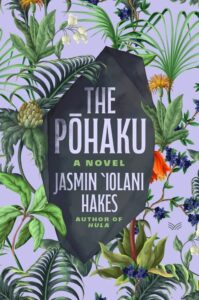
The Pohaku by Jasmin ’Iolani Hakes is available from HarperVia, an imprint of HarperCollins Publishers.

Jasmin Iolani Hakes
Jasmin Iolani Hakes was born and raised in Hilo, Hawai'i. Her essays have appeared in the Los Angeles Times and the Sacramento Bee. She is the recipient of the Best Fiction award from the Southern California Writers Conference, a Squaw Valley LoJo Foundation Scholarship, a Writing by Writers Emerging Voices fellowship, and a Hedgebrook residency. Dance has always been central to Jasmin's life and creativity. She took her first hula class when she was four years old and danced for the esteemed Halau o Kekuhi and the Tahitian troupe Hei Tiare. She worked throughout college as a professional luau dancer. She lives in California.