Understanding the Complex History of Anti-Asian Racism
Scott Kurashige on the Rise of Asian Hate and Violence
Five years ago, in the aftermath of the mass shootings that struck Atlanta-area spas three words appeared on the breaking-news ticker as I followed coverage of the horrifying events.
Though Asian women comprised six of the eight victims, news networks declared the attacked were “not racially motivated.”
The murders magnified the terror and sorrow emanating from thousands of anti-Asian attacks arising in the months preceding. Following the outbreak of COVID-19, bias incidents and assaults against Asian Americans soared to alarming heights as demagogues on the streets and in high office inflamed xenophobic fear and animosity. In the aftermath of the shootings, at least 70 percent of Asian Americans felt that violence and discrimination had become greater threats to the community during the pandemic.
Against this backdrop, authorities carelessly repeated the claim of suspect Robert Aaron Long that the violence “was not racially motivated.” In the words of the Cherokee County Sheriff’s spokesman, Captain Jay Baker, he just had “a really bad day.” Long was a young white man afflicted by a “sex addiction,” and Baker conveyed he viewed the massage parlors as “a temptation for him that he wanted to eliminate.”
But as Jina Moore of Business Insider countered, sex addiction is not a medical condition based on diagnostic criteria. It is, quite to the contrary, “a piece of evangelical theology.” The shooter’s projection of evil onto the spa workers betrayed his immersion within “purity culture.”
Soon enough, there was even more reason for outrage.
According to scholars Andrew L. Whitehead and Samuel L. Perry, the Christian nationalist mission to purify America of its would-be sins is rooted in “assumptions of nativism, white supremacy, patriarchy, and heteronormativity, along with divine sanction for authoritarian control and militarism.”
An informed response to Long’s statement should, therefore, have probed how his ideas about sex and gender were interconnected with his thinking about race, religion, and colonialism. It was not necessary to prove that Long hated all Asians. The most pertinent question to ask was this: What led Long to target Asian women in the businesses he patronized yet derisively saw as ungodly?
We do not need to read the killer’s mind to know how the dehumanization of Asian women as sexualized labor, whose value lies only in its service to American men, pervades our culture. It is steeped in the history of exclusion, when Chinese women were stigmatized as prostitutes and a menace to public health. Since the mid-twentieth century, it has proliferated through the decades-long practice of “camptowns” set up to serve the recreational desires of U.S. soldiers stationed in Asia and “mail-order bride” catalogues promising to bring submissive women to American patrons.
Directly or indirectly, these histories—including their dramatization on film and television—shape the image of “oriental” massage parlors before one ever sets foot in them.
Soon enough, there was even more reason for outrage. Internet sleuths revealed that Baker had liked and shared a racist “CHY-NA virus” meme on social media. Placed under the national spotlight, Asian Americans were reminded how common it is for their fates to be determined by powerful figures committed to misrepresenting them. When called upon to validate the oppression of Black, Brown, and Indigenous peoples, Asian Americans are stereotyped as the high-achieving but docile “model minority.” But the attacks of the pandemic accentuated the stereotype of Asians as the “perpetual foreigner” who must be contained or excised to make America great again.
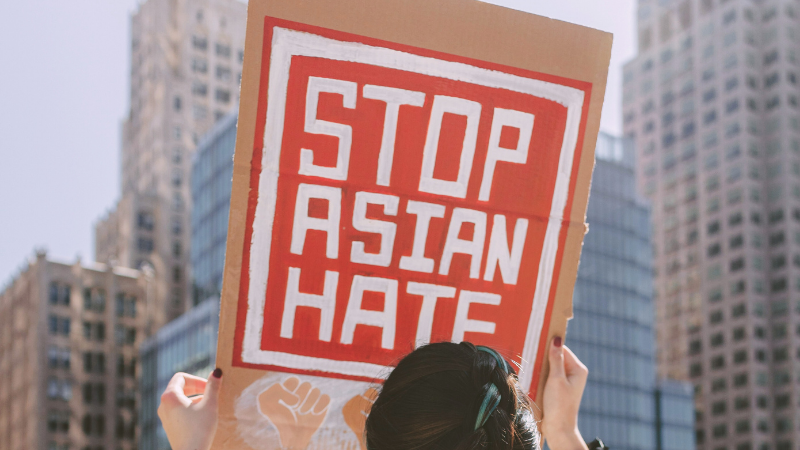
Tens of thousands of Asians and non-Asian allies responded with an unprecedented wave of protests and demonstrations spanning at least fifty cities. Hollywood celebrities joined grassroots community organizers. In 2021, over 8.4 million Twitter posts used the hashtag #StopAsianHate. Millions in donations and pledges were devoted to programs, events, advocacy groups, and awareness campaigns. In a sign of broader shifts among policymakers, Congress passed the COVID-19 Hate Crimes Act with rare and overwhelming bipartisan support to address anti-Asian attacks in May 2021. “Too often,” President Joe Biden lamented as he signed it into law, anti-Asian hate “is met with silence—silence by the media, silence by our politics and silence by our history.”
Over the past 175 years, that silence has been the product of a wide range of actors, including leaders on both sides of the aisle. Time and again, horrendous physical assaults and rampant discrimination have officially been deemed “not racially motivated.” Although we can identify signs of overt bias in many instances, this is often just the tip of the iceberg. The reproduction of systemic racism occurs not simply through white denial but also through the promotion of cultural incompetency.
While individuals may harbor unconscious bias, this calculated form of erasure stems from the willful amnesia at the core of the U.S. empire.
“Racism is one of those crimes of which we in America seem content to allow the perpetrators to decide whether they are guilty,” journalist Frank Shyong commented following the Atlanta shootings. “Like a conceited person staring into a mirror, America’s white-dominated institutions investigate themselves for flaws and find none.”
Although confronting the scourge of anti-Asian violence has long been a priority for Asian American scholars and activists, their insights have too often been ignored or minimized by policymakers, educators, and journalists. The guardians of knowledge have customarily deemed the history and experience of Asian Americans to be inessential or peripheral to all levels of American education. Someone with a PhD will not necessarily possess more accurate information about Asian Americans than a high school graduate.
Anti-Asian violence thus presents a twofold problem. Physical acts of racist terror have been coupled with the violent erasure of history. This disturbing pattern has allowed anti-Asian violence and racism to escape both notice and censure. It stretches back to the nineteenth century, when white mobs and assailants subjected Asian immigrants to lynchings and pogroms with impunity. It also stretches overseas to encompass nearly every major U.S. war since Reconstruction. American soldiers wantonly committed scores of war crimes that the U.S. military routinely covered up. Such events are mostly or entirely missing from school textbooks. Thus, students learn a one-sided account of wars with Japan and Vietnam, and next to nothing about places like the Philippines, Okinawa, Korea, Cambodia, Indonesia, Laos, Bangladesh, and Afghanistan that have had their entire histories devastatingly remade by U.S. foreign policy.
While individuals may harbor unconscious bias, this calculated form of erasure stems from the willful amnesia at the core of the U.S. empire. The ideology of American exceptionalism set in place the myth that the United States was born free and uniquely destined to spread liberty and democracy, acting solely out of virtue. Under Donald Trump, the U.S. government is brutishly acting to rewrite history to promote white nationalism. Overcoming this willful amnesia is a crucial first step in addressing the problem. We cannot expect better policies or leadership to stop anti-Asian violence until we develop a better understanding of its historical and contemporary causes and manifestations. But power emanates from historical consciousness. It can reshape collective identity and foster the shared awareness necessary to build multiracial coalitions linking our struggles to transformative movements for social justice.
Given the long list of tragedies in American history, we should not have needed one more to function as a proverbial “teachable moment.” Yet the Atlanta shootings served as a national wake-up call that has proven harder to ignore. Asian Americans have demonstrated overwhelming support for more educational measures to confront anti-Asian bias. Twelve states have now passed legislation requiring Asian American history to be taught in K–12 schools. Such an education is needed as much for Asians as for non-Asians. Only 24 percent of Asian Americans report being highly informed about the history of Asians in the United States. That equals the percentage saying they know little or nothing.
What are we trying to remember? How should we go about recovering history? And most crucially, what must we do with this vital knowledge?
As the late philosopher-activist Grace Lee Boggs stated, “History is not the past. It is the stories we tell about the past. How we tell these stories—triumphantly or self-critically, metaphysically or dialectically—has a lot to do with whether we cut short or advance our evolution as human beings.”
By unearthing what the groundbreaking historian Yuji Ichioka called the “buried past,” we establish the foundations for our endeavor to revisit and reimagine history. We get a sense of history as trajectory—one whose past patterns we must understand to exercise our power in the present and chart a course toward a better future.
Our objective should be stopping anti-Asian violence before it happens.
The fear that anti-Asian violence can randomly strike anyone caught in the wrong place at the wrong time has been a vital unifying force—one that scholar Yen Le Espiritu has characterized as “reactive solidarity.” Peoples of Asian ancestry in the United States are not necessarily bound together by a common language, culture, or lineage. As such, the perverse logic that “all Asians look alike” to racists provides a harrowing source of mutual identification.
But there is a danger of falling into a knee-jerk response to anti-Asian violence: first, look for signs of racial motivation, then demand that authorities arrest, prosecute, and imprison. Frustrated by the repeated failure to bring perpetrators to justice, victims’ advocates pushed to criminalize hate. Seeking to hold assailants and police accountable, new legislation expanded anti-hate prosecutions, enlarged protected categories, and enhanced sentencing. But this hate crimes framework also reinforced the power of policing, which functions to perpetuate social hierarchy.
Viewing better policing as an antidote can further cause us to overlook victims of state violence. As written and implemented, these laws place undue burden on proving individual culpability based on smoking-gun evidence of hate. Thus, they platform police officials like Jay Baker to make determinations of racial motivation. Prosecutions tend to be rare, and it is difficult to discern the degree to which such laws deter acts of hate. In a July 2021 study developed in partnership with civil rights advocates, the Movement Advancement Project cautioned that “hate crime laws are varied, often flawed, and can even harm the very communities they are meant to serve.”
Transcending the legal definition of hate crimes, we need to adopt a wide-angle perspective to study anti-Asian violence. A minority of cases involve a random attack by a perpetrator who is overtly bigoted. But the effects of anti-Asian racism surface far more broadly. Violence and intimidation have been used to terrorize Asian communities and to achieve political objectives. Less directly, societal prejudice can inspire crimes of opportunity.
Our objective should be stopping anti-Asian violence before it happens. Spotlighting the work of organizers helps us dispel the myth that Asians in the United States do not have an extensive history of social-justice activism or antiracist resistance. Crucially, movement builders in majority nonwhite cities fully comprehend that achieving social justice for Asian Americans cannot happen in isolation from organizing that seeks justice for the multiracial populations in which they reside. That is why their analysis and strategy cut across race, class, gender, sexuality, disability, citizenship status, and religion. Going beyond reactive protest, they are doing the difficult work of grassroots organizing to build community in the face of incessant attacks. They link the struggle against anti-Asian violence to a model of safety driven by restorative justice and a vision of collective care.
The United States stands at a historic crossroads, and there are signs for possible futures. They point one way, toward more solidarity within a democratic, egalitarian system; or the other way, toward more conflict and violence within a plutocratic, authoritarian system. We should thus be prepared for these countervailing trends—rising anti-Asian hostility and Asian American political empowerment—to continue. They situate Asian Americans at the center of the decisive struggles and debates that will define the future.
__________________________________

Adapted with permission of the publisher from American Peril: The Violent History of Anti-Asian Racism by Scott Kurashige (University of California Press, on sale May 2026).

Scott Kurashige
Scott Kurashige is author of The Shifting Grounds of Race: Black and Japanese Americans in the Making of Multiethnic Los Angeles and coauthor, with Grace Lee Boggs, of The Next American Revolution: Sustainable Activism for the Twenty-First Century.