
Toni Morrison on What Flannery O’Connor’s Short Fiction Reveals About Race in America
Considering the Role of Blackness and Black Bodies in the American Literary Canon
The novels of Ernest Hemingway, as well as most fiction of the twenties, thirties, and forties, are no longer obliged to do the technically strenuous work of establishing racial difference that we observed in the nineteenth century with Edgar Allan Poe. The negative “other,” the freely available surrogate, is already convention so entrenched, it seems “natural.” The writer has only to observe the rules, employ any combination of the codes that move about in social/cultural discourse: make sure the Africanist character is never without the sign of color or other marks of racial identification; never identify him or her as a citizen of a country or state; never give black personae power other than the power to serve; nor any voice other than comic, cowardly, obsequious, unreasonable, illicit, or de-sexed—unless the voice reinforces the status quo.
Since the codes are already embedded, what startles us now are the ways in which writers illuminate and reveal them, dismiss them or disentangle them. It is still possible to write Negro or nigger and rely comfortably on the reader’s comprehension of what all of that signifies; but it also becomes possible to load the term with irony. It is still possible to write Sapphira and the Slave Girl to ensure more or less complete communication because if the title were Sapphira and Nancy the power relationship would be out of kilter, off balance, because what would we feel if Sapphira called in her nephew to sexually assault a girl or woman who is not a slave? How could the reader be so sure that there would be no legal recourse Nancy could take, no risk to Sapphira? No demur or hesitation from the nephew. How could we believe that not only is escape illegal, so is remedy. And how could a reader accept the possibility that there would be no objection from Nancy’s mother? Such is the nature of slavery and the assumptions folded into that system.
But such things do occur to Willa Cather, and when they do they surprise us, and relieve us. We are relieved that Nancy’s welfare does matter to [Cather and] Till—that social death and natal isolation (in this case) is not complete. For if it is, then Till is thoroughly demonized, robotized either by slavery or something “innate” in her different genes. Although Cather’s novel was published in 1940, we seem not to need the historical frame of slavery for the story to exude credibility. Faulkner’s Africanist characters situated in mid-twentieth century could very easily respond the same way as Blue Bell, Jeff. [The difference between Nancy’s flight for her life, and the flight of the young black man in the film Crimes of the Heart is the mode of transportation.] And the possibility of a virile and serious and seriously taken black man—all three—is ignored in virtually the entire world of Cather’s and Hemingway’s fiction.
The text speaks another tale, one consistent with the habit of American fiction to engage Afro-Americans only as inventions of and the demands of the imagination to construct a self.
Still, the most glaring assumptions of these novels, so far—Melville’s work being an exception—is the social death of the Africanist characters—they either have no family context or obligations, or if they do have family, they are irrelevant emotionally to the black person and certainly to the whites. Their condition is timeless, history-less, without a cultural context other than their convenience or inconvenience to white culture. In short, they are bodies—for labor or exploitation; or they are shadows that haunt, hound, or threaten; or they are shadows that protect and guide.
Willa Cather in the very act of confronting these anomalies has recourse to distancing language, linguistic shortcuts, and although she does more than many to avail herself of a writer’s obligation to chart or imply a character’s interior life from some reliable point of view, Miss Cather rests too much of her case in character description on such hopelessly inadequate characteristics as skin color: the very black being evil, the lighter skinned being good. And carnal knowledge: what, for example, does Jeff think about his position, his castration, his wife, his stepdaughter?
By the time we get to Flannery O’Connor, we can see just as clearly as the old grandfather does the “artificial nigger” on the lawn and it is to O’Connor’s credit and her astonishing powers of observation that she knew all about it and put it on display. Showing us exactly what estranging devices are inherent in Africanism, and what purposes they serve in a white male consciousness and ultimately in literature itself.
Had I not had to submit a course title respectable enough to pass muster with the Committee on Academic Instruction, I would have called this course, or subtitled it, the same title Flannery O’Connor gave to the story by her I’ve asked you to read.
Apparently Miss O’Connor believed it her most satisfactory story. It isn’t mine—there are several of hers I find most and more satisfactory—but for the purposes of this discussion, it is as perfect and as perfectly written as a short piece of fiction can be—both identifying the thesis of this course and dramatizing that thesis.
For O’Connor the questions are these: How does Mr. Head come to deserve mercy, God’s forgiveness, self-realization, reconciliation through and because of this child abuse and treachery? Is the treachery the education he wished to and succeeded in giving him, or his cowardice in denying his grandson? The latter, of course, is what the character is concerned with, that he has mercifully recognized Original Sin and been spared, seen his sinful nature and been permitted to repent of it.
The sin, however, is both the denial of the grandson and the denial to the grandson of the grandson’s own body (i.e., having shown him the bodily distance from and alienness of black bodies, he strips the boy of a connection with his own body: the desire, hunger, and longing he felt in the presence of the black woman. Now that feeling of hunger is shame. Is O’Connor in collusion with Mr. Head? Has she also employed the artificial nigger as the unifying force, the thing about which one must know like the serpent which is the train leaving the safe haven, the home, the Eden they left for the educational journey to the city? How has the religious trope subverted and blinded the characters and possibly O’Connor herself ? Her letters might provide some clarity here, but one should be warned about equating racial tolerance or racial hatred with the exigencies of a written text. Is this a story about a touch of and by evil, and how is it given to us to recognize it (evil) out there and in us, and that with the grace of God we can attain salvation?
If so, the geography of the nigger has several roles to play, some known and understood on the surface, some subcutaneous, and some perhaps subliminal: Afro-Americans as “lost territory,” “wilderness” [the experience in the neighborhood]; as a “fall” into desire, vulnerability to which is weakness and the absence of “sense” [“You act like you don’t have any sense!” p. 262] and brute, animal ignorance [“standing there grinning like a chim-pan-zee while a nigger woman gives you direction. Great Gawd!” p. 263]. After which is closure—the lesson is learned: to listen to a nigger, especially a nigger woman, is to be like an unreasoning animal, not human, alien to the species; Afro-Americans as both that from which humans (whites) do flee and that from which humans must flee, if they are to be known as and to understand themselves as human and to have a place among humankind.
In other words, the question of who am I is answered with I am not them. Not “Je pense, therefore j’existe,” but the definition of self by what one is disconnected from. Affirmation by negation. And into this dilemma, this problem of identification, steps the ever merciful hand of O’Connor’s God saying, in effect: “Now you know evil, have been tempted by it, surrendered to it, suffered from its presence, and I offer you grace and salvation as a result of your acknowledgment that to stray into the wilderness is forbidden by Me.” Substituting niggers for the pronouns and nouns, God’s admonition reads as follows: “Now you have seen, encountered known niggers, have been tempted into identifying with niggers, have surrendered to niggers, have suffered the consequence of the presence of niggers and have received My grace, mercy, and forgiveness because you admit that the wilderness of niggers is forbidden to you.”
It is clear, therefore, that regardless of the apparently empathetic, sympathetic, even distantly objective stated view of Blacks, the text speaks another tale, one consistent with the habit of American fiction to engage Afro-Americans only as inventions of and the demands of the imagination to construct a self [in this sense the nigger is “artificial,” meaning made up], and to reconcile the contradictions inherent in this construct by a retreat into (in this case) the claims of a moral universe.
To, in fact, summon black presences in order to define what it is to be. The silence of the heretic is instructive here, that is, the blacks speak only to (1) not be heard (softly, in the train), (2) make haughty claims but not about themselves (the waiter’s instructions), their claims are haughty because they reproduce the white man’s rules, and (3) lastly (the woman in Atlanta) to help. The black people who do not serve the master narrative cannot be heard, because it is possible that the voices too soft to be heard may be engaged in conversation about themselves—a conversation to which O’Connor is not privy, and even if she were to invent, imagine it, such a conversation would destabilize the story. Derail it. Lose, as Mr. Head does, the tracks altogether.
Note that Mr. Head cannot understand or bring himself to understand the black woman’s perfectly accurate advice about how to find his way back; but the white man with the dogs is understandable, and what is more, lives in a neighborhood adjacent to the railroad stop that is their only hope of getting home at all—three blocks away, and they arrive just in the nick of time. In this sense, the good middle class white man (with dogs) is the saving deus ex machina. And the “artificial” nigger proves to be not just made, not just made up, but summoned by the author for a safe engagement with mortal sin.
One of the questions to be explored in the assigned fiction is how does the work perceive and then employ the benefits of “knowing” an Africanist persona; what are the consequences of that knowledge to the knower? Once the work establishes whether and how it knows, what satisfaction or dissatisfaction follows? Is the knower more in control? Does he or she behave differently and in what way?
At the opening of “The Artificial Nigger” the reader is lured into a vision of what there is to yearn for and to protect. And once the seduction is complete we are quickly deprived of the vision of power, elegance, and class superiority. [p. 249—“Mr. Head had awakened…”] Mr. Head’s dreams of power are dashed by O’Connor with “overturned bucket beside the chair.” But before that we learn that he has one major source of strength left: the ability to be “a suitable guide to the young.” Although this “young” is a dark spot.
The balance of the story is the rite of passage, the education, the distribution of “knowledge” to a white male child. To change him from a dark spot to a white one. [p. 241] But this sojourn, likened to Virgil’s, is education by deprivation—a kind of child abuse in its point and in its strategies. The goal—to know a “nigger”—is at once put forth as almost the sole objective of the “teaching” Mr. Head has to offer his grandson. [top p. 252] This, it turns out, is the documentation of such knowledge there is for the rite of passage to adulthood. Mr. Head is “showing Nelson that ‘he ain’t as smart as he thinks he is.’ ” He is initiating him into the limits of life and the pangs of “reality.” He believes this to be his duty as a good grandfather: to warn, to name, to demonstrate, etc.
A paradigm of the ancient initiation in forest or jungle. Africanist people, therefore, become the thing and its symbol: the battle plain upon which this initiation takes place. Once we learn that the area to be known is some body of knowledge known as “nigger,” the second step is of contact—of actually sighting and identifying the area here represented as the physical Africanist body as well as the body of knowledge. And the knowledge to be gained is that it is different and that the difference is lesser in all of its details. [p. 252: “You ain’t never seen…”] It is also important that in the process of identification, the warning, and the context in which this knowledge of difference should be held.{??} Third is to show the novice how to behave with, toward, or in the company of the Africanist presence in order to gather unto oneself courage, dominance, and power. This last is actually unavailable to Mr. Head, so he settles for contempt, and wit to cover ignorance as in the dining car scene. And, when in Atlanta, and the two of them are lost in a colored neighborhood—it is the ultimate nightmare of the forest: to be lost among them without protection or resources of defense.
It is the boy, Nelson, who ventures to ask directions and to feel desire for the black woman who gives him information about how to get out of the forest. The consequence of this teaching and knowing offered by the grandfather is recommended form of behavior linked to and cultivated as part of what in the world there is to know to support, perhaps, the visions of beauty and power and class superiority the story opens with. It does not matter what the black people are really like—now that the knowledge has been transferred, the knower need only find support for the veracity of the knowledge, even if he discovers exceptions to it. How Nelson is reformulated from one who feels desire to one who feels detestation (as well as shame for having desired) is the remarkable achievement of both the story and the storyteller and the system that requires it.
This means by which unification takes place, by which forgiveness is possible, by which mercy arrives, by which self-respect is regained is via the transference of humiliation to a plastic black form.
It is significant that the first step in knowing this Africanist topography is limited to the sighting of the skin, the color of the skin. Nelson complains, “But you said niggers were black not tan.” It’s hard not to put the question of whether Flannery O’Connor was being impartial and realistically objective in her descriptions of the blacks. Her descriptive terms of Mr. Head and Nelson are ghostly pale; she stresses their aversion to looking at themselves; they have a self-loathing which is consistently implied when they catch sight of themselves. Contrast this self-loathing with the absence of it in the descriptions for the black characters. [p. 254…“A huge coffee-colored man…”]
This man, followed by two young colored women who are talking softly, walking purposefully, the ruby, the sapphire, the walking stick, the gaze—may suggest excess to us, but would be an envied opulence to both Mr. Head and Nelson. Then there is the expert powerful-in-this-context demeanor of the waiters. [pp. 256-57] And in Atlanta the watching, unself-conscious children, the black woman to whom Nelson is attracted with a passion that is as seductive as it is maternal. This woman’s hair is a mess, but she fondles it; her body is described as unattractive, but desirable. She gives helpful information and caressing speech: “sugarpie.” [p. 261] There is a conflict between the description of their bodies and their absence of self-loathing. What then is there to say, in this story, about love and the body, knowledge as weaponry and the uses to which and for which the black people serve—both narrator and text—in a meditation on these matters.
One wonders what might signify the unlovely body in the story? The skin is coffee colored, but since that has no value acceptably repellant to the author, although it is to Mr. Head, there are other signifiers: the woman and the man are both fat and the woman’s hair is unkempt. Fat and unkempt hair then are two such signals. And we know they are, for the two young women who accompany the fat colored man on the train are not described at all. One is in yellow, one in green, and they speak in “throaty” voices. O’Connor’s black women are almost always in primary colors.
The climax of the story and the adventure is the encounter with a plaster nigger, not real flesh, and although we have been concentrating on the flesh of the body in the penetration of these Africanist characters as bodies of knowledge, it is important that the denial of his grandson is a denial of the head about the evil of its own body via the rejection of the body of his grandson.
The narrative turns at this point. This means by which unification takes place, by which forgiveness is possible, by which mercy arrives, by which self-respect is regained is via the transference of humiliation to a plastic black form and the clear evidence that self-loathing disappears once it is projected onto this plastic, artificial (invented, made, constructed, built) figure who, fortunately for the characters’ requirements, is not alive and cannot speak, move, or, most importantly, look, return a look, or be understood to also know Mr. Head. It is my contention that this story is paradigmatic and is an uncommonly explicit model of the way in which black characters function in fiction as a trope for (catalyst of) self-fabrication.
Indeed the route to the fabricated self is dependent on a fabricated other, on the concept of othering. For if Mr. Head has no other, only aspects of the self that the self can choose to enter, the burden of genuine knowledge, genuine sight—like freedom—may be far too much to bear. Yet one wonders what the consequences would be. Suppose there were no niggers live or conveniently artificial for purposes of self-definition and self-approval if not self-love. Against the imposition of education-as-trauma there would be anarchy/chaos (racial education becomes a severance of the self and/or a denial of an aspect of the self that is vital).
This trauma visited here on the male white child, and is followed by and dramatized by another incident of child abuse: (when the grandfather first deliberately fakes abandonment and then actually performs abandonment of the child to “teach him a lesson” in all senses of the word: the lesson being fear, dependence, isolation, distrust of anything outside “family/turf/tribe,” and especially distrust of one’s instincts, one’s love, one’s imagination, one’s intellectual independence. It is this the grandfather hates in the boy and needs to stamp out) one’s connection to others—all that is reduced or eliminated as part of the lesson, and the final lesson is a formulation of, separation of the self from the body—so it is not irrelevant that the grandfather’s name is Mr. Head. Mind (knowledge, education) must win over the body (spirit, self-reliance, etc.).
__________________________________
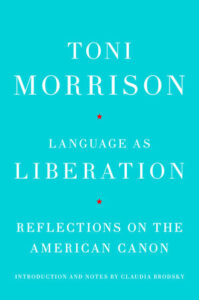
From Language as Liberation: Reflections on the American Canon by Toni Morrison. Copyright © 2026 by Toni Morrison. Excerpted by permission of Alfred A. Knopf, a division of Penguin Random House LLC. All rights reserved. No part of this excerpt may be reproduced or reprinted without permission in writing from the publisher.

Toni Morrison
Toni Morrison wrote eleven novels, from The Bluest Eye (1970) to God Help the Child (2015), and she received the National Book Critics Circle Award and the Pulitzer Prize. In 1993, she was awarded the Nobel Prize in Literature. She died in 2019 at the age of 88.