Thomas Jefferson Couldn’t Resist the Allure of Fame
Andrew Burstein on the Founding Father's Desire to Be Remembered by History
Thomas Jefferson was a secretive individual, for the most part. As a product of his culture, he almost had to be. What self-revelation occurred was not done casually. It, too, was performative, and it generally came about through letter writing, a mannerly occupation whose conventions were not limited by geography. A letter bore a dignified face, which unfolded into something both refined and personal. Enough personality emerged that a letter-based friendship might endure for decades. More than a routine conveyor of information, the familiar letter (as these penned testaments are known) was treated as a keepsake, periodically reread, almost like a favorite poem.
Theirs was an age of typography. The penned or printed word directed both reason and imagination. For this reason, a skilled writer’s collected letters were published and circulated. No one understood this fact better than the unusually well-read Thomas Jefferson, an enlightened practitioner within the justly named “republic of letters.” He recognized the converse of the pen as the lifeblood of educated men and women, abounding in possibilities for practical instruction and psychological well-being. A polished, discriminating style was valued as a manifestation of one’s identity, a way of sharing while adroitly establishing public credentials. When done well, it delivered personal advantage. Jefferson was famously artful in this manner, to the delight of most and to the dismay of those who saw him as duplicitous and were gleeful whenever a leaked letter caused him political embarrassment. Letters carried personal power and therefore invited judgment. They were barometers of emotion.
It was through a passive-aggressive urge to shape the literal, as well as political, landscape that he became an iconic force in the larger story of continental empire.
Untranslated, out of context, eighteenth-century letters can appear technical and unfeeling compared to what we now consider conversational writing. But as the practice evolved, eager writers like Jefferson and John Adams (but not George Washington or James Madison, for instance), gravitated to a richer, sympathy-bearing idiom, which no doubt bled into intimate speech, now lost. Soft-spoken in person, Jefferson was extraordinarily adept at communicating emotion on the page. He designed his letters with the recipient’s unique sensibility in mind and at times took real chances with what he left on the page. No matter what prompted a letter, he considered the exercise pointless if he did not at the same time convey an unmitigated spirit of elevated humanity—his true calling card.
Still, his words require considerable decoding. Within one letter, he’ll transition from serious matters to local gossip with witty references to history or popular literature sandwiched in between. Often, his philosophy of life, his vaunted pursuit of happiness, anchored his letter. That optimistic spirit he delivered on was a supple tool of the trade, especially when he came to pair refined behavior with affectionate social bonds—initially denoted as “republican,” and later “democratic,” feeling. This was the beginning of America’s comforting (albeit mythic) ideal of national greatness: selling the nation, and then the wider world, on the image of a young country that was the home of a do-good, upright, generous-hearted, exceptional people.
Notwithstanding a temperament ill-suited for hand-to-hand combat, Jefferson was unable to restrain himself from pushing his grand recipe for public happiness. Opposing those who excited (in the idiom of the day) “unhealthy passions,” he put forward a galvanizing concept, “affectionate sympathy,” which helped grow a popular fascination with the American idea of enlightened commonness—which, once again, translated as “democracy.” The most hopeful voices of every subsequent generation have chosen to define democracy Jefferson’s way. While by no means entirely of his invention, the rhetoric of the American Revolution has forever attached to the idea of Jeffersonian democracy. Jefferson is thus a fixture in both the birth of the United States and in the moral identity it claims.
*
Jefferson may have been the firstborn son in a land-rich lineage, but he did not have it easy. His was a fractured family, and he suffered profound losses. His private character came under fire at key moments in his nation’s early history, conditioning his attitude toward political enemies. Inaction on the subject of race enslavement, which stains his modern reputation, was already a subject of mockery when he was president. And though he did not react, allegations of his sexual attraction to Sally Hemings, a woman he’d inherited from his father-in-law, rendered him a cartoonish figure in those places where he had more detractors than supporters. Indeed, sordid unauthorized histories detailing the sexual lives of the titled and the privileged were nothing new—they went back centuries and were to be expected.
Yet it is important to note that neither race nor sex, important as they may now be in exploring who Jefferson was, caused him to lose sleep. Rather, it was the scandals he could not hide from involving personal hatreds that he struggled with until the end of his days. These were the ones that threatened his entire legacy as the patriot who strove to save his nation from devolving from sovereign republic into an overcentralized, antirepublican tyranny of the few.
He wanted to let go of ambition, to retreat, but he was egged on by those in politics who regularly pleaded with him to return to the field of action when he wanted only to retire to the protected mountaintop where he’d carved out an idyllic (if economically insecure) family seat. He tried retirement more than once, but it did not stick. His close confidants knew, even though he and they never acknowledged it publicly, that he thrived on being designated a “man of the people,” and so they let his private impulses play out.
Public and private combined to disrupt his personal quest for peace. The exercise of power, not surprisingly, contributed to the restlessness of a busy mind that waged battles against a committed opposition. Recurring headaches at pivotal moments in Jefferson’s political life, sometimes lasting weeks, tell a story of frustration, overexpectation, and hidden angst. A fastidious man of unspoken, but very real, ambition, he lived with chronic bowel issues and could not tolerate disorder or derangement of a ritualized, lifelong system of health-conscious self-governance. There was no rest for the famous—except when he lived surrounded by family at the mountain refuge of his own design. His ideals were ever at home at Monticello.
*
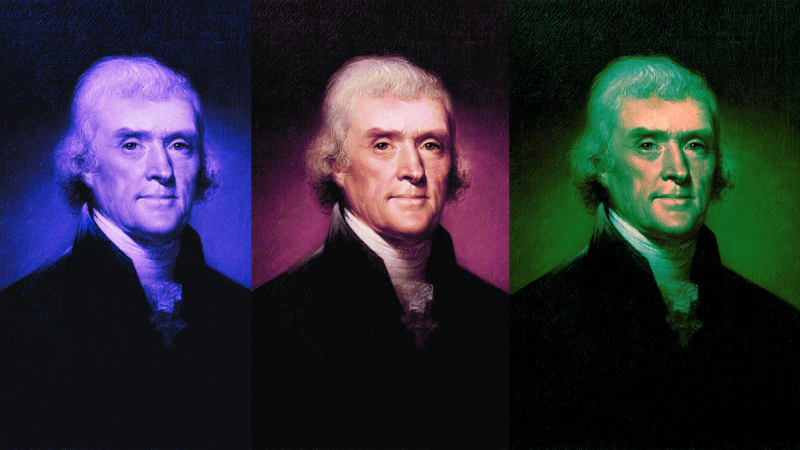
Fame is a facet of culture and needs to be viewed through a historical lens. Something no Jefferson scholar, myself included, has previously reckoned with until now is this beguiling writer’s pursuit, not just of happiness, but of celebrity. He needed to publicize his thoughts, both to achieve a feeling of concordance (that all was right in the world) and to assert his vision for state and nation. It was through a passive-aggressive urge to shape the literal, as well as political, landscape that he became an iconic force in the larger story of continental empire. He crafted the laws of Virginia after independence was declared, planned state and federal buildings in the grand classical manner, and longed to preside over an America that would awe Europeans by its embrace of individual freedom.
Jefferson the visionary came to regard himself as a rescuer, the preserver of a creative, dynamic spirit without which American political culture could not progress to its destiny.
The word “fame” had multiple meanings in eighteenth-century America. Depending on context, it was akin to “rumor” (as in “common fame,” word on the street); or it meant character, respectability, reputation; or it meant just what it means today: public eminence, a name. The fame Jefferson sought was the second one, closer to honor and the acceptance of one’s ideas, credit for possession of a desirable character and a favorable reputation that would outlive him. Of course, he couldn’t have the second meaning of “fame” without the third as well.
The fame (respect for his ideas) that Jefferson feared losing was that which he tied to a vibrant localized democracy. He worried about his political vision dissolving into one that moved governmental power from periphery to center, potentially leading back to monarchical forms. This became an extreme fear at the end of his life, though his prescriptive writing tried to deny it. What tends to be lost in the record is how stubbornly Jefferson resisted change. At identifiable moments over a long public career he prophesied ruinous consequences if his personal vision for a healthy republic was ignored. As a result, he made enemies, and he came up with behind-the-scenes plans to get the best of them.
He did not experience fame as it is typically thought of today. He lived decades before photography, at a time when having a name meant recognition in print, and being talked about as a result. For much of his life, Jefferson enjoyed anonymity when he traveled. His manner of dress—shabby, his critics said mockingly—was largely a performance, symbolic of the lack of ostentation he deemed appropriate for elected leaders in a republic. In most other respects, he spent lavishly; for example, in maintaining a wine cellar from the earliest iteration of his home, and in making his family seat a showpiece of architectural splendor. Monticello is stunningly beautiful. It has been a National Historical Landmark since 1960, and it is now a UNESCO World Heritage site—one of only twelve in the United States.
The larger point is that whatever his underlying reasons, Jefferson from a fairly early age wanted to make a difference. That mission to stand out grew by the decade until he could not have it any other way: to preserve the republic, and the vaunted spirit of 1776, America’s historical consciousness required that his name and fame endure. This is not what is conventionally termed “vanity,” and he was the very opposite of flamboyance. Yet his passion became a rare species of idealistic extremism. Jefferson the visionary came to regard himself as a rescuer, the preserver of a creative, dynamic spirit without which American political culture could not progress to its destiny.
__________________________________
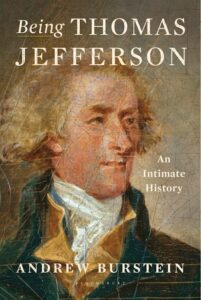
From Being Thomas Jefferson: An Intimate History by Andrew Burstein. Copyright © 2026. Available from Bloomsbury Publishing.

Andrew Burstein
Andrew Burstein recently retired as the Charles P. Manship Professor of History at Louisiana State University. He is the author of The Passions of Andrew Jackson, Jefferson's Secrets, and several other books on early American politics and culture. He is the coauthor (with Nancy Isenberg) of Madison and Jefferson and The Problem of Democracy. Burstein’s writing has appeared in The New York Times, The Washington Post, and Salon.com He advised Ken Burns’ production “Thomas Jefferson,” and was featured on C-SPAN’s American Presidents Series and Booknotes, and numerous NPR programs. He lives in Charlottesville, Virginia.