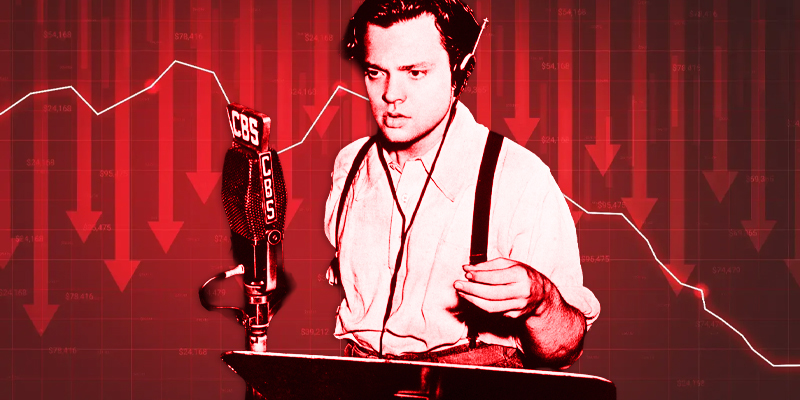
This week, the stock market lost $200 billion over a short story.
It’s not quite a War of the Worlds freak out, but this week, once again, a piece of eerie speculative fiction made a big, real world impact. On Monday, a blog post imagining an 2028 economy choked by AI agents sent ripples through the stock market, to the tune of $200 billion. (Wall Street’s loss because of short fiction is a big win for all the English majors who’ve been told there’s no money in writing.)
The post that rattled tech investors was published over the weekend by Citrini Research, a firm that believes “narratives drive markets more than any other factor.” As covered across the financial media—by Eric Levitz at Vox, Hannah Pedone at MarketWatch, and Georgie McKay and Ryan Vlastelica in Bloomberg—Monday’s big dip in software and tech stocks amounted to a reduction in value of over $200 billion and closing figures lower than they’ve been in years. And while Citrini’s blog post is likely not solely responsible, the points it made were grounded enough, and dovetailed ominously with other predictions of an AI future.
“The 2028 Global Intelligence Crisis” is framed as a research memo from June 2028—a great format for a short story! The “scenario, not a prediction” reports from a near future, AI-focused economy that is a victim of its own success. As AI agents improve, companies fire white collar workers and reinvest the money they’re no longer spending on salaries into more AI. The increased investment improves AI agents and tools, which leads to a further erosion of labor value.
Wealth further stratifies in this spiral: owners and CEOs rake in record profits as corporate productivity soars. But the ultra wealthy’s accumulating money doesn’t circulate, while high unemployment drives down wages and reduces the spending power of the middle and lower classes. As capital flows ever upward, vast swaths of the economy are left decimated. This redistributive feedback loop accelerates, without an obvious brake.
Citrini’s post also digs into a specific case study of how this dynamic impacts one company, DoorDash. A majority of consumers in this sci-fi 2028 outsource their decision making and comparison shopping to AI agents, which fundamentally reshapes the incentives and realities of industries like food delivery, insurance, real estate, and more. These middle-man companies like DoorDash that profit on extracting rent (as opposed to creating something) get fatally caught in the destructive spiral of lay offs and AI reinvestment.
Oh, and all of this leads to a giant financial crisis.
I’m impressed by the writing of the piece, which I don’t think would have landed its points as hard without the fictional world-building. Opening with a crossed out dateline to cleverly shift the time frame—“February 22nd, 2026 June 30th, 2028”—the piece commits to the premise fully, complete with invented charts, data, and headlines. It’s subtle but convincing.
The piece in Vox points out some issues with Citrini’s predictions—all the money pumped into AI has to pay at least a few salaries, maybe this time the government will regulate something—but the story is plausible enough to have really spooked a noticeable chunk of the tech industry.
I doubt this fiction will have a lasting financial impact, and most of the shaken stocks seem to have already recovered. But if nothing else, after so many times when the stock market has jumped around and made trouble for all of us, it’s nice for once to see a blog return the favor.

James Folta
James Folta is a writer and the managing editor of Points in Case. He co-writes the weekly Newsletter of Humorous Writing. More at www.jamesfolta.com or at jfolta[at]lithub[dot]com.