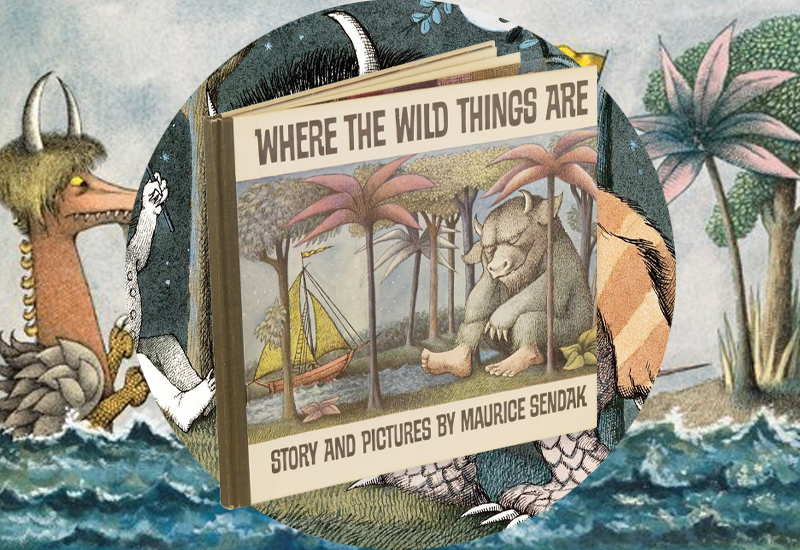
This Week in Literary History: Maurice Sendak’s Where the Wild Things Are is Published
Your Favorite and Ours
This first appeared in Lit Hub’s Literary History newsletter—sign up here.
When Maurice Sendak published Where the Wild Things Are, on April 9, 1963, he had been working as an illustrator for some 15 years—at 20, he was designing windows at FAO Schwarz, a gig that led him to the storied children’s book editor Ursula Nordstrom—and already had two children’s books under his belt: Kenny’s Window (1956) and The Nutshell Library (1962) (though of course The Nutshell Library is actually four books in a tiny box).
“He didn’t have any formal education in art,” writes Lynn Caponera, Sendak’s longtime caretaker and the President of the Maurice Sendak Foundation.
He chose from an early age to educate himself, to study and draw on his own. While most kids would pin up athletes and movie stars on their bedroom walls, Maurice would pin magazine clippings of Titian and El Greco paintings. He would spend countless hours sketching his family and the children playing in the streets outside his apartment window.
Where the Wild Things Are catapulted Sendak to fame. For the uninitiated, it concerns a little boy named Max who retreats into his imagination after he is sent to bed without supper for being a “wild thing”—he becomes the king of all wild things, but eventually comes back. The book won the Caldecott Medal, given to “the most distinguished American picture book for children published in the United States during the year,” and continues to be a favorite among children, parents, and critics.
“At first,” Sendak told the LA Times in 1993, “the book was to be called Where the Wild Horses Are, but when it became apparent to my editor I could not draw horses, she kindly changed the title to ‘Wild Things,’ with the idea that I could at the very least draw ‘a thing’! So I drew my relatives. They’re all dead now, so I can tell people.”
The book’s publication kicked off a long, productive career; Sendak is widely heralded as one of the best and most important children’s book authors and illustrators of all time. But as you probably know, contrary to the spirit of the times, Sendak was never tempted to write a sequel to his smash hit. Why? As he told Stephen Colbert in 2012, it would be “the most boring idea imaginable.” Bless.