This Week in Literary History: Lord Byron Swims Across the Hellespont
“I plume myself on this achievement more than I could possibly do on any kind of glory, political, poetical, or rhetorical.”
This first appeared in Lit Hub’s Literary History newsletter—sign up here.
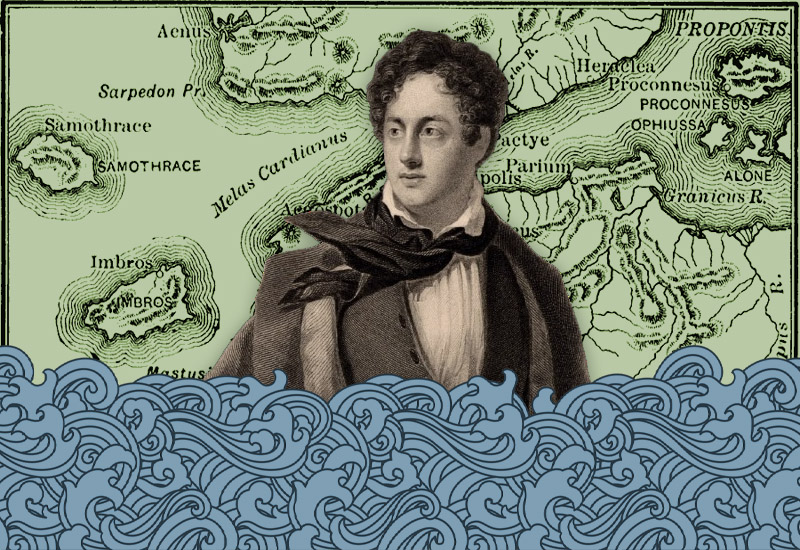
In Greek myth, the hero Leander swam four miles across the Hellespont—a choppy strait in Turkey now called the Dardanelles, which separates Europe from Asia—every night to visit Hero, a virgin priestess of Aphrodite, with whom he had fallen in love. He was guided through the turbulent waters by a light from Hero’s tower, but one stormy night, the light was extinguished, and Leander drowned. When his body washed up on Hero’s shore the next morning, she threw herself from the tower.
Romantic! Tragical! Sporty! Obviously, Lord Byron had to try it. On May 3, 1810, the famous romantic poet, who had been born with a club foot, now 22 and on a grand European tour, completed what he would often refer to as his greatest accomplishment (“I plume myself on this achievement more than I could possibly do on any kind of glory, political, poetical, or rhetorical,” he wrote in a letter to his mother): swimming the four miles across the Hellespont. “The rapidity of the current is such that no boat can row directly across,” he wrote, and “the water was extremely cold from the melting of the mountain-snows.”
It took the poet an hour and ten minutes, doing the breaststroke; he was accompanied by a Lieutenant Ekenhead, a crew member from the frigate Byron was traveling on, who managed it in an hour five. It was actually their second attempt; the first, Byron wrote, was three weeks earlier, “but having ridden all the way from the Troad the same morning, and the water being an icy chillness, we found it necessary to postpone the completion till the frigate anchored below the castles.” Persistence!
A few days later, Byron (of course) wrote a poem about it, in which he compares himself favorably to Leander, ending thusly:
‘Twere hard to say who fared the best:
Sad mortals! thus the gods still plague you!
He lost his labour, I my jest;
For he was drown’d, and I’ve the ague.
Byron also referenced the event in Don Juan, Canto II, stanza cv, giving the feat to his hero: “A better swimmer you could scarce see ever,/ He could perhaps have passed the Hellespont,/ As once (a feat on which ourselves we prided)/ Leander, Mr. Ekenhead, and I did.”
Now Byron’s course is a famous challenge for open-water swimmers—if you too fancy yourself a hero of legend, you can sign up for the annual race here.