This library’s annual lock-in is an autodidact’s dream come true.
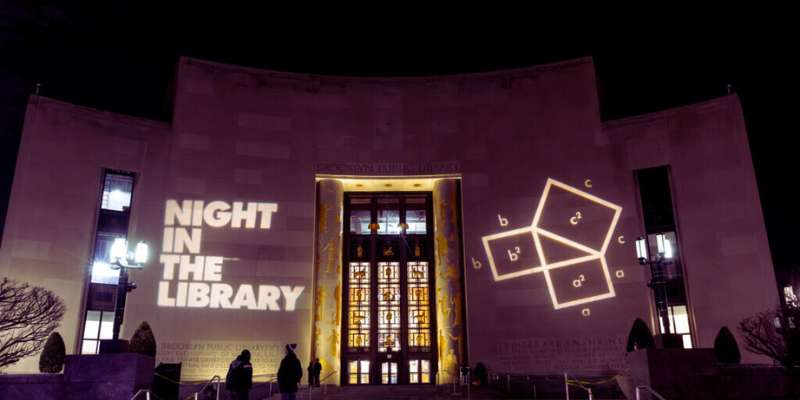
For the past ten years, the Brooklyn Public Library has played host to a highly niche adult sleepover: the Night in the Library.
The annual festival amounts to a series of free public teach-ins, typically gathered around a theme. Last Saturday, thousands of Brooklynites poured into the stacks to celebrate and explore—of all things—truths, proofs, “and other paradoxes.”
This mission was is in keeping with the Night’s general mandate to celebrate math and philosophy with a rich evening of discourse. Jammies optional, naps discouraged.
According to The Brooklyn Daily Eagle, this year’s festival was stuffed like a generalist’s backpack. Events ran from 7 in the evening and wound down deliberately at 3:14 am, in honor of Pi Day.
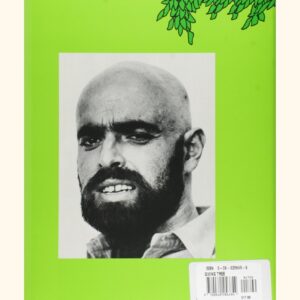
The program was anchored by German filmmaker Werner Herzog. And as Min Chen at ArtNet reported, the thinker known for his dulcet monotone and preoccupation with human weakness was in apex form for his keynote on “Mathematics and the Sublime.”
Herzog delivered a dense, apparently unscripted speech covering the golden ratio, numerology, fractals, Euler’s Identity, the landscapes of Caspar David Friedrich, and “the mysteries of the Ulam spiral.”
The heady vibes encapsulate a stealth aim of the Night: to draw out the unlikely connections between fields and modes of experience. From math and poetry to aesthetics and ecstasy.
After Herzog relinquished the podium, several other speakers riffed on these themes. The novelist Michael Cunningham spoke about mysticism. The artist and activist Molly Crabapple led a chat about the perils of generative A.I. And the artist Paul Chan demystified calculus. (For some, at least.)
For the tactile learners, there were tap dancing and textile workshops, and concerts by Marcus G. Miller and Joe Goodkin. All to the public, and all for free. In case of any numbers-related overstimulation, there were even therapy dogs on hand.
Nights in the Library kicked off in 2017, as the brainchild of BPL’s Vice President of Arts and Culture, Jakab Orsós.
Over email, Orsós told me that the festival began as an experiment, inspired by a similar French Embassy event in 2016. “The motivation for the program was quite simple,” he wrote. “We wanted to bring people together to engage with new ideas and points of view.”
This is curiously broad framing for such a specific offering. While many libraries have jazzy public facing events after hours—like this Bridgerton-themed soiree in Hoboken, or the Chicago Public Library’s annual Night in the Stacks fundraiser—very few have lock-ins with agendas that resemble graduate school course catalogs.
The Nights make a case for the library as public forum. In a 2019 Baffler piece covering the event, Andrew Schwartz observed that the evening’s unique shape meets the public at its most unruly and ambitious—which is always something to celebrate. (Just like, apparently, math.)
An evening of thinking and tapping and yawning together, Schwartz claimed, engenders the “simultaneously sensible and subversive notion that sharing a public space is a necessary condition for sharing power.”
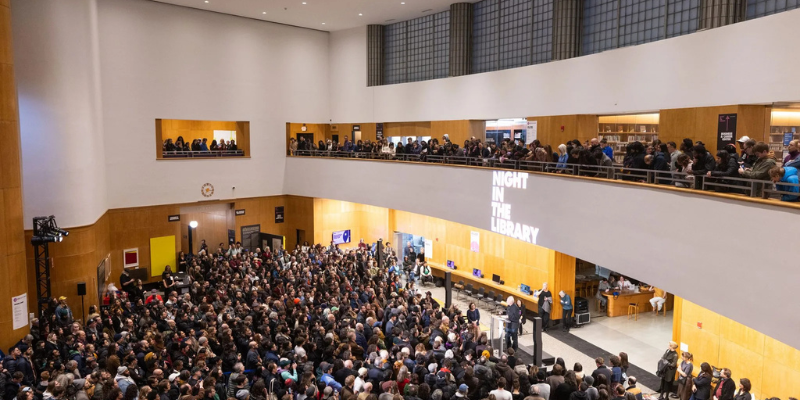 Photos by Gregg Richards, courtesy of Brooklyn Public Library.
But must that sharing be at night?
Orsós suggested that de-familiarization can go hand in hand with learning. “It’s such a singular idea: being in a familiar space like the library in an unconventional format and at an unusual time, and coexisting with interesting people and intriguing ideas. There’s a beautiful chaos to it that cannot exist anywhere else.”
This year’s event drew thousands of visitors. According to Orsós, nearly 10,000 people RSVP’d, and “from all walks of life,” making the festival “an accurate representation of the diverse fabric that is Brooklyn.”
Most Brooklynites—nay, readers, full stop—love the library. But our reasons may differ. Some of us put a premium on the resources, others the atmosphere. We theoretically value its use as a third and public space. But often, in practice, this shows up as quiet tolerance.
Nights in the Library make a case for the public forum as something to shout about. ‘Cause when Werner gets into numerology, you know it might get loud.
Assuming this “subversive notion” is your cuppa, next year’s Night is something to mark on your calendars, New Yorkers. And for everyone else, a quandary: can you bring the golden ratio to your town?
Brittany Allen
Brittany K. Allen is a writer and actor living in Brooklyn.