
The Weight of the Self: On James Merrill’s A Different Person
Hilton Als Considers the Influence of Class and Queerness in the Life and Work of a Gay American Poet
A number of the people I first shared my love of James Merrill’s writing with are gone now, so I write this for them as much as for you. Some of the gone people perished from AIDS, the same disease that killed the extraordinary poet in 1995, when he was sixty-eight years old—a great injustice in an epoch defined by injustice and the indignity of premature loss, the effort of saying goodbye when all the dying throat wants is to be flooded by water, by air, the energy of life.
But James Merrill’s throat never closed up, not until the end; days before his death he was still writing, and with the same pith and compassion that made his voice one of the wonders of the late twentieth century, a voice I don’t stand a chance of getting past in terms of influence, that’s how deep he is in my bones. Not so much his syntax, for no one can approximate the delicacy and complexity of his lines, but his ethos, the graciousness of his form that invited one to join him on this or that journey to an island in Greece, or in pouring the tea—i.e. gossip—with Maya Deren, walking in Key West, or “just” visiting the inner recesses of his mind.
These stories and landscapes, atmospheres and tete a tetes—you are not reading him carefully if you do not see the yearning behind his polish, or as one of the few bulwarks he had against his yearning for intimacy—were stitched with needlepoint-like precision on page after page of his poetry, plays, fictions, letters, and in this, his only book-length memoir, but he’s never precious about any of it, his poetry encompasses the high and low, the split self, and in some strange way his triumph as man and artist was what one might call his emotional egalitarianism.
He wrote about the best and worst of himself, and when he failed (because no one can avoid being selfish, no matter how high-minded), he admitted it. He knew the difference between telling the truth and self-mythologizing, and to get at the truth he often employed his considerable skill as a dramatist to tell a good story that said what he needed to say about Eros, the power of place, and money. You’d have to be a really bad actor not to score with an audience when reading “Days of 1935,” aloud, for instance. Merrill’s fabulous 1972 poem in which the writer imagines himself being kidnapped—a born-rich queer Lindbergh baby.
If you come from wealth, it takes a lot to jump into the unknown. Merrill had the same impulse—the need to become a self not necessarily free of all that money could buy but not crippled or deadened by it, either.
And while his kidnappers in the poem, Floyd and Jean, are both compelling characters, it’s Floyd who engages the eye of Merrill’s eros (“The man’s face/Rivets me, a lightning bolt’), a tough guy with hands big enough to bite. You don’t need to be rich to have power. But in Merrill’s universe, being a man helped. Throughout his work, long before it was possible or fashionable to be out, Merrill was emotionally out; this was reflected in his style as a writer, his elegant, precise, funny, and romantic words, which always stand on this side of queer; he’s the smartest kid in the room who’s delighted you can keep up, when you can.
Also, he was often the richest kid in the room. He was the only child of the stockbroker and philanthropist Charles E. Merrill, co-founder of the brokerage firm Merrill Lynch, and Helen Ingram, a Southern-born society reporter and journalist. (Charles Merrill, who was also known as “Good time Charlie,” had two children from a previous marriage. He loved his youngest son and was proud he was a poet who worked as hard as any businessman on his writing.) Scattered children, scattered lives, all laid at the footsteps of a father who couldn’t keep it in his pants. From Merrill’s “The Broken Home”:
My father, who had flown in World War I,
Might have continued to invest his life
In cloud banks well above Wall Street and wife.
But the race was run below, and the point was to win.
Too late now, I make out in his blue gaze
(Through the smoked glass of being thirty-six)
The soul eclipsed by twin black pupils, sex
And business; time was money in those days.
Each thirteenth year he married. When he died
There were already several chilled wives
In sable orbit—rings, cars, permanent waves.
We’d felt him warming up for a green bride.
He could afford it. He was “in his prime”
At three score ten. But money was not time.)
As a kid, the pudgy then scrawny Merrill—whom his mother found unattractive as a baby—bit on and licked any number of silver spoons, but they never gagged him. Still, being rich and queer were isolating factors; each made him vulnerable to the “other” that was other people; in their eyes, he was all wrong. And that could be exciting, too, like the fantasy of being abducted by a Floyd with his big hands. Meeting the Other was a recipe for potential violence—and the humiliation informing queer need. Merrill’s “Days of 1941 and ’44:”
The nightmare shower room. My tormentor leers
In mock lust—surely?—at my crotch.
The towel I reach for held just out of reach,
I glare back petrified, past speech, past tear.
Or Saturday night war games. She of the whole
Student body, and my own, I’ve hid
In the furnace room. His warning strokes my head:
This time, Toots, it’s your pants up the flagpole!
But his body wasn’t a game, this was Merrill’s life or at any rate erotic life those boys were playing with—a whole world of shame and desire he took apart and then put together like a half broken cup; the two parts never add up in Merrill’s writing—being rich doesn’t make you equal, but it can make you deeply aware of inequality, economic and otherwise—and the liquid that seeps through is sometimes a wonderful and bitter wine, and sometimes it’s semen. Reading Merrill as a more or less isolated college student, I felt a sense of relief: His poems told me gay domesticity was possible, it’s part of the fabric of his magnum opus, “The Changing Light at Sandover” (1982).
There and elsewhere in his work the message was implicit: You could find shelter as a gay person, and your primary relationship could be as real and alive and mundane as your friend’s parents. And a source of protection. This had the effect of giving me (some) of my long-hidden body back. The other James (Baldwin), Merrill’s near contemporary, once said that you think your pain and your heartbreak are unprecedented in the history of the world, but then you read. It was books that taught me that the things that tormented me most were the very things that connected me with all the people who were alive, who had ever been alive.
Merrill’s poems, particularly the book-length Ouija-board epic, “The Changing Light at Sandover,” which I read first, connected me not only to myself, but to possibility: the possibility of one’s chosen family becoming one’s primary emotional focus and “text,” and writing as a means to talk about one’s individual self, and what that self meant in the world. It was clear to me, from the start, that Merrill’s great ability had to do with discipline and habit. He was a writer who could make a world because he knew how to build one. And then put real and imagined bodies in it.
Merrill’s writing is a product of his hard work. One thing he had on his side that was genuinely his was discipline, a love of work that does not inspire envy but admiration. Day after day, year after year, he sat down at his desk in whatever country he happened to be in to discover what it is he might be thinking. Writing doesn’t care how much money you have; it wants you. You without all your stuff—houses, girlfriends, whatever. You and the page, maybe a little view sometimes, but that’s it. And I think, given the enormity of Merrill’s production, the writer liked having “nothing” but his mind, with its endless invention.
By starting each day from scratch, he was starting with his vision, not his wallet. While practicing one’s art, one is “classless.” Which is a feeling that the late photographer Diane Arbus, whose grandfather co-founded Russek’s, a once thriving clothing and fur store on Fifth Avenue, felt when she started to make pictures on her own: starting from scratch, being in the world, freed her from the isolation of wealth. But, as Arbus has said, “It took a long time to inherit my kingdom,” or finding her way in the world. If you come from wealth, it takes a lot to jump into the unknown. Merrill had the same impulse—the need to become a self not necessarily free of all that money could buy but not crippled or deadened by it, either: it’s so easy to become complacent if all the other stuff is taken care of.
Part of what makes his significant and beautiful memoir, A Different Person (1995), an important work of art is Merrill’s self-awareness that writing a memoir is an act in service of not a self but many selves, amounting not to a definitive statement but to a kind of treatise about being. As a person and artist, he never stopped moving. He’s never “just” rich, white, gay, whatever. He means to be a human being here, a man who was interested in his own story and flight away from and to love because he was interested in consciousness, and in describing where the mind takes you as life takes you, which is usually somewhere other than where you intended.
Merrill’s mind never stopped evolving, that’s what I meant to stress again before I interrupted myself—a Merrillian trope if there ever was one, interrupting myself to tell a story that reminds me of another story. Toward the end of his collected letters, Merrill writes to a young friend named Torren living in Stonington, Connecticut. (At the time Merrill was ill in Tucson with his lover, the actor Peter Hooten). The writer acknowledges receipt of an article Torren wrote for a local paper. He compares Torren’s piece about racism to what the Bishop of Connecticut has written on the “Sin of Racism.” Merrill writes of the bishop’s poor writing on the subject. He says: “Someone is bound to speak up saying that the issues matter more than the languages does, but as I see it, they rise and fall together.” He goes on:
As for racism, my brother…is certainly part of the solution. His school in Boston (he was headmaster 1960-1990) featured immediate seating for black & foreign students. His daughter Amy in fact married one of her black classmates after each had out-grown the original color-coordinated spouse. We are all proud of them; it can’t have been easy. In my different sphere, as a “creative” gay man, I feel I too am part of the solution, though never quite persuaded that it helps to know this. Our sister, amazing at 80—with her foursquare life in four Lovely Homes like the discreet letterings in gold on a plate glass shopwindow: NEW YORK, SOUTHAMPTON, PALM BEACH, SAN FRANCISCO—remains transparently part of the problem.
Merrill sent this letter off to Torren when he had less than a month to live; he doesn’t even mention being ill. (Nor does he mention that his maternal grandmother once wrote an essay on the superiority of whites over blacks.) In fact, he writes toward the end of his letter that he’s looking forward to seeing Torren and his family again; he even sends Torren a sprig of Rosemary for his mother. (Ophelia: “There’s rosemary/That’s for remembrance”). In hope you can find fortitude, and I think hope was always a sustaining factor for Merrill. You can’t have grace without it. I don’t know that many people who would take time off from the self-absorption of being ill to lay anything out for a young writer.
The letter to Torren is an extraordinary document made even more so by certain phrases that made me laugh out loud, such as “color coordinated,” and feeling “part of the solution, though never quite persuaded that it helps to know this.” There’s an ardor to Merrill’s charm, and a bounce to his humility, which he wears lightly, the only way to wear it if you have to. Merrill’s body may have been failing him day after day but not his mind, and not his compassion, and there it is again: his ethos of work as a kind of grace, but it’s only grace if you can extend it to another person.
I was twenty when I first read Merrill. I’d spent the year before reading Proust with a friend. Their respective genius didn’t become forged in my mind as much as they gave me a kind of permission to think my own thoughts in my every sense of the word queer way. You could make a fiction out of philosophy, said Proust by example, or you could make your own genre, while Merrill taught me that poetry’s use of short lines was not the refuting of narrative, but a way of condensing a multitude of feelings that made up the story. I was delighted and not really surprised by the fact that Proust had been one of Merrill’s masters as well (the poet wrote his thesis about the French artist while at Amherst) an artist the poet commemorates in his poem 1962 “For Proust”:
Over and over something would remain
Unbalanced in the painful sum of things.
Past midnight you arose, rang for your things.
You had to go into the world again.
You stop for breath outside the lit hotel,
A thin spoon bitter stimulants will stir.
Jean takes your elbow, Jacques your coat. The stir
Spreads—you are known to all the personnel—
As through packed public rooms you press (impending
Palms, chandeliers, orchestras, more palms,
The fracas and the fragrance) until your palms
Are moist with fear that you will miss the friend
Conjured—but she is waiting: a child still
At first glance, hung with fringes, on the low
Ottoman. In a voice reproachful and low
She says she understands you have been ill.
And you, because your time is running out,
Laugh in denial and begin to phrase
Your questions. There had been a little phrase
She hummed, you could not sleep tonight without
Hearing again. Then, of that day she had sworn
To come, and did not, was evasive later,
Would she not speak the truth two decades later,
From loving-kindness learned if not inborn?
She treats you to a look you cherished, light,
Bold: “Mon ami, how did we get along
At all, those years?” But in her hair a long
White lock has made its truce with appetite.
And presently she rises. Though in pain
You let her leave—the loved one always leaves. […]
All those rooms, those palms, the forgotten moments in a life that included servants but what was presumed luxury when the work worried you, caused sleepless nights, while saying over and over again that you weren’t worthy of Art. How could you meet her demands? After all you were mortal. After “The Changing Light at Sandover,” I read “everything,” but the marvelous thing was that when it came to Merrill there was always more “everything,” and I fell in love with it all, and didn’t he want us to love him, too? You can’t be as loving as he was on the page and not want it in return.
Reading Merrill is like listening to Al Green sing, “If I gave you my love/Tell you what I’d do/I’d expect a whole lot of love out of you,” or in more Merrillisian terms, his poetry is no stranger to the heart beating beneath Rodolfo’s aria of love, “Che gelada manina,” from “La Boheme.” It’s fun, given Merrill’s wealthy background, to imagine him—his mother’s “operatic child”—as Rodolfo, singing
I am, I am, I am a poet.
What’s my employment? Writing!
Is that a living? Hardly!
Sometimes Merrill was Mimi. But at the start of A Different Person, Merrill is hardly himself. Not yet. He writes: “Meaning to stay as long as possible, I sailed for Europe. It was March,1950. New York and most of the people I knew had begun to close in.” His interior life—that which feeds the poet, let alone one as attuned to nuance and the glamour of social life as Merrill—had grown stale. He goes on:
It took a fair amount of perversity to want to distance myself from my friends, for with them only—never in solitude or with my family—did I feel at ease. After a day that typically included lunch uptown at my mother’s bedside, followed by an hour or two of “work” in order to deserve the evening’s fun, I plunged giddily into their midst, drinking and laughing and “being myself” until my face ached and it was time to return, alone, to my apartment in the East Thirties.
Part of “A Different Person’s” pathos and wonderful humor grows out of the realization, on that trip abroad, that no matter how far you run, family will be there to meet you, often looking like some version of yourself.
Was that his real face, the face that ached? Or was there another beneath the gray mask gay men of the “I Like Ike,” generation were forced to wear out in the world: butch and relatively silent, solicitous of mother and then screaming in a bar somewhere to shatter the effects of it? Only time will tell, Merrill more or less says in A Different Person, and we travel with him because of that which he could never hide, even as he tried to obscure it in early poems addressed not to a him, but a you: a near Proustian understanding of how we love, and the selfishness at the heart of it, certainly in Merrill’s early days.
Describing a visit to Greece to see his first lover, the eminent poet and translator Kimon Friar—who also appears in “The Changing Light at Sandover”—the memoir’s Merrill looks back at an earlier reunion, and says, in one of the italicized present-day sections that comment and provide a gloss on the narrative about his past:
And yet this first love, so largely the intoxication of being loved by such a man, failed to surmount the three obstacles in its path: my own callowness, my mother’s horrified opposition, and a year away from each other.
Like his near contemporaries, Edward Albee and Stephen Sondheim, two gay guys who also came from moneyed backgrounds, Merrill had his subject from the first: the family triangle—or trinity—ultimately dominated by homophobic mother. Albee, adopted by a powerful woman who showed little interest in him, wrote about the absent child most of his life (the invented son in 1966’s Who’s Afraid of Virginia Woolf?, for example) while Sondheim brilliantly evoked the terrors of intimacy and married life in shows such as Company (1970).
It would take Merrill until he was in his mid-thirties, really, to get to poems like “The Broken Home” (1965), poems that started to pick away at the lock of his hitherto semi-locked-up soul. In a sense, putting an ocean between himself and his false face—the face that laughed until it ached—was less an act of independence than a dream of independence. Merrill may have thought, starting out, that family couldn’t get at him, and if they couldn’t get at him, maybe he could be himself. But that dream is just that. Part of “A Different Person’s” pathos and wonderful humor grows out of the realization, on that trip abroad, that no matter how far you run, family will be there to meet you, often looking like some version of yourself.
Merrill barely settles in Rome before his father comes for a visit (the clannishness of the rich!), while Helen sends her emissaries first, young Southern ladies who cannot know that “Jimmy” is traveling with a boyfriend. Over and over again in these pages, Merrill poses this question: Who can he be in this whole wide world? One thing’s for sure: he can’t be alone. And maybe the family drama that follows him across the ocean had an open invitation. He cannot be without Father and Mother, despite his best efforts. “According to Rilke, a young poet can’t have enough solitude,” says Merrill near the start of “A Different Person.” Then:
I pondered the dictum ruefully. Being alone was not my long suit. Aside from activities that might loosely figure as aesthetic—going to the opera or a museum, reading, writing a term paper or a poem—I was not in the habit of doing things by myself. I was eleven when my parents separated, old enough to be allowed some liberty. Instead, I have the impression of proliferating guardians no longer nurses and maids, perhaps, but schoolmasters, camp counselors, army sergeants…I functioned blankly, imperfectly, without a confirming viewpoint. The unexamined life wasn’t worth living? Even so, only in my case the phrase meant a life not examined by someone else.
Or might one say observed? Just as his poems and memoir can give one the feeling of being perfectly shaped objects the observer-reader can hold and marvel at? The most profound relationship Merrill has while living mostly in Rome is with a Hungarian psychoanalyst named Dr. Detre. But in re-reading A Different Person, I see that’s not entirely true. (Is anything entirely true?) All relationships are productive if we listen to them, especially the bad ones. The trick is to find the lessons in repetition and repeat no more, as Dr. Detre or his master might have had it. But how do we learn from the ultimate repetition, a negative parent? One who does not see the child as separate from herself, or what she would want for herself?
The most agonizing and gripping sections of the book for me are the poet’s raw observations about where selflessness can lead you (as in Kimon’s exploitation by his culture, and younger writers) and how self-interest can be a kind of armor. About two thirds of the way through the memoir, Merrill describes a visit his mother Helen pays him in Rome. He promptly gets sick before her arrival. After recovering, he hosts a drinks party in her honor, and invites people he’s met abroad, some he likes and some he doesn’t especially like; this happens a lot when you’re traveling, you take up with people you may never see again. There’s a Black couple. What ensues between Merrill and his Southern-raised mother is typical of the time. Helen: “Do you know this is the first time in my entire life that I’ve had to meet colored people socially?”
It’s not the “had” specifically but generally that gets to the reader; one can hear her little cries of pain in this exchange, which Merrill lets stand; he does not explain or minimize. And when Helen lets him in on a secret she and his father have kept from him—I won’t reveal it here—your heart leaps out of your chest, in part because of what she says, and in even larger part because of the precise way Merrill renders it: with the patience of an artist who understands what he doesn’t understand about his parents, the family of man, while admitting that he’s not interested in family stories as such (a confession I took as a bit protective covering at first). He assers that what does interest him is Art.
And how art can change us. He describes sending this bombshell chapter to a friend, who writes, he reports in the italicized present-day section, that “The fearsome blessing of that hard time continues to work itself out in my life the way we’re told the universe is still hurtling through outer space…I think grace sometimes explodes into our lives like that—sending out pain, terror, astonishment hurtling through inner space until by grace they become Orion, Cassiopeia, Polaris, to give us our bearings into something like full being at last.” To which Merrill responds, giving us a generous handle to read this book, and all his work:
I might have said that it’s the gradual focus of human vision, intelligence rather than grace, whereby those traumatic stars, like their ancestors in the night sky, acquire names and stories. But why split hairs? Let the mind be, along with countless other things, a landing strip for sacred visitations.
__________________________________
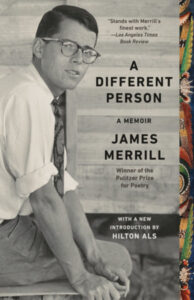
From A Different Person by James Merrill. Copyright © 2026. Introduction copyright © 2026 by Hilton Als. Available from Vintage, an imprint of Knopf Doubleday Publishing Group, a division of Penguin Random House, LLC.

Hilton Als
Hilton Als is an award-winning journalist, critic, and curator. He has been a staff writer at the New Yorker since 1994. Previously, Als was a staff writer for the Village Voice and editor-at-large at Vibe. He has received numerous awards for his work, including the Clark Prize for Excellence in Arts Writing (2022), the Pulitzer Prize for Criticism (2017), Yale’s Windham-Campbell Literature Prize (2016), the George Jean Nathan Award for Dramatic Criticism (2002-03), and a Guggenheim Fellowship (2000). His first book, The Women, was published in 1996. His book, White Girls, was a finalist for the National Book Critics Circle Award and winner of the 2014 Lambda Literary Award. He published My Pinup in 2022 and in 2024 he edited God Made My Face: A Collective Portrait of James Baldwin for the centenary of Baldwin’s birth. He is currently a visiting professor at NYU and teaching professor at the University of California, Berkeley, and has also taught at Columbia University’s School of the Arts, Princeton University, Wesleyan University, and the Yale School of Drama.