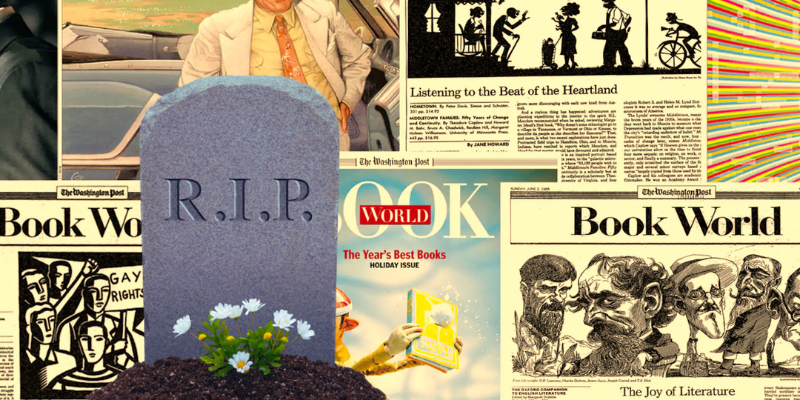
The Washington Post is gutting its books coverage.
Earlier today, Jeff Bezos’ Washington Post laid off hundreds of its employees, in what one staffer called “an absolute bloodbath.”
As The Guardian reported this morning, editor-in-chief Matt Murray told his masthead that the paper was due for a “strategic reset.” Citing flagging subscriptions and grim growth, Murray announced that the Post would be laying off a third of its workforce, and sundowning several popular sections—including the sports desk, the daily news podcast, most of the “international reporting operation,” some local coverage, and the books desk.
Going forward, the paper will pivot to prioritizing news concerning “national security,” and topics like science, health, medicine, technology, climate and business.
The Post’s book coverage—chiefly via the beloved Book World section—has long been a gold standard in the industry. Critics like John Williams, Becca Rothfeld, Jacob Brogan, Michael Dirda, and Ron Charles have shaped the literary landscape. For decades, in some cases.
Book World originated in the aftermath of Watergate. In a fond 2022 reflection, editor Dirda described the section’s early days, during which he nurtured and commissioned many literary greats—like the polymath Guy Davenport, the novelist Angela Carter, and David Remnick, who’d go on to edit The New Yorker.
It’s critical voices like these who will be first affected by the section’s sunsetting. But authors and publishers should also worry about what the end of Book World means for national press.
At least Charles, who learned of his firing while eating “eating one of the two remaining Harry & David pears that the Post sent to celebrate [his] 20th anniversary at the paper,” is determined not to go gentle. He is starting a Substack.
In his first missive to readers, the unleashed critic quipped: “Honestly, the worst aspect of this impoverishing, family-wrecking, confidence-crushing ordeal is that it will inspire David Brooks to write an essay about the hubris of American media.”
Meanwhile, the paper’s long term strategy remains unclear. As the Times reported, the Post is “far from alone” in the battle to stay relevant in a downward-trending media ecosystem whose traffic is increasingly threatened by AI summaries. But it is possibly the only outlet where the bottom line is meaningless, given the owner is richer than Satan.
Bezos, whose personal wealth is estimated at $261 billion, could not be reached for comment about any of the cuts his team architected.
Post employees who have been laid off will continue to be on staff through mid-April, though “they will not be required to work.” Health insurance coverage will continue for six months.
A union-led protest to denounce the cuts is scheduled for tomorrow.

Brittany Allen
Brittany K. Allen is a writer and actor living in Brooklyn.