The Unusual Suspects: Who Were the Main Players in the Black Dahlia Murder
William J. Mann on Revisits the Almost Mythic 1947 Crime That Shocked America
All morning long, the detectives in the Homicide Department had done their best to keep to their regular business, refraining from glancing up every time the door opened. But the nearer the hands of the clock moved toward ten, the more that became difficult. The waiting wasn’t made any easier by the heat, which the papers were calling a sample of July. It was the sort of weather where trousers stick to seats and envelopes seal themselves. What a crazy winter this had been.
The “letter to follow” they’d all been hoping for had apparently arrived. A small, one-cent postcard addressed to the Los Angeles Examiner with words crudely printed in ink:
here it is
turning in wed jan. 29 10 a.m.
had my fun at police
Unlike the previous message, there were no words or letters clipped from newspapers. This was printed in blotchy ink. And it was signed, black dahlia avenger.
Jack Donahoe was optimistic that the postcard was legitimate. By printing the message, the killer no longer seemed to care about being discovered, despite the fact that not a single fingerprint was found on either side.
Also, based on conversations with Dr. de River, Donahoe expressed the belief that the phrase “Black Dahlia Avenger” suggested that “the killer had suffered a real or imaginary wrong from his beautiful victim.” Discarding his belief that the perpetrator was a woman, de River now declared that Elizabeth Short’s murderer was “a wronged man.”
The newspapers were all over the story. Agness Underwood, recently named city editor at the Her-Ex, a rare accomplishment for a woman in the male-dominated field, had a vested interest in promoting the “Avenger” message as authentic. Newsstand sales were back up, and Aggie didn’t want them dropping now that she was in the driver’s seat. ”
Investigators termed the note another typical gesture by an egomaniac,” the Her-Ex re-ported, “a weak, frustrated man delighting in the bewilderment of police efforts to track him down, or a woman starved for attention who is seeking to establish her superiority over her male searchers.”
But at the Los Angeles Times, two additional postcards quickly put the lie to the “Avenger” note. In letters affixed with transparent tape, the first postcard spelled out: “Changed mind. Find me.”
The second card was apparently hand-delivered to the mailroom, as it came in an unaddressed envelope. It read: “Five tomorrow evening at the Los Angeles Times. Promise.” The cops were being played, likely by more than one player, which became embarrassingly obvious to everyone when the so-called “Avenger” never showed up at ten o’clock on the 29th to surrender.
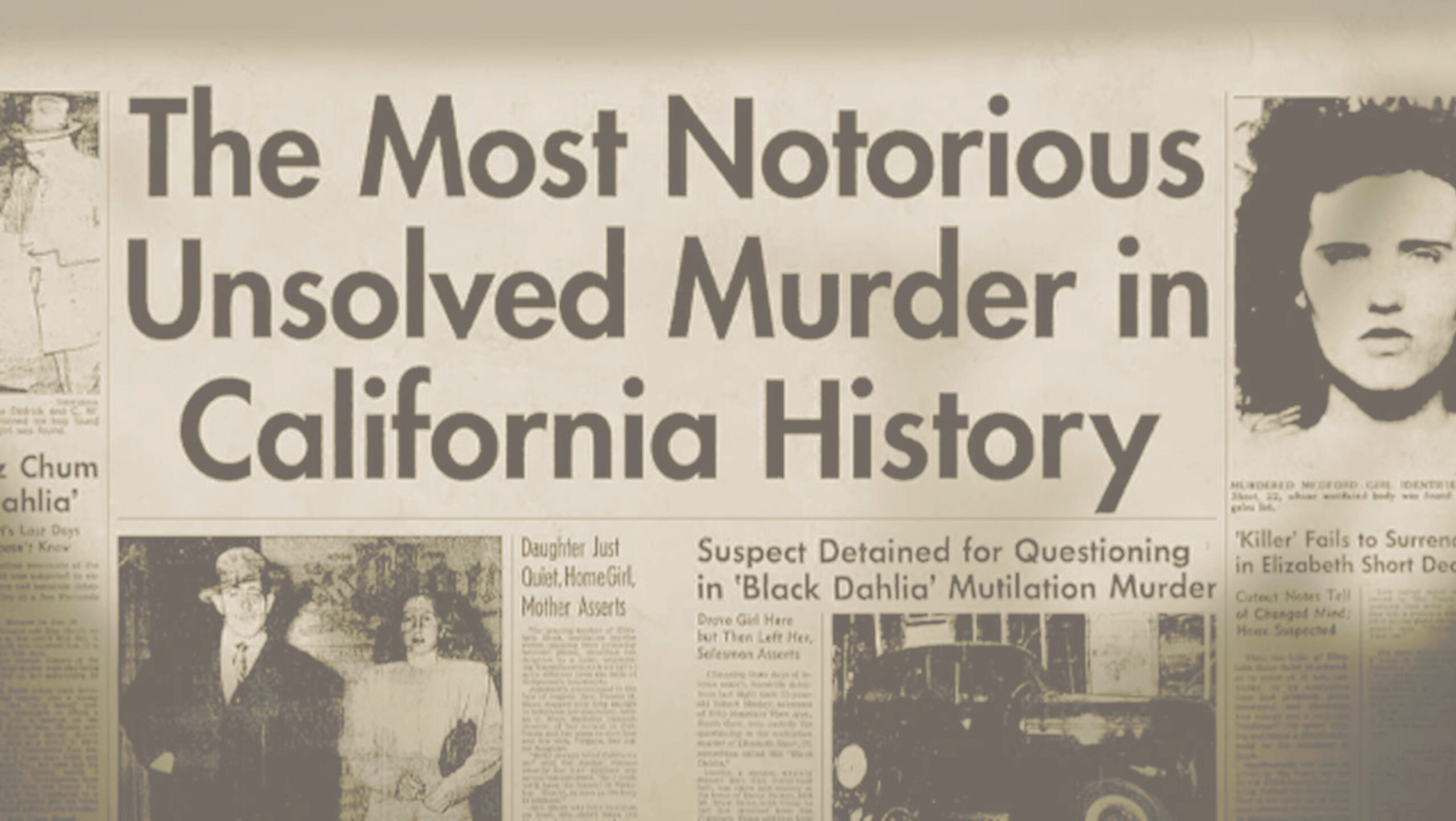
The “Black Dahlia Avenger” note has become a staple within accounts of Elizabeth Short’s death; one author has built an entire franchise on it. But at the time, detectives quickly determined it to be a hoax; even J. Paul de River and the Herald-Express dismissed it as similar postcards kept flowing in.
Of course, all claims and leads needed to be investigated. But in the opinions of the two lead detectives on the case, to comment on every single one, to give credence publicly to even the most dubious messages, as Captain Donahoe was doing, only made the department look like a bunch of saps.
Donahoe was not dissuaded. News gatherers showed up every day at the same time, rather like stray cats conditioned by saucers of milk set out at regular times, and the captain was always there to share some new report. His reason for continuing to play ball with city editors was simple. He wanted to give the impression that the investigation was still rocketing toward a conclusion, when in truth, it took time to run down the more than one hundred names found in Elizabeth Short’s address book.
The message should have been: “Detectives are hard at work. We’ll let you know when they find something.” But that wouldn’t have satisfied anyone. Not the press, not the public, not Chief Horrall, not Mayor Bowron.
Harry and Finis understood what was going on. Horrall and Donahoe were beginning to panic. What if they couldn’t solve this crime? If that was so, then they at least wanted to create the impression that the police had investigated every possible lead. It was vital that detectives were seen to be hard at work, exploring all theories, and not sitting around scratching their heads. Pressure from the top could come at any time. So could reorganizations of the department.
Horrall served at the pleasure of Mayor Bowron, but it was the Los Angeles Board of Police Commissioners on which the mayor relied for decisions regarding the LAPD. A civilian oversight board of five members appointed by the mayor, the police commission was, and still is, the collective head of the police department. In early years, commission appointments tended to be chummy, but more recently, as minority groups, child advocates, veterans, and women began demanding more accountability,
Bowron, who’d come into office as a reformer, attempted to satisfy those constituencies. The previous summer, he’d filled four vacancies with a diverse group of individuals: Agnes Albro, president of the Young Women’s Christian Association; Irwin Snyder, state commander of the American Legion; Bruno Newman, an attorney who represented Mexican American clients; and Charles Matthews, formerly an assistant district attorney and the first Black appointee to the commission.
Each commissioner, even if they were politically far apart, represented communities who sometimes experienced issues with the police. And any one of them could call for an inquiry into actions that were taken, or not taken, by the department.
Matthews had, in fact, recently blasted a police report that concluded the beating of a prominent Black doctor, Joseph Harold Hayes, by two white officers was “justified.” By February 1947, it wasn’t unreasonable to imagine something similar if the Elizabeth Short case dragged out much longer. Maybe Albro would raise concerns that the police weren’t doing enough to protect young women’s virtues, or Matthews would criticize the lack of a similar dragnet to find the killer of Mary Tate.
Unlikely, perhaps. But not unreasonable or unimaginable. And so, the grotesque pas de deux between the police and the press continued.
One detective, according to his family, remembered Harry Hansen always “working with his head down” at his desk, “deep in reading something, oblivious to anything around him unless it was somebody he was interviewing.” It’s a good image of Harry, especially at this point in our story, as clues run dry and the coverage of the case is all nonsense.
For several days at the end of January and the beginning of February, virtually every story published on the Short murder turned out to be either fictitious or meaningless, and it’s a safe bet that city editors knew that was the case. The blizzards of crank notes were reported as breaking news to fill the required daily minimum of column inches reserved for “the Dahlia.”
The Her-Ex, in a moment of honesty, admitted it was all hooey: “The baffling ‘Black Dahlia’ murder case degenerated into a weird jumble of ‘Idiots’ Delight’ today, with three confusing ‘confessions’ and a mounting flood of anonymous letters purporting to be by the killer.” That didn’t stop the paper, however, from printing them all.
Only one story received serious consideration from the police. Joseph Dumais, twenty-nine, an army corporal stationed at Fort Dix, New Jersey, told his superiors that he had killed Elizabeth Short while on furlough. Dumais claimed he’d blacked out and had only just remembered what he had done: “I get drunk and forget, and I get rough with women.”
At first, the corporal was very convincing. His picture topped newspapers across the country under headlines announcing that the killer had surrendered. Handsome, looking like a cross between Charles Boyer and Robert Mitchum, Dumais made a popular poster boy for the Black Dahlia case—until almost a dozen soldiers testified that they had seen him at Fort Dix between January 10 and 15.
The relentless news coverage was inevitably going to trigger people with delusional psychoses or inspire those with schemes for cash or fame. Caral Marshall, twenty-one, was overheard bragging in a Barstow barroom that she knew who killed Elizabeth Short and “would only tell if the reward was high enough.”
State police picked her up and brought her to Los Angeles, where the press, recalling the queer woman killer angle, described her as a “160-pound Amazon” with a “rather good figure… but somewhat masculine in her mannerisms.” Marshall, like all the rest of them, was eventually let go for not knowing anything, but not before more time was wasted by detectives, who were obliged to interview most of these sideshows.
It’s notable that during the last week of January and first few weeks of February, when all these crank postcards and crazy confessors were showing up, neither of the two lead detectives on the case were quoted in the press. Harry and Finis refused to play Jack Donahoe’s game of commenting on every idiocy that came across their desks. Harry’s last comment to the press had been way back on January 23, after Robert Manley was cleared. “We’ve got nothing,” he said then, and it’s what he would have said if he’d been talking to reporters at the start of February, too.
The press sometimes generated new Dahlia material on its own. Jimmy Richardson flew Dorothy and Elvera French to Los Angeles, where newshawks tried to squeeze one more story out of them about their former houseguest. Pushed to their wits’ end to come up with something—anything—Dorothy finally recalled a story told to her by a neighbor.
Two men and a woman had come to the Frenches’ door while Betty was staying there. It was during the day, while Dorothy was sleeping off her night shift, and her mother was at work. The neighbor told Dorothy that when no one opened the door, the people left and drove away in a car.
“I asked Betty about them,” said Dorothy, or so the Examiner quoted her as saying. “She admitted hearing them knock and she said she peeped at them through the window. She was terribly frightened and refused to talk about them.” For good measure, the Examiner reported that the people “backed away quickly and ran to their parked car.”
dahlia’s fear of mysterious trio was the headline on the next day’s front page. This is what passed for big news on the case by the end of January. A trio of salespeople, pollsters, religious proselytizers, city surveyors, or whoever else, knock on a door. Girl inside, who probably isn’t dressed, doesn’t answer. The people leave. That’s it.
Did Dorothy really say that Betty was frightened? Who knows. Maybe she was frightened of being seen without makeup or her hair styled high. Whatever Dorothy said—whatever she was prompted to say—was undoubtedly exaggerated by the Examiner’s rewrite men to get the story they wanted.
Of all the stories published during this period, there’s really only one worth our attention. The district attorney’s office asked Lynn Martin, who was now in juvenile custody, for help in identifying clients of hers who may have been involved in underage prostitution or pornography rings.
“Among the men implicated by the girl are several prominent Hollywood personalities,” the Examiner disclosed. Those included, as we know, Dutch Darrin, but we also know that Darrin got off while itinerant bunco artists like Duke Wellington got pinched, so it’s doubtful any of those prominent names faced any consequences. But Lynn did identify another client, George Price, whose name was also found in Elizabeth Short’s address book. Harry and Finis thought there might be something to learn there.
Sometime in the fall of 1946, Price, forty-eight, had driven Lynn to his home in Laurel Canyon, where she agreed to pose for nude photographs. “She made further admissions which police would not permit to be disclosed publicly because of the girl’s status as a minor,” the Times reported. In other words, Lynn had sex with Price.
Back at the start of the investigation, Alex Constance had told detectives that Lynn, Betty, and Marjorie Graham had visited “a Hollywood photographer living in Laurel Canyon,” and that some of them had posed for him in the nude. Had Betty, despite her puritanical tendencies, joined Lynn in disrobing?
Witnesses were found who claimed to have seen Betty in Price’s car in early December, a time when she was at her lowest and unable to pay her rent. Did she capitulate and take her clothes off for cash? Were nude pictures of Elizabeth Short out there as part of a porn distribution ring?
It’s a titillating possibility that many “Black Dahlia” writers, both fiction and nonfiction, have been unable to resist. The innocent girl turned jaded seductress, peeling off her sheer black lingerie to pose for the camera. Maybe there was even a stag film.
Bolstering this theory, Phyllis Jean Cyr, twenty, a photographer’s model and waitress, told detectives that Betty was friendly with a character known as “Lee,” a black marketeer of nylon stockings. According to Cyr, Lee tried to get Betty involved in black mar-ket schemes, but she refused. Black market or pornography rings—either could get you killed if you knew too much.
The theory offered a compelling, believable motive for why Elizabeth Short was killed. The Glasgow smile could have been used to send a message to anybody who was thinking of ratting them out.
But within a day, the entire hypothesis flopped. George Price wasn’t some scary underworld figure. His real name was Clarendon Kenney, a North Dakota native who’d worked as a musician in Fresno before coming to Los Angeles during the war to work in the defense industry. While it was certainly creepy to keep nude photos of girls with whom he’d had sex (detectives found a couple of Lynn stashed under his house), Kenney was an amateur. He wasn’t part of a network selling photos on the black market.
Cyr’s story was tossed out when she claimed that Betty had worked with “Lee” in February of 1943, when Betty was not in Los Angeles. It seems quite possible that when Cyr described “Lee” taking Betty to “a hillside rendezvous and attempt[ing] to attack her,” she was mixing her up with Lynn and Dutch Darrin.
Lynn Martin fades from our story at this point. Apparently, the Meyers in Long Beach were ruled unfit as guardians, or Lynn refused to go back to them, so juvenile authorities located some blood relatives, possibly her father or half sister, and put her on a train back East. There’s no record of what happened to Lynn after that.
Maybe when Lynn stepped off the train in Minneapolis, she assumed yet another new identity and disappeared onto the streets once again; if so, her fate is unknown.
In 1950, a Joanne Smith, of the correct age of twenty, was working as a receptionist at a bank in Minneapolis, living in a rooming house. This might be Lynn. If so, then we can console ourselves that three years after the world closed in on her in Los Angeles, Lynn had found a place to live and a job to support herself, that she’d survived where Betty had not.
But it’s just as likely that the Joanne at the bank was someone else. Maybe when Lynn stepped off the train in Minneapolis, she assumed yet another new identity and disappeared onto the streets once again; if so, her fate is unknown.
When her father died in 1966, his obituary listed a son but no daughter. Perhaps that was because Lynn had never reconciled with the man who had abandoned her, or perhaps, by the time of her father’s death, Lynn had already passed on. She would’ve only been thirty-five in 1966 and could have died much younger.
But let’s imagine that she lived to a ripe old age. Maybe, in fact, she’s still alive, happy in her mid-nineties, many lifetimes away from her difficult youth.
______________________________

Black Dahlia: Murder, Monsters, and Madness in Midcentury Hollywood by William J. Mann is available from Simon and Schuster.

William J. Mann
William J. Mann is the New York Times bestselling author of Kate: The Woman Who Was Hepburn; How to Be a Movie Star: Elizabeth Taylor in Hollywood; Hello, Gorgeous: Becoming Barbra Streisand; and Wisecracker: The Life and Times of William Haines, winner of the Lambda Literary Award, and and Tinseltown: Murder, Morphine and Madness at the Dawn of Hollywood, winner of the Edgar Allen Poe Award. He divides his time between Connecticut and Cape Cod.