The Trump administration is illegally gutting NASA’s largest research library.
Meet the team fighting to save our scientific knowledge.
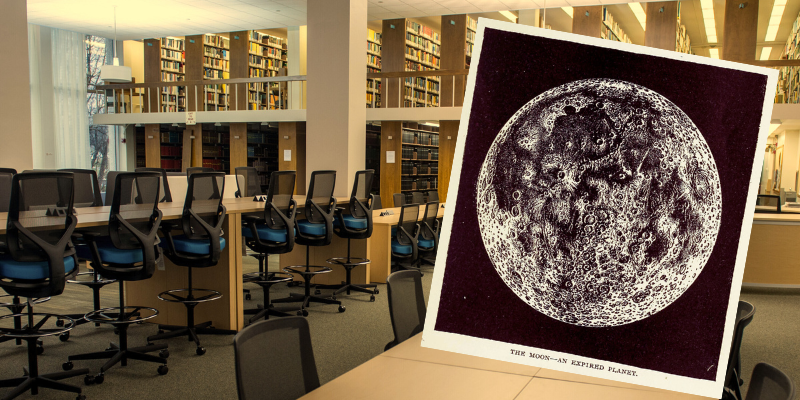
Founded in 1959, the Goddard Space Flight Center in Greenbelt, Maryland is home to NASA’s largest research library. For decades, scientists, engineers, students, and a curious public have leaned on the archive to understand the physics and mechanics of space travel and satellite technology.
But late last year, the Trump administration began a shadowy campaign to destroy the library and most of its irreplaceable contents.
This shuttering was part of a larger reorganization plan. In 2025, the Trump administration and its henchmen in DOGE proposed drastic cuts to NASA facilities, including the closure of 13 buildings and more than 100 labs.
Goddard’s archives were then placed on the chopping block. But a groundswell of public response stayed the administration. Activists working to save the library briefly secured provisions for its continued operations, via the FY26 Appropriations Bill. But this week, the administrative hammer came down anyway.
In the words of Colette Delawalla, the CEO of Stand Up For Science—an activist organization dedicated to defending and advancing America’s scientific ecosystem—the imminent purge is illegal. And tantamount to a “modern day book burning.”
I spoke with Delawalla this morning about what the administration’s cloak and dagger action means—for both scientific research, and a sentient public.
“I cannot overstate how much knowledge is housed in this library about literally our entire universe,” she told me. “The most expansive understanding of human knowledge about space is being packed up.”
What many people don’t realize is the breathtaking extent of what constitutes ‘space knowledge.’ As planetary scientist Dave Williams told NPR back in January, the Goddard library houses “a database covering all the missions and everything that’s flown back all the way back to Sputnik.” Which institutional intel has proved crucial for designing modern missions.
And according to Delawalla, the Goddard is also the keeper of great stores of earth science data, which means research crucial to climate science is also in peril. Especially the files on yet-to-be-digitized floppy discs.
As The New York Times has reported, the Goddard’s tens of thousands of books, documents, and journals have shaped our sense of the world, from the ocean to the sky. “Scientists and engineers at Goddard have designed and built probes to explore the sun, an asteroid and the atmosphere of Mars,” wrote Eric Niller.
They have also developed a system of satellites that record changes in the Earth’s atmosphere, ice cover, oceans and land surface—data that is useful for scientific research and disaster response. Future missions taking shape at Goddard include spacecraft to explore Venus and Saturn’s moon Titan, and a new telescope to search for planets that might hold life in deep space.
Stand Up for Science is currently leading the campaign to mobilize Congress against the library’s destruction. The group is “trying to apply inside and outside pressure to get Congress to act. Because once this is in a trash can, we can’t get it back.”
Time is of the essence. “We have caught word that on Saturday morning there will be trucks coming to the Goddard Library to take books away,” Dellawalla said. In the meantime, she’s urging readers of every persuasion to pressure their reps to voice dissent. Or join the National Day of Action for science, scheduled for March 7.
As well as the ramifications for curious people everywhere, Delawalla also stressed the social significance of this attack on public knowledge. She left me with a message for our cultural and academic first responders.
“Librarians have such an important and critical place in the resistance against authoritarianism,” she said, “because you all are the keepers of our knowledge…and we’re already seeing the power of what librarians can do in a moment like this.”
Let’s follow the stacks, and not go gently into that good night.

Brittany Allen
Brittany K. Allen is a writer and actor living in Brooklyn.