The Town Where The Last Picture Show Was Filmed Absolutely Hated It
David Streitfeld on the Varied Reactions to the Cinematic Adaptation of Larry McMurtry’s Novel
Like many artists with uneven careers, Peter Bogdanovich learned to keep his distance from reviews, especially bad reviews. “My analogy is, if somebody’s shooting at you, you don’t really want to raise your head to see what kind of gun they’re using,” he explained. But Picture Show was always an exception, and he could quote from the reviews, accurately, fifty years later. It’s possible that the movie received better notices than any American film between Gone with the Wind and The Godfather. As Pauline Kael observed in The New Yorker, “Bogdanovich has made a film for everybody—not just the Airport audience but the youth audience and the educated older audience, too.”
The review Peter would take with him to his grave appeared in Newsweek: “The Last Picture Show is a masterpiece. It is not merely the best American movie of a rather dreary year; it is the most impressive work by a young American director since Citizen Kane.”
To be compared to his idol, his mentor, his friend, in whose own movie Peter was at the moment playing a role, with the character based on Peter himself—a career, a life, doesn’t get any better than this. In February 1972, the movie opened in the big Texas cities as well as Wichita Falls. The battle lines were quickly drawn. “It doesn’t matter to me what people in Archer City think about it,” Larry said, speaking of the town where the movie was shot. He added that he didn’t have many fans there. Gene Bynum, minister of the First Baptist Church in Archer City, told a reporter he had not seen the movie and did not plan to, “but several people have told me about the lewdness, nude scenes and that it is filled from one end to the other with curse words.”
John R. Adams was probably the most upset about the movie. He was the principal of the high school, and he felt properly hoodwinked when the movie appeared with a coarser script than the one Peter had used to gain admittance to the classrooms. “The producers of the film told everybody in town The Last Picture Show was going to be a family movie about small town life,” Adams fumed. “They said they would not be filming the dirty parts of the book, that the picture’s worst possible rating would be GP,” which basically meant suitable for everyone except little kids. In fact, for a while it was supposed to get an X rating, which would have severely limited its commercial viability. The tentative decision was appealed, and the movie got an R instead.
Perhaps Peter believed too strongly in film and Larry in prose to ever meld the two successfully again. Peter thought Picture Show showed that film was a superior art, a conclusion Larry was bound to resist.
“The moral integrity of this town is far above what Larry McMurtry depicts,” Adams said, noting that “there isn’t one, not one long-haired boy in the entire school.” The principal said Larry had inscribed a book to a woman in town with “Revenge is so sweet,” which doesn’t sound like something Larry would do. Adams got his own revenge by telling the newspaper, “Larry McMurtry was not accepted by the majority of his schoolmates when he went to this school.”
Bill Abernathy, a rancher, noted there was enough history in the area for Larry to fill forty good books. “So, what does he do? He writes about something scrawled on a men’s room wall.”
Larry responded in a long letter to The Archer County News, which printed it on March 9. He knocked off his critics one by one, just like the hero in a Western. He said he was surprised by Abernathy’s censorious tone: “When I knew him, in the ’50s, he was not unlike any other SMU fraternityite—genial and pleasure-loving; even, in his more stylish moments, something of a playboy—though of course it might have only been my own utter unsophistication that led me to think so.”
As for Principal Adams, Larry said he had never met him. “What can one conclude about the sense of responsibility of an educator who judges people he’s never met and then casually passes his judgments on to the press?”
Bynum was dinged for criticizing something he had not seen. Larry also pointed out that he and the reverend used the same raw material: sin. “If sin weren’t so prevalent in this world I would write very dull novels and he would preach very dull sermons. How many Sundays can you keep people awake with descriptions of the Pearly Gates?”
Larry invited the three critics to join him in a debate on the public morality of the book and movie. He offered to fly to Archer City for the occasion and to rent a hall. The letter ended with his phone numbers, which he said could be called collect.
The three men did not take Larry up on his offer. Principal Adams tried to change the subject and promote the school system, telling The Dallas Times Herald that Archer City “isn’t going to have any riots over colored students, like the one in Dallas.” After further questioning, he revealed there were no Black students at Archer High.
Larry achieved his own revenge in All My Friends Are Going to Be Strangers, which was published just as the controversy was cresting. There’s a scene late in the book where Danny is at the hospital trying to see his newborn daughter. Sally’s parents, as hateful as she is, are there to prevent him. They have the same surname as the minister: Bynum. The novel’s Bynum is such a bad sport he hits Danny from behind. Danny uses his only weapon: words. “Cunt and prick and fuck and shit,” he says. “Titillate, masturbate, cunnilingus.” The parents flee.
Given the lag time in publishing, Larry must have written the scene long before the movie opened in Texas. Either he had a long-standing grudge against Bynum or, in his typical fashion, he had casually appropriated the name and the whole thing was a coincidence.
*
The money the production crew dispensed in Archer City helped most people over any hurt feelings. “The film company spent $150,000 in this town,” said Fred McDaniels, former Texas Ranger and county sheriff. “Who the hell cares what the movie was about.”
There were a handful of naysayers outside of Archer City. Rita Mae Brown was a founding member of the Furies Collective, a group of lesbians who believed heterosexuality was the source of all exploitation. She attacked the movie in the group’s newsletter and then in an expanded piece in the magazine Off Our Backs, calling it out for “male supremacy, white supremacy and class supremacy,” along with other sins. Brown, who later became a successful commercial novelist, found the movie literally oppressive. “The people who make movies are male, white, usually middle class and usually heterosexual. The people who review the movies for the most part bear those same distinctive scars. So the rest of us who don’t fit into those categories have to watch movies that have nothing to do with our lives.” She wrote that the men in the movie “have zero ability to empathize with a woman’s life and only the tiniest ability to empathize with each other.”
In a lengthy reply, printed in a college newspaper called The Daily Rag, Larry took issue, however, with Brown’s assertion that all the women in the story would have been happier if they were more in sympathy with the Furies Collective. “Miss Brown seems to resent the fact that none of the women in the story quite realized that Lesbianism was the true solution to the problems of life,” he wrote.
Brown’s complaints about the whiteness of Picture Show found an echo in a moviegoer’s letter published in The New York Times: “There is not one Negro, not one Mexican-American. And this in a small Texas town. Is this real? The director goofed.”
Larry had some quibbles of his own. He did not like the swimming party scene, where Cybill is forced to strip. The room was really a spa—the production crew could not find anyone who had an indoor pool and would allow it to be used. Larry thought the scene was awkward. With its unabashed nudity it seemed to have wandered in from a movie set in Beverly Hills in the 1970s.
Others had different complaints. Peter met Marlene Dietrich about eighteen months later—he and Ryan O’Neal were flying to Denver, and the star of The Blue Angel and Shanghai Express somehow was too. Peter had a rare bout of shyness but O’Neal asked Dietrich what she thought of Picture Show.
“I thought, if one more person strips slowly I vill scream,” she said.
*
Peter’s confidence in himself was unbounded. “I expect to win the Oscar,” he blithely told an interviewer in November. When the nominations were released on February 22, it looked likely. The movie got eight nominations. Both Ben Johnson and Jeff Bridges got nods in the supporting actor’s category, while Cloris Leachman and Ellen Burstyn were finalists in the supporting actress category. That in itself was extraordinary—four actors from an ensemble film all getting nominated.
Robert Surtees was nominated for his cinematography, Peter for directing, Peter and Larry for best adapted screenplay, and the movie itself for best picture.
Peter sent a telegram to Larry in Virginia: “Too bad they don’t give an Oscar to best book of the year because that’s what deserves it. I love you.”
The other best picture nominees were Nicholas and Alexandra (a would-be epic of Tsarist Russia that failed at the box office), A Clockwork Orange (topical and brilliant but too violent to win), Fiddler on the Roof (a sentimental musical), and William Friedkin’s The French Connection (a largely plotless drug thriller set in New York City).
Peter was on a talk show with Friedkin.“Which film do you think is the best?” the host asked Peter.
“Mine, but it won’t win,” Peter said.“The best picture never wins.” When Friedkin was asked the same question he smoothly replied:
“The Last Picture Show, of course.”
“They hated me for that!” Peter exclaimed when he was older and wiser. “I wasn’t political, I should have done it differently. I was really stupid. I should have been humble.” There would be one consolation if they lost: Stephen Friedman would lose too. “I thought if we won Best Picture and he went up to collect it, I’d be sick,” Peter said.
Surtees, who already had three Oscars, lost to Oswald Morris for Fiddler on the Roof. Ben Johnson and Cloris Leachman won in the supporting category, as Peter had predicted. Leachman thanked her childhood piano teacher and dance teacher, and her parents. Johnson thanked Peter and Polly, John Ford, the movie’s cast and crew, Columbia Pictures, “and all of the folks down in Anarene, Texas,” forgetting it wasn’t real.
Best adapted screenplay was presented by Tennessee Williams, who said something incomprehensible about the rehearsal and a white piano. Nominees were Stanley Kubrick for A Clockwork Orange, Bernardo Bertolucci for The Conformist, Ugo Pirro and Vittorio Bonicelli for The Garden of the Finzi Continis, Ernest Tidyman for The French Connection, and Larry and Peter. Williams did the Italian names well but stumbled on Larry, calling him “McMurry.”
Tidyman, a former assistant women’s editor at The New York Times, won. A big solid guy wearing shades, he gave an unusual speech: “I called my mother the other day who said I want to see you on the stage because I’m going to watch. I said, those other poor guys, they got mothers too. I’d like to say those other four mothers have a lot of pride because there are many great scripts involved, and I’m deeply grateful.” That was it—no thanks to anyone connected with the film. Tidyman had been hired for $5,000 to adapt a book by Robin Moore. Friedkin added his own name to the script, which made Tidyman angry. He protested. The Writers Guild removed Friedkin’s name, which up-set Friedkin, who retaliated by saying in interviews that the movie was largely improvised. When Friedkin won the directing award he thanked the cinematographer and the editor but not Tidyman. In his autobiography, he called the script “workmanlike.”
Peter considered his loss ridiculous, and it was. Larry, who hadn’t bothered to attend the ceremony, hung his laminated nomination in the bathroom of Booked Up.
Best picture winner was The French Connection. Over the long term, Picture Show has been much more influential. The French Connection is now mostly remembered for its virtuoso chase scene and Gene Hackman’s charm. The script has aged poorly: The way Popeye Doyle, the character played by Hackman, treats the Black street characters is offensive to contemporary sensibilities. The movie resembles nothing so much as a classic Western, with the hero outnumbered and outgunned and a big shoot-out at the end. It’s thrilling but cold.
Peter was right: The best movie did not win.
*
Picture Show was Peter and Larry’s only successful collaboration, although they would keep trying to work together for the rest of their lives. Perhaps Peter believed too strongly in film and Larry in prose to ever meld the two successfully again. Peter thought Picture Show showed that film was a superior art, a conclusion Larry was bound to resist.
“I think I took Picture Show to a level he couldn’t, because movies have that ability, more easily than a novel,” Peter told me. He cited the last scene. In both book and film, the coach’s wife says, “Never you mind,” and consoles the young lover who betrayed her. That’s the end of the novel but the movie keeps going. “It goes to a two-shot”—Leachman and Bottoms in the same frame—“and the camera pulls away from them and there’s a slow lap dissolve to the town, and the camera pulling back here blends into the panning shot, which I’ve never seen done before, which is why I wanted to do it, and it ends on the picture show. The few moments it takes to do that lifts the whole story to some other place. That’s what movies can do.”
The shot doubles down on the grimness of the story. “Make it as sad and depressing as you can,” Peter told Surtees.“Bleak and cold. Make it look like the end of the world.”
Even that, though, is not quite the end. In the credits we see all the characters again at a happier time in their lives, to the upbeat tempo of Hank Williams’s “Why Don’t You Love Me (Like You Used to Do),” the song that began the film.
Said Peter: “I knew if the picture worked that at the end of the scene in the kitchen people would be crying. And I wanted to give them time to compose themselves. I don’t like a movie where you cry and then the lights come up. And I always wanted to do a kind of curtain call. Orson Welles did it in Citizen Kane. He brought the actors back.” Larry thought the movie might be unbearable without that flourish.
The ending, taken as a whole, “leaves us, not just with a movie about defeat, but with a movie about living-in-spite-of-or-in-the-teeth-of-defeat, a superb thing for any work of art to try and be about,” he wrote in “The Last Picture Show: A Last Word.”
It helps too that the movie is compassionate toward everyone. There are no villains—or maybe life, or growing up, or getting older, is the villain. Everyone is doing the best they can.
It’s still pretty grim, though. I once asked Peter, Is life as bleak as the movie? He didn’t stop to think. “It’s even worse if you’re not good looking.”
*
In March 1972, Peter had two popular movies in theaters: Picture Show was still doing good business. It made $29 million at the box office against a budget of a little over $1 million. His new film, the screwball comedy What’s Up, Doc?, was on its way to becoming one of the biggest hits of the year. It took in $66 million. Adjusted for inflation, the two movies made $750 million. Peter embraced his fame. “This is my year and you only get one,” he told a reporter, a remark that turned out to be true. His friends noticed a difference.“You cannot speak to Peter for more than fifteen minutes without feeling the chilling breeze of self-adulation,” said Village Voice critic Andrew Sarris.
Keep life and art separate, [Larry] was telling Peter. Do not sleep with your star, and do not let praise go to your head. If you break these rules, you will make bad art.
A large ego has few needs for the contributions of others. In a feature headlined “Who Is It That Makes a Movie Great?” in The New York Times, screenwriter William Froug made the case for screenwriters. With Picture Show, he wrote, “McMurtry is rarely mentioned while Bogdanovich is declared an authentic genius in the tradition of Welles.” True, but it was hard to go against the cultural imperative that saw the director as auteur.
Americans, especially, love to celebrate their lone heroes. It is the general who wins the war, not the soldiers, and the chief executive who finds the path to corporate success. “Reporters didn’t talk to Polly Platt about The Last Picture Show, or to Toby Rafelson”—wife of director Bob Rafelson—“about Five Easy Pieces, even though they made major contributions to those films,” film historian Peter Biskind said in 1998. “That’s partly a gender issue, but it’s also a reflection of Hollywood’s belief that nobody matters but the director.”
Bert Schneider would try to bring Peter back to earth. When Jean Loth, the head of Columbia Pictures’ story department, wrote to Schneider that “there was not a moment in Peter Bogdanovich’s movie that didn’t reach me and didn’t strike up a chord of recognition,” Schneider passed the note along to Peter with his own comment: “Fuck you.” It didn’t seem to have much effect.
Larry did his best as well. He inscribed a copy of Picture Show for Peter in slightly barbed terms for omitting a minor scene: “You should have figured out a way to put in the scene where Lois plays dominoes with Joe Bob in his jail cell—but then you did beautifully by Miss Mosey.” He signed it, “From the writer to the director with love.” Peter sent Larry a photo of the two of them together. Peter is in the foreground, larger; Larry is off to the side, a bit in shadow. Peter is talking and Larry is listening.“Just a memento,” Peter wrote in the inscription.
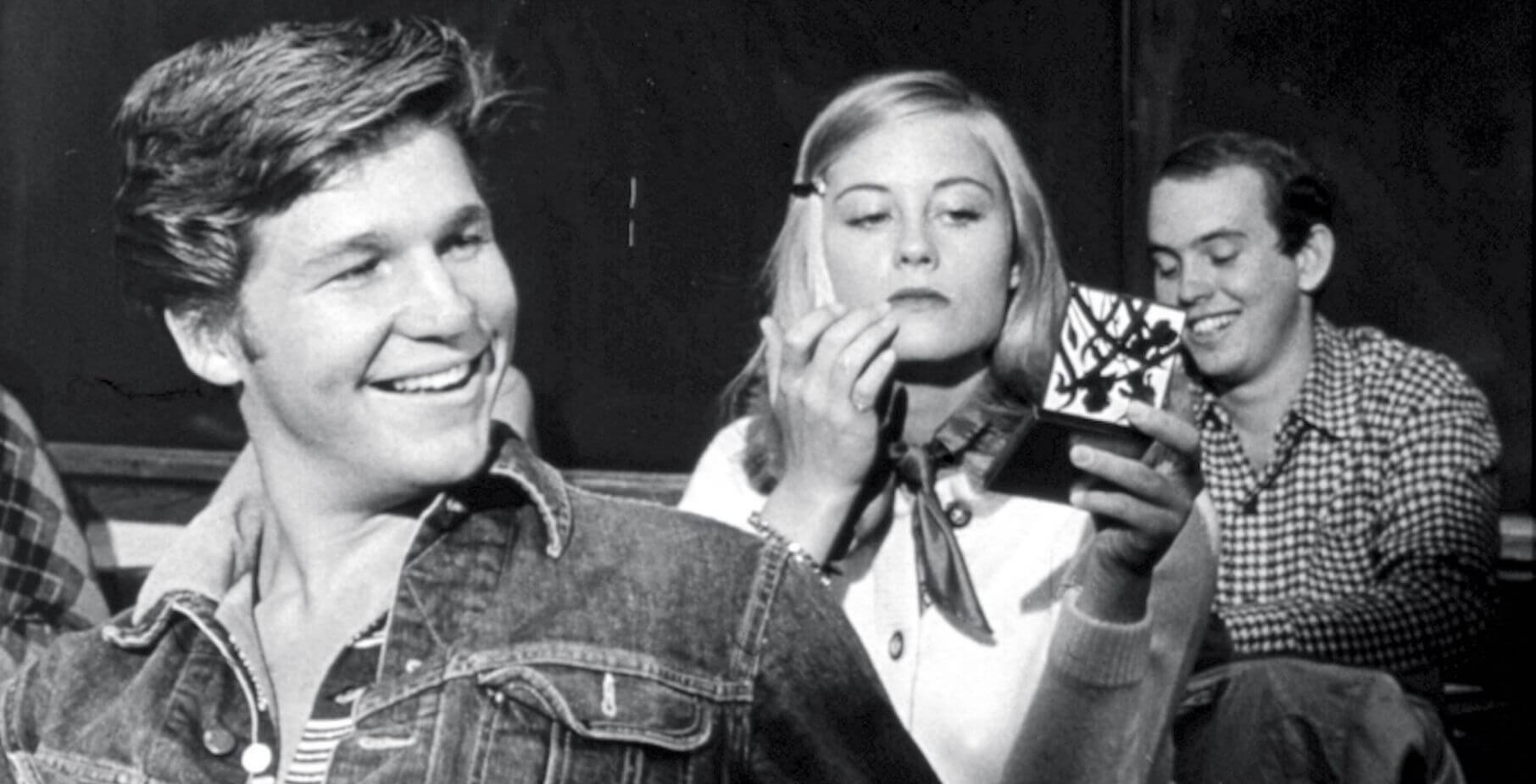
Peter’s explanation for why Picture Show is so capable of evoking emotions is that so much emotion went into it. The passion off-screen created and fueled the passion on-screen. There was a scene, Peter said, where Cybill’s nose was red because she had been crying all night. You couldn’t tell because it was black and white, and in any case the turmoil helped her performance.
Larry was uncomfortable with this approach. His books might have had autobiographical elements but they weren’t romans à clef. He thought a director sleeping with his star was a recipe for trouble. He had proof of the way it weakened Picture Show.
When they were finishing the script, Larry had an idea for two scenes that would play off each other to give a tragicomic echo. In the first, Duane and Sonny emerge from basketball practice in high spirits. Jacy is waiting in her convertible and they all go off. They begin to sing the school song, mockingly at first but then with genuine feeling. It is a celebration of themselves, their youth and their friendship.
The second scene comes toward the end of the movie. It’s a year later. Both Jacy and Duane are gone but Sonny is still in Anarene. He is at the football game when the band plays the school song again. Sonny, and perhaps the viewer, remembers those high spirits in the car. It is a bittersweet moment about the passage of time.
Larry was on the set when it came time to film the first scene. It was shot multiple times, he said, but it never worked because there was no gaiety, no warmth. Bottoms was miserable with everyone for his own reasons. Shepherd and Bridges had ended their affair and Cybill was in love with Peter but Peter, in response to an ultimatum by Polly, was attempting to do the right thing, which upset Cybill. It was a mess.
The scene didn’t make it into the finished movie, which meant the scene of Sonny at the game lost its point. The borders between real life and make-believe should be high, Larry concluded, because the emotions surrounding the former can easily kill the fragile art of the latter. He was implicitly rebuking Peter for poisoning the chemistry on the set.
Before publishing an essay spelling all this out in American Film, Larry sent a draft to Peter, saying if there were any objections he would make changes. It appears Peter did have objections, because the essay that was published was considerably toned down and turned Larry’s point inside out.
The draft of the essay says the car scene “was shot and shot and shot, in each case revealing three young people who absolutely hated being in the same vehicle with one another.” In the published version, Larry says the opposite: “The scene worked, catching something of the lightness, adolescent gaiety, and warmth which was needed to make its echo, at the end of the movie, all the more bittersweet.” The scene was dropped from the movie not for quality reasons but because the movie was too long.
When it came time in 1987 to publish the American Film column in a book, Film Flam, Larry did not include that particular essay, even though the book was only 159 pages. And when it came time to do a director’s cut of the movie in 1992, Peter made sure to put the car scene back in. Even if you watch it with a critical eye, the actors do not seem like they are trying to suppress anger. They are young but they are professionals. As Larry wrote in the published article, the scene works.
What to make of this? Larry was completely wrong about the particulars here. But he was nevertheless right to sense trouble. Keep life and art separate, he was telling Peter. Do not sleep with your star, and do not let praise go to your head. If you break these rules, you will make bad art. Beware the embrace.
__________________________________
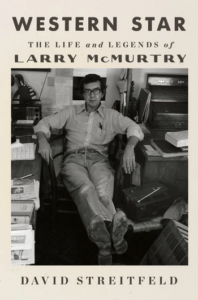
From Western Star: The Life and Legends of Larry McMurtry by David Streitfeld. Copyright © 2026. Available from Mariner Books, an imprint of HarperCollins Publishers.

David Streitfeld
David Streitfeld is a Pulitzer Prize–winning journalist at the New York Times, where he writes about technology. He lives in the Bay Area with his family and too many books.