The Surprising Similarities Between the Kardashians and WWE
MJ Corey on the Emotional Athleticism and Performance Spectacle of Keeping Up With the Kardashians
However immersive Keeping Up With the Kardashians might have been, it was limited to two dimensions on-screen; few viewers would likely make it to California Community Church or the paths in Jerusalem that Jesus walked. It was only a matter of time—about one year into her reality show’s run—before Kim Kardashian stepped into the real-life ring of one of the most profitable and well-known American storytelling institutions: World Wrestling Entertainment, which, according to its corporate website, partners with top media networks, from NBC Universal to Fox Sports, to reach more than one billion homes across twenty-five languages and 165 countries. Of course, the WWE comes with plenty of its own connections to Christianity.
In 2006, WWE’s chairman, Vince McMahon, faced off with “God”: Addressing a beam of light hovering over the ring’s arrival path, he booms, “This is not your house, this is mine!” The WWE megastar Shawn Michaels publicly became a born-again evangelical Christian, and, in 2017, WWE Studios (and Blumhouse Tilt) released a film based on his journey, which was, as Dan Mathewson writes in Sacred Matters magazine, only emblematic of the countless wrestling stars who contribute to “the booming industry of professional wrestler autobiographies, an informal sub-genre of Christian autobiographies . . .recount[ing] their journeys from wrestling stardom to salvation.”
Scholars have applied the literary theorist Joseph Campbell’s “monomyth,” or the theory of the “hero’s journey,” as detailed in his tome The Hero with a Thousand Faces, to most forms of popular media, from biblical myths to autobiographies to professional wrestling itself. Campbell writes that the hero’s journey is the narrative structure fundamental to most great stories because it reflects “the unconscious desires, fears and tensions that underlie the conscious patterns of human behavior.” (The neuropsychology of storytelling has since been studied, revealing that well-told story arcs can induce dopamine, cortisol, and oxytocin responses in us.)
The simple, linear narrative structure of WWE conversion memoirs and the Kardashian narrative—tales of struggle and triumph—is common to both media enterprises.
Campbell’s idea of narrative generally sees a main character being “called to adventure,” facing obstacles, and then returning home transformed for the better—a sequence recycled and reused by the Kar-Jenners anytime they undergo plastic surgery, enduring physical suffering for a guaranteed transformation or “rebirth.” The same arc appears in every episode of their TV show: Kim is invited to dance onstage with the Pussycat Dolls! But her bad eyesight makes it hard to learn the steps!
So, with her family’s help, she undergoes a medical procedure to improve her vision! Finally, Kim masters the steps and takes to the stage with confidence, as her family cheers her on!
In the big picture, too, the Kar-Jenners abide by this structure: Kim wants to be famous! But compared with Paris Hilton, she’s a lowly wannabe! Yet with enough grit and enterprise she—along with her family—fulfills her American dream of becoming a cultural icon!
The simple, linear narrative structure of WWE conversion memoirs and the Kardashian narrative—tales of struggle and triumph—is common to both media enterprises.
In March 2008, Kim, wearing a blue dress and her pre-Instagram face, hosted WrestleMania XXIV, which was the twenty-fourth annual pay-per-view event, to be purchased by more than a million people, grossing nearly $24 million in revenue, according to a press release (only a touch less than the previous year’s, which had been headlined by the future president Donald Trump as he slammed around the ring with Vince McMahon in a “battle of the billionaires” that ended with a victorious Trump shaving McMahon’s head). W
hile explaining the structure for an upcoming WWE championship, Kim is interrupted by the tattooed and bleached-blond Mr. Kennedy, a popular “heel” (bad guy) played by Kenneth Anderson, who leans into her mic to announce his intentions to win. The most replayed part of the YouTube clip from this moment is at the end, when the scene physically escalates like in any good WWE match, with Mr. Kennedy lunging toward Kim to holler his name into her face.
The French literary theorist Roland Barthes explored the spectacle and narrative inherent to wrestling in his 1957 essay collection, Mythologies, which argues that pop culture semiotics can both create and reflect larger cultural myths, ranging over the 1953 film Julius Caesar, soap commercials, striptease, astrology, and Greta Garbo’s face. This text laid the groundwork for the kind of cultural critique we seem to know and love in the social media age (analyses that my friend, the artist Pia Marchetti, has described as “smart about dumb, dumb about smart”). Barthes makes explicit an unspoken truth about wrestling matches: that their conflicts are both real and unreal, a matter of suspension of disbelief, also known in the American wrestling world as a rather postmodern phenomenon called kayfabe.
In other words, this high drama of winners and losers follows a very, very old human narrative tradition rooted in our craving for catharsis.
Barthes, writing of French wrestling (which he says is more focused on moral quandaries than on the politicized identities of American wrestling), doesn’t use that term—the origins of which are unknown—but he defines it just as well: “It no longer matters whether the passion is genuine or not. What the public wants is the image of passion, not passion itself.” They want to see what Campbell would call the “ordeal,” and Barthes, “the ancient myths of public Suffering and Humiliation: the cross and the pillory. It is as if the wrestler is crucified in broad daylight and in the sight of all. I have heard it said of a wrestler stretched on the ground: ‘He is dead, little Jesus, there, on the cross,’ and these ironic words revealed the hidden roots of a spectacle which enacts the exact gestures of the most ancient purifications.”
In other words, this high drama of winners and losers follows a very, very old human narrative tradition rooted in our craving for catharsis. But here’s the important part: “A wrestler . . . never disappoints, for he always accomplishes completely, by a progressive solidification of signs, what the public expects of him.” The “heels” (bad guys) and “faces” (good guys), the image of a prim and polite Kim Kardashian giggling while being screamed at by a big, muscled man, or Donald Trump lurching around in his signature suit, throwing Vince McMahon over a conference table—all of these performances play out everything that each person involved is supposed to represent in the service of our own gratification, and using spectacle and exaggeration to ensure “intelligibility,” the resulting fantasies are almost like a cartoon come to life. If wrestling is so watchable thanks to its intelligibility—every appearance, utterance, and movement is so extreme that the point of the story cannot be misinterpreted—then the same can be said of many scenarios in KUWTK.
When Kim’s new boyfriend, Kris Humphries, tosses her into the ocean in Bora Bora, and then she realizes her diamond earring is gone, she is hysterical with grief. “Kim, there’s people that are dying,” her sister Kourtney drones as the camera zooms in on Kim’s crying face. Kim’s Crying Face would become another meme both within the show and across social media, and with every sob Kim conjures the sensibility of a wrestler, who, Barthes writes, “as on the stage in antiquity . . . is not ashamed of [his] suffering” and “has a liking for tears.” Tears, a visual representation of something internal, transform the scenario into a far more intelligible meme, or drama, or myth.
As the family’s fame grew, the more WWE-like their storylines became. Other critics have applied professional wrestling to pop culture by comparing Kanye and Kim’s feud with Taylor Swift to superhyped kayfabe wrestling rivalries, but I find the intra-family Kar-Jenner conflicts to be the most demonstrative of the concept, because they happen within the safe “ring” of the family name. In season 18 of KUWTK, Kourtney and Kim, while lounging around at Khloé’s house, get into a tiff over work ethic that somehow turns into hand-to-hand struggling. “Don’t ever come at me like that,” Kim warns Kourtney. “I swear to God I’ll punch you in the face.”
When Kourtney goads her to “do it already,” it becomes a full-blown fist- fight, forcing Khloé to referee and, later, clean their makeup off her walls. Kourtney and Kim’s rivalry had long functioned as one of the series’ primary storylines, but this incident was extra memorable because it had gotten physical. In 2015, Kim and Kourtney fought because Kourtney was reluctant to share her likeness for a character in Kim’s video game, Kim Kardashian: Hollywood, and almost every year that followed, they engaged in some new arbitrary but vicious battle.
The fact that in some shots during the 2020 fight scene it looked as though the women were giggling as they grappled only added a layer of “real or staged?” uncanniness to the spectacle, hardly the first time such an effect had been elicited by a Kim and Kourtney conflict. In 2018, after they had clashed over logistics for a Christmas card photo shoot, Kim declared Kourtney to be the family’s “least exciting to look at.”
In anticipation of that episode’s debut, the sisters brought their fight over to Twitter. “We all have different priorities. Mine is being a mother,” Kourtney tweeted, earning fifty-four thousand “likes”—but not without using the hashtag KUWTK to promote the show. Kim responded, “And mine is not? The shoot was with our kids!!!!! My #1 priority is being a mother as well and I can work too, so can you!”
As fans began chiming in with their takes on the complexities of sister relationships, coworking dynamics, which sister was coming off as more spoiled, and what they would do in the situation—and the sisters responded to or retweeted them—Glamour reported on the uncanny interaction with the headline “The Kardashian Sisters Are Fighting on Twitter, and People Think Kris Staged It.” The mystery of what living in a perpetual state of kayfabe must feel like is much of what compels me to keep up with the family’s content. The TV show “is our therapy,” Kim has claimed more than once. It’s true that they get to surveil their most performative and authentic moments at a scope the rest of us have no access to, and perhaps they find catharsis in replaying conflicts and staging resolutions.
It was intense, and it must require a kind of Olympian emotional athleticism to do it all the time.
Once, for fifteen minutes, I experienced a version of this process. During my early twenties, when my sister and I were moving out of our shared Brooklyn apartment, we hired a mover to help—some NYU kid making extra money over the summer. After he caught sight of our bong, we allowed friendly jokes about weed to grow too familiar, and when the packing job was done, he plopped on our couch and lit a joint, expecting that we’d all hang out. We felt too guilty about having led him on with our friendliness to ask him to leave.
In the back of every woman’s mind is safety—he knows where I live—but maybe most of all looms the great female fear of seeming rude. After shuffling into the hallway for a stolen moment of privacy, we decided to stage a spat to tell him without telling him that it was time to go. I forget what we fought about; all I remember is that we started off stifling laughs, and then halfway through, our performances began to feel more real. We paused and held eye contact, searching for confirmation that the other wasn’t really mad.
It took the kid a while to get the hint, and the longer he gawked at us, the harder we felt obligated to fight, and the more unclear our reality became. Finally, he stood up and said, “I was hoping to hang out with you girls, but I’ll let you sort your issues out.” Freed from our problem, we were exhausted, forced to process how much of that had been a matter of problem solving, and how much had brought up our real baggage. It was intense, and it must require a kind of Olympian emotional athleticism to do it all the time.
But the fact that any onlooker of the Kardashian spectacle can tell it entails some mix of the real and the staged contributes to the family’s stigma for being duplicitous—an extension of a skill set that has cartoonishly characterized women throughout time: “feminine wiles,” or a woman’s use of charisma and truth stretching for manipulative purposes, which are arguably honed through a woman’s awareness of her own perpetual objectification and physical vulnerability. My point is that criticism of Kardashian kayfabe might be a bit gendered, while when it comes to wrestling, many fans are grateful to be entertained.
One of the WWE’s greatest memes comes from a fan named David Wills who, during a 2005 wrestling event’s Q&A, stood up to tearfully tell his wrestling heroes, “I just want to thank each and every one of y’all for all you’ve done to your bodies—it’s still real to me, dammit!” He understood, like Barthes, that wrestling was both fake and real, and the performer’s body served as a medium between the two poles. In a paper titled after Wills’s quotation, the humanities scholar Brian Jansen explores the ways the WWE “benefits financially from the genuine violence its performers enact on their bodies in the act of performing ‘fake’ violence while disavowing responsibility for long-term health consequences of that violence.”
He highlights the fact that WWE performers, responsible for their own training and costumes, are independent contractors, which relieves the conglomerate of liability for anything that may go wrong, and a quick visit to the Wikipedia entry for “botch,” the wrestling term for “to fail in attempting a scripted move or spoken line by mistake, miscalculation, or an error in judgment,” reveals some jarring injuries.
We may never know whether Kar-Jenner conflicts, however trumped up for the camera, have caused any kind of actual emotional injury between the women. All we know for sure is that reality TV, professional wrestling, and Kar-Jenner industries have billions of dollars running through them because humans crave to watch heroes and villains fight it out. And that displays of such stories have made certain personalities, whether interpreted as heroic or villainous, so viral that they could eventually become president. (Jansen also points out that the WWE was “reported in 2017 to be the single largest donor to the Trump Foundation.”)
As for the Kar-Jenner clan, they have yet to botch their own kayfabe. To conclude the sisters’ messy and uncanny Twitter matchup, Kim made sure to tweet, “Dont ever get it twisted, me, Kourtney and Khloé are GOOD! ALWAYS!!!! Never question that!”
__________________________________
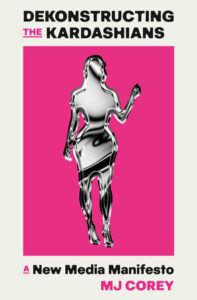
From Dekonstructing the Kardashians. Used with the permission of the publisher, Pantheon. Copyright © 2026 by MJ Corey

MJ Corey
MJ Corey is a Brooklyn-based writer and psychotherapist best known as Kardashian Kolloquium on TikTok and Instagram, where she applies media theory and postmodern frameworks to the Kardashian family. Her culture writing has been featured in Refinery29, Paper Magazine, Vogue, and The New Yorker, among many other outlets.