The Stories Our Mothers (Never) Told Us: Alice Martin Writing About Family Archives
“At what point does writing about extraordinary circumstances for women become ordinary?”
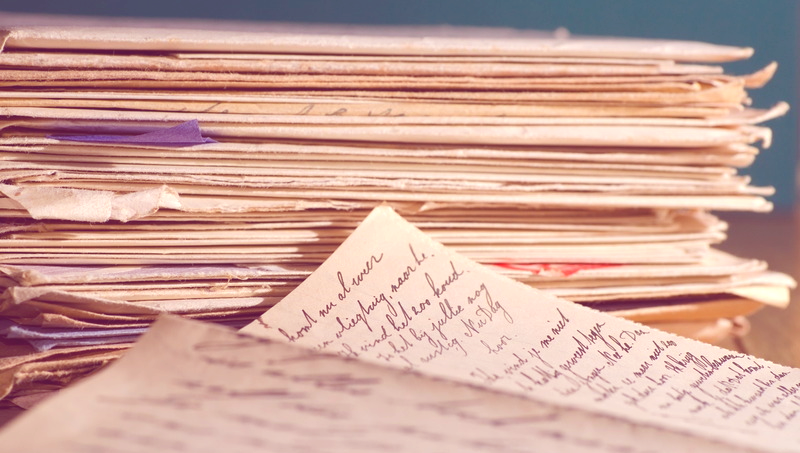
No one knows it, but I come from a long line of women writers. Scratched on diner napkins and the backs of envelopes, tucked away in un-seamed notebook paper and date books, the many words my grandmothers, aunts, and mother wrote have long sat yellowing in the corners of basements.
Five summers ago, family members began shipping these things to my (small) Brooklyn apartment. Maybe there’s something in here that relates to your research! they wrote on sticky notes. As part of my work as a PhD candidate in literature, I studied ordinary women’s manuscript materials from the nineteenth century. In my dissertation, I was writing about anonymous women’s letters, diaries, and albums, material genres that embody archival detritus.
These stories of the women in my family—stories of desire and yearning, of ambition and hidden pains—were extraordinary. But they were ordinary, too.
I suspected they actually sent me these sagging boxes to finally empty their basements. They included everything from to-do lists to annotated kitchen calendars, crumbled receipts to scraggly notes on the backs of photographs. Everyday scraps that are, as Laurie Langbauer puts it, “the very things we cannot read because they are so commonplace as to be boring.”
Despite this, I did read them. And what I found didn’t direct me toward my dissertation. Instead, these fragmented pieces of writing the women in my family left behind gave me imaginative possibility—to creatively fill in the gaps between these slivers, to piece together skin-thin scraps into something more full-bodied.
That summer I didn’t start my dissertation. I started writing a different kind of book instead, a novel inspired by the daily lives women in my family had never told me about but had written down anyway.
*
This novel, which became my debut, Westward Women, follows four women who leave their hometowns in Appalachia in the summer of 1973 on separate but interwoven, phantasmagoric, cross-country road trips to the West Coast. My family archive was my inspiration.
This archive included a haphazard collection of train ticket stubs and a beat-up travelogue kept by my great-aunt and namesake. At 18, she traveled to the Alps, an extraordinary trip for a woman who was one of ten children from coal-mining country at the turn of the century. The trip was made possible—in a very Austen-ian manner—by her wealthy great-aunt. Her accounts were full of wonder and longing, but also a kind of bruised pain; “such beautiful things” she wrote wistfully on a creamy sheet of hotel stationary.
Another scrap was my maternal grandmother’s day book, which she kept for three months after she traveled from her rural western Pennsylvania hometown to Pittsburgh to serve as a nurse after World War II. In just half a sentence a day, this book includes frank discussions of women’s sexuality as she embarked on a carousel of dates with men returning from war: “Got high with T. Kissed T. G. was mad.” This woman—my cat-loving, sometimes forgetful, always generous Mimi—wasn’t just full of desire but also of the confidence to claim it.
Other scraps were dozens of unpublished newspaper articles and fair copies of my grandfather’s sermons, written by my paternal grandmother, an aspiring writer herself. She even left behind sections of an attempted memoir about surviving infancy only by being an incubator baby in a freakshow on Atlantic City’s Boardwalk in the 1930s. Here, she—my prolific sweater knitting and audiobook listening Gram—was a young woman full of ambition, of words, of ideas, bursting at the tightly sewn seams of her life. She ends the surviving section of this memoir looking forward: “this sketch,” she writes, “may only prove to be the historical background for a play, upon which the curtain is about to arise.”
But mostly, I was drawn to the letters exchanged between my mom and her sister during separate road trips they each took out West in the 1970s. The scraps from their trips revealed two women who mapped the world as a place waiting for them to discover it, two women who had realized they could use travel as a form of autonomy. Their trips included things like spooky overnight ferry rides across the Great Lakes, bad trips from drugs procured by some guy Mom’s boyfriend knew, and a stint as an apple picker outsider of Seattle to make enough money for a Greyhound bus ticket home.
But these letters and remembrances were also concerned with the habits of daily life: the ways my mom invented to keep the children she watched during a stopover on a farm busy, problems with a stuttering thermostat, the difficulties of taking a shower at the orchard. Once, my mother’s sister wrote her, “city life is no good for me. I start eating and boozing and smoking in large quantities and eating bad things like steak and hot chili. My body is saying ‘fuck you.’” A hangover and indigestion—what’s more ordinary than that?
The more I uncovered from this scattered archive, the more I understood that the scandalous moments from my mother’s stories weren’t ruptures in these daily routines but embodiments of them. These stories of the women in my family—stories of desire and yearning, of ambition and hidden pains—were extraordinary. But they were ordinary, too. The things women have done and felt and hidden for centuries.
Piecing together the scraps of my family’s archive for this novel wasn’t as simple as filling in the gaps to create a cohesive whole, the way I’d imagined.
*
These themes of women’s desires and systemically halted ambitions ultimately took centerstage in my novel. But reading ordinary women’s manuscript materials was a lesson in writing as a craft. In The Extraordinary Work of Ordinary Writing, Jennifer Sinor describes how reading such materials, “turns our attention away from what the writing does…and toward what the writer is doing.” These fragments were evidence of what writing is as a process, even when there’s no final, polished product to show for it. They demonstrate how stories are a labyrinth of interlocked paths rather than a single road. And they were testaments to how writing happens in the scraps of time women find woven into our daily lives, emerging from our ordinary routines and domestic iterations, not in spite of them.
Piecing together the scraps of my family’s archive for this novel wasn’t as simple as filling in the gaps to create a cohesive whole, the way I’d imagined. Instead, this novel became a celebration of the fragmentary nature of these scraps. In my novel, the single character I’d envisioned became many women, a chorus of stories that, while they cannot capture exactly what happened, try to express a collection of women’s experiences and relationships and states of being.
Like my ancestors, I also wrote in fragments. I wrote this novel in the in-between times and places: on countless New Jersey Transit commutes; via scribbles in notebooks sandwiched between class notes; between shifts at freelance and part-time jobs I held down while a graduate student. There were many drafts of this book—some with one point of view and others with ten. And it grew out of innumerable conversations I had with friends and family and mentors and agents and editors. It is the result of ordinariness, iteration, and sociality. This is the life and work of a writer.
My novel joins the collection of the stories we tell ourselves about our mothers, our sisters, our grandmothers, our selves. When I received the draft of the novel’s flap copy from my editor, I had to laugh. It read: “a story of three ordinary yet unforgettable women in extraordinary circumstances.” When, I wonder, are women not facing extraordinary circumstances? And at what point does writing about extraordinary circumstances for women become ordinary?
__________________________________
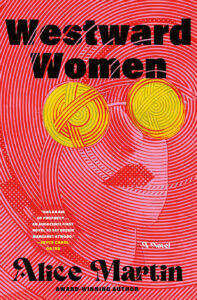
Westward Women by Alice Martin is available from St. Martin’s Press, an imprint of St. Martin’s Publishing Group, a division of Macmillan.

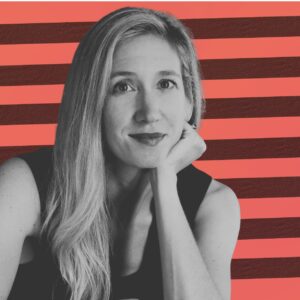
Alice Martin
Alice Martin is an Assistant Professor of English Studies at Western Carolina University, where she teaches fiction writing and American literature. Her debut novel, Westward Women, is out now from St. Martin’s Press