The State Department is forcing certain libraries to shutter their passport services.
Nonprofit libraries—or to be precise, any library that receives some of its money from 501 (c) (3) nonprofit contributions—are sundowning their passport services.
The federal government announced this new dictum in late 2025, breaking with a long-standing tradition. And as Book Riot reported this morning, communities are starting to feel the effects.
Also called the Passport Acceptance Facility program, library passport services previously allowed citizens to apply for or renew a passport at any participating library.
This policy allowed folks to skirt trips to City Hall when getting their documents in order. But as a State Department spokesperson told the AP in February, “federal law and regulations ‘clearly prohibit non-governmental organizations’ from collecting and retaining fees for a passport application.” So the program is now on the chopping block.
The American Library Association estimates that about 1,400 libraries nationwide could be affected by the new policy. Which is about 15% of all public libraries, depending on how many offer the service.
States like Connecticut, Maine, Rhode Island, and New York, where half of the public libraries enjoy nonprofit status, will take the heaviest hit.
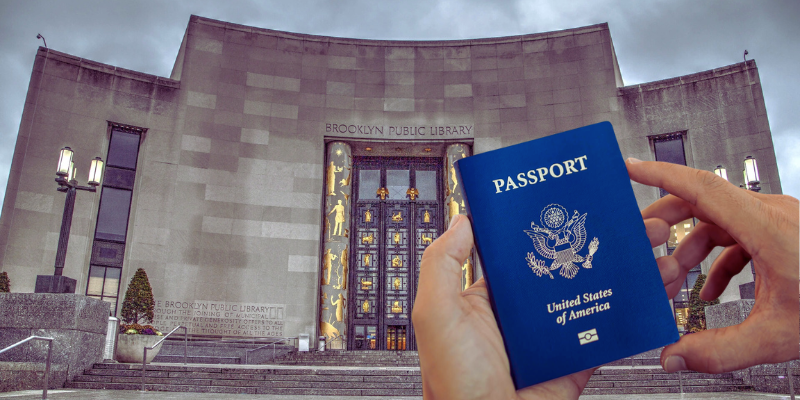
As Time Out reported last Friday, the Brooklyn Public Library will no longer offer the service. This branch alone processed nearly 300,000 applications since launching the program in 2011.
This morning in Book Riot, Katie McLain Horner—who works as a Circulation & Reference Manager at an Illinois library and was in charge of passport services there until recently—explained the intricate funding structure that accounts for nonprofit libraries in the first place.
Funding laws vary wildly state to state. But according to Horner, most American libraries receive most of their money from property taxes and local governments, with supplemental income coming from state and federal grants.
The nonprofits currently in the crosshairs may even receive government funding. But their unique tax status allows them to pursue additional money through donations and grants. Which is just to emphasize the loophole aspect of a change that will surely harm government-funded public goods.
As the AP noted, the new policy has dire implications for folks in rural areas, where passport offices are thin on the ground.
In Pennsylvania, for instance—where 85% of public libraries are classified as non-profits—citizens seeking documents will now have to travel many miles or possibly take unpaid time off work to get their docs.
This is the case in a south-central Perry County, where the Marysville-Rye Library was one of only two passport facilities serving the community. (Until this month.)
A bi-partisan coalition of lawmakers did write to Secretary of State Marco Rubio protesting the change. Leaders noted the inconvenience, and the sus timing.
The new policy comes at a moment when passport demand is surging thanks to Real ID requirements, increased fear of immigration stops, and—I speculate—renewed urge to get outta Dodge. And we shouldn’t forget those pesky federal attempts to make proof of citizenship necessary to vote.
May the gears of bureaucracy slow this roll-out. We don’t need one less reason to go to the stacks.

Brittany Allen
Brittany K. Allen is a writer and actor living in Brooklyn.