The So-Called Tragedy of the English Commons Was Anything But
Kate Brown Explores the Intersections of Class and Land Use in 19th-Century Britain
The sign said, “Welcome to the Northfield Allotments,” but the gate was closed and bolted with a heavy steel padlock. We were in Ealing, a West London residential neighborhood. Peering through the grating of a six-foot fence, Marjoleine and I could see the first brave apple blossoms, red spears of rhubarb, and compost piles, some neat, most unruly. Between them, paths of bright green grass linked the large garden network.
Northfield, the oldest existing allotment in London, was founded in 1832 just after England suffered waves of machine breaking, arson, looting, and attacks on authorities and wealthy farmers across forty-five counties, the largest explosion of social unrest in English history. Trying to appease hungry, stone-throwing workers, the English elite carved up twenty acres of land on the outskirts of London into tiny provisioning gardens. Since its founding, the Northfield Allotments have shrunk to a few acres, land siphoned off over the years by developers.
That Sunday afternoon, there were only a handful of gardeners tending their plots. We finally got the attention of one. She came over but did not open the gate. We asked if we could come in for a look around. She said there was an Open Day in midsummer. We explained we would not be in London for that special day. We had come a long way just to see the gardens.
Instead of being drawn to cities, rural people were pushed into cities from their ancestral homes. And they did not go willingly.
She said she’d love to help, but she could not allow entry to strangers. She was a new gardener and did not want to lose her plot by breaking the rules—she’d waited three years to get it.
We walked to another entrance, along a two-hundred-year-old hedge packed with blackthorn, hawthorn, apple, willow, and blackberry brambles. At another bolted gate, we stood looking in wistfully until a woman leaving the garden agreed to quickly show us around.
We walked through the gate to her plot. She had a few fruit trees in bloom plus some greens and herbs, peas coming up, and a drift of flowers in beds. But my eye was drawn to the rich, dark soils. Two centuries of gardeners’ care showed in each springy step. I stopped myself from kneeling on the ground to touch and smell the earth, sensuous as it is.
“Don’t play in the dirt!” Parents spend a lot of time training their children out of their habit of handling and sometimes tasting earth, though scientists are just starting to understand how contact with soil microbes supports healthy immune systems and childhood development. Maybe this instinctual allure is why waiting lists for allotments have doubled and tripled in the past decade. Maybe that’s why, I thought with some bitterness, it’s time to open the gates.
We continued our perambulation around the fence. A quiet, narrow footpath led along one edge. There, birds sang, mostly sparrows and doves, diving in and out of the hedge. I stopped and tasted a few leaves of wild garlic mustard. This “Class A noxious weed” was delicious, tender still in April.
We reached a commercial street and stopped at a café (where everyone spoke Polish) for a bowl of borsch. Nearby, in an old Anglican church, musicians were practicing for a Hindu ceremony. The public park (no fence, no gate) was jammed with children at play, parents, and young men, heads and knees together, nodding to a beat. The population in the park was starkly different from the few, all-white gardeners in the allotment.
Both public parks and private allotments served as compensation for a long process of enclosing public commons to make the urban and rural landscapes of today, in which territories are divided, fenced, and often guarded. Historians will tell you that once cities grew large in the nineteenth century, they broke the connection people had developed over millennia to their surrounding environments. City dwellers piped in fresh water and flushed dirt away. They purchased provisions, clothing, and materials from around the world. Urbanites skated along barely touching the earth on paved landscapes. For a long time, people associated cities with humans, and saw humans as somehow distinct from nature. But now scientists understand the human body not solely as a discrete vessel, shaped by ancestors’ DNA, but rather as an ecosystem, a kind of Grand Central Station of microorganisms: bacteria, fungi, viruses, and invertebrates. Human bodies merge with the larger ecologies in which they live. Humans are in the thick of “nature.”
The conventional historical narrative telling us that people flocked to cities to find jobs in new, large factories isn’t entirely satisfying. Who would want a mind-numbing, physically brutal, and poorly paid job in a factory? When asked, nineteenth-century women said they would rather work long days in the fields than shorter days in a factory. Instead of being drawn to cities, rural people were pushed into cities from their ancestral homes. And they did not go willingly.
1830, Kent, England. A damp, twilight breeze snaked around the ivy-covered stone walls of an elegant manor house. From the stables, the neigh of a horse, and then, a scratching sound followed by a spark that illuminated the silhouette of a figure quickly stepping away. As flames spread from the barn, neighbors came running to help. Well, some helped. Others cheered from the darkness as the timber frame collapsed. A couple of people pulled out knives and slipped over to puncture leather hoses pumping water to put out the fire. A journalist for Punch claimed the blaze illuminated a “satisfied gleam in the eyes of a starved, sullen and revengeful peasantry.”
The invention of coating the tip of a stick with sulfur first appeared in English markets in 1829. The “strike-anywhere” Lucifer match made fire portable, quick, and dependable. Good for house servants, cooks, and cigar smokers. Good for arsonists. Lucifer matches gave easier voice to grievances that had been smoldering in the breasts of rural people for decades.
When the fires started in 1830, Great Britain had just emerged from decades of conflict. English armies fought wars abroad for labor, markets, and territory, and they engaged in battles at home for the same. Beginning in 1750, Parliament passed Acts of Enclosure, making it much easier to privatize the common property of a parish without the consent of commoners. From 1750 to 1850, landowners used these acts of enclosure to appropriate six and a half million acres of communally managed property, a quarter of the country’s cultivated territory.
By 1830, rural working people had reached a breaking point. Cut off from the pastures, forests, swamps, and gardens that had fed and sheltered them, they found it harder to feed themselves, to pay taxes and rent. Villagers had to work for wages that dropped each year as more and more people sought jobs. People lost their homes and shifted each year to new farms as hired laborers. Evicted commoners and poorly paid farmhands turned what weapons they had—arson, machine breaking, and looting—on the wealthy who were profiting handsomely from privatizing common land.
Historians have used the phenomenon of enclosure to debate the great changes to human and nonhuman life that occurred with the Industrial Revolution, the scientific revolution, and the second agricultural revolution, all led by the English. The common view is that commons were and are a “tragedy” because, for lack of private property, people raced to get their share and overgrazed, overfished, drained aquifers, and depleted minerals. And that is certainly true. The biography of any robber baron shows how people take what they can get and keep it. But the Nobel prize-winning economist Elinor Ostrom, who was born during the Great Depression to a family of limited means, showed that when people are part of decision-making processes set up to govern shared resources with clear rules and boundaries, they can be adept stewards of commons. So, it’s useful to take another look at how English commons worked before dropping them into the wastebin of history.
Common land use existed on every continent where people settled. In England, many legal categories of people had a share in the commons, but in short, the population could be divided into three classes. Peasants either rented or owned land that came with rights to use common pastures, wastelands, and forests. Wealthy tenants had large farms they rented from a landowner. Landowners claimed large portions of a parish, but by law they had to respect villagers’ rights to use territory deemed as commons. Landowners were often absent for long periods. Until the eighteenth century, they rarely took an interest in farming beyond collecting rents.
Landscapes held in common were distinctive. Villagers called them “open,” meaning the land was not divided by fences or hedges. People lived in cottages clustered in a village. A commoner could have a lease of sixty acres or just six. Commoners would pool together a team of horses and a plow. They had no individual control over what they planted but met regularly to devise a course of cultivation for all.
There are hundreds of books on English commons and their enclosure, many of which I read, but I still didn’t have a good idea of what an open agricultural system looked like or how it worked. Finally, I wrote to Sarah Tarlow, a historical archaeologist who in The Archeology of Improvement in Britain, 1750-1850, describes how it is possible to still see remnants of older agricultural traditions written on the landscape. I asked her if she would take me for a walk, and she kindly obliged.
On a rainy spring day in the English Midlands, we set off across a field planted for hay. On the other side of the hedge, the land was flat and marked by tractor treads, but where we stopped the pasture undulated up and down in long, gentle waves. In the furrows, water gathered, and we sank into mud. On the ridges, elevated by a meter, our feet were dry. Sarah explained that as pre-tractor farmers plowed, the moldboard pushed earth to one side, building up the ridge at the expense of the furrow. In the wet clay fields of the English Midlands, furrows served to drain ridges, making them dry enough to grow grain. When farmers got to the end of the row, they turned, kicking earth up onto a bulkhead. Villagers used the raised land of the “balks” to walk and lead their livestock. With no boundaries for private property, footpaths crossed the landscape wherever a person desired to go.
Standing in the field, Sarah showed me how farmers would sow or “broadcast” seed on the ridges, a hand in a bag, tossing grain left and right. Birds flocked around, taking their share of seed. Such haphazardly and closely planted crops could not be hoed, so other plants and grasses grew with the grain on the ridges. Herbs, wildflowers, and grasses also populated the wet furrows below and the higher balks. At harvest, reapers took what was in the mix, both cultivated and wild.
As the landowning class became interested in farming at the end of the eighteenth century, they viewed open-field agriculture with a critical eye. All those wild plants growing on the ridges they saw as a “nursery for weeds,” while the furrows wasted space that could be used for cash crops. The English landowner and novice farmer Jethro Tull hated the idea of giving seeds away to birds. Tull fixed a box to a rotating wheel that dropped seeds in straight lines into furrows and a harrow that covered the seeds with dirt. His new seed drill lined up plants in straight rows that could be weeded. He then devised a horse-drawn hoe to clear unwanted plants.
Commoners wanted no part of Tull and other elites’ “improved” farming techniques. They used agricultural practices honed over centuries, a kind of traditional ecological knowledge, that varied from place to place. Tull, trained as a lawyer, was new to agriculture. He only turned to farming to pay off family debts. Villagers, eyeing the seed drill, did not understand what was wrong with sharing a few seeds with birds or hosting wild plants alongside cultivated ones. Sowing seeds closely prevented weeds from taking over crops. In the balks, on the edges of the fields where the birds flew and dropped seeds, wild cousins of wheat plants took root. The feral versions crossed with cultivated varieties and increased the genetic hardiness of the crop. Saving seeds for the new season, commoners choose hybrids that were best adapted to that particular spot and climate. This was a kind of spontaneous plant breeding before Gregor Mendel’s famous experiments with peas.
The balks and furrows, left undisturbed, had other uses too. The wildflowers that grew there attracted pollinators. Bees and birds carried soil microbes that inoculated and enriched the terrain. Unplowed land on the balks offered undisturbed spaces for fungi to spread underground networks that fed nutrients to plants. Today, after decades of plowing to the very margins of fields, farmers are advised not to till at all and to ring cultivated crops with buffers of wild, flowering plants. Commoners’ untidy open fields are returning to contemporary agricultural practice.
From the villagers’ perspective, it made no sense to plant straight rows of one crop variety that then had to be hoed and was vulnerable to pests. The harvests proved them to be correct. By Tull’s accounting, his seed-drilled fields produced only about half the yield per acre of commoners’ traditional broadcast sowing, but, if the farmer had a lot of land, as Tull did, the seed drill and horse-drawn hoe produced greater profits because he saved on seeds and labor.
As the landowning class became interested in farming at the end of the eighteenth century, they viewed open-field agriculture with a critical eye.
Commoners, usually women, also kept kitchen gardens near their cottages, where they grew plants for food, medicine, textiles, flavored ales, and tea. Tansy and wormwood stopped the bugs biting. Roses, lavender, and rosemary scented the soap. Botanical knowledge was passed on in verse, which is easier to remember, so a gardener knew to place raspberries next to roses, that September was the best time to transplant gooseberries and currants, and that sowing edible weeds like fat hen and thistle between the crops serves as a living mulch. All plants, including some weeds, went into the pot for the daily soup.
A quarter-acre plot would hold several hundred species of plants. Plants work together to great effect. When a threat is near, they send off alarms to warn others. They release chemicals that kill insects, or they issue aerosol compounds that attract pests’ natural enemies. The more kinds of plants, the more defenses to fend off the blights and insect infestations that ran unobstructed through landowners’ large mono-crop fields.
In a parish, commoners had historic rights to use vast tracts of land called “wastes,” a misnomer because the wastes were rich in resources. Commoners relied on swamps, fens, forests, and heaths for fuel, gravel, stone, and wood to make tools and to build and repair houses. Women and children especially turned to wastes to enrich the family diet with small game, birds, fruit, mushrooms, and nuts. From fens, they gathered fish, eel, and waterfowl, and collected berries and greens from hedgerows. The list of foraged materials goes on and on. Commoners were considered poor, but had a richly varied diet at a time when the English elite had come to favor meat, wheat, and sugar, the precursor to today’s fast-food diet. If one crop failed, commoners had others to harvest. A mixed economy on a patchwork of land served as an insurance policy against hunger.
Commoners worked for wages, too, usually as farm laborers. Women joined for the harvest to reap and thresh. As teens, boys apprenticed on farms or with artisans, and girls as dairy maids. Peasants usually married after their apprenticeships in their mid or late twenties. Delaying marriage kept family size in check.
The idle rich disparaged commoners’ small-scale farming and foraging as “the trifling fruits of overstocked and ill-kempt lands.” How wrong they were. A woman’s kitchen garden, foraging, and family cow, pastured on common meadows, could earn as much as a male “breadwinner’s” annual wages, or the same profit as a wealthy farmer with eighty acres after he paid for horses, fertilizer, and labor.
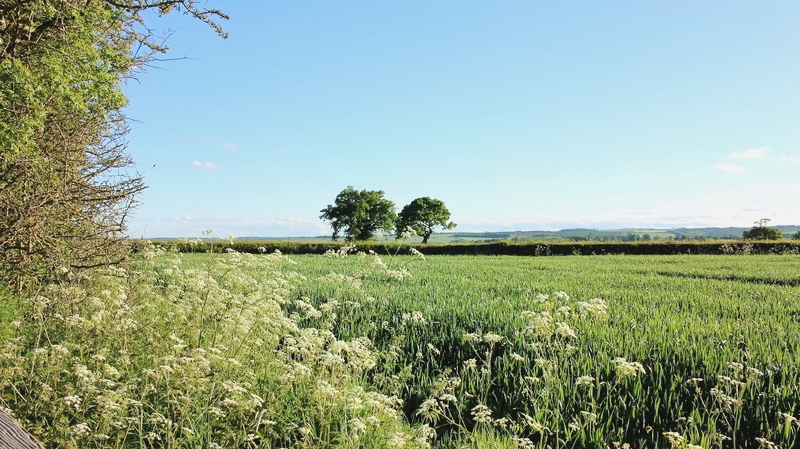
As Sarah and I continued our walk, tall, thick hedges flanked every field. Hover over the English Midlands and you see emerald green pastures embraced by such dark green hedges. There are lots of reasons to cultivate a hedge. Hedges shelter plants and animals from the wind, protect against the neighbors’ animals, and manage social relations. Most hedges today are populated with hawthorn and blackthorn, thorny, quick-set hedges, that laborers rolled out like carpet in the nineteenth century to mark borders of newly enclosed fields. But not all hedges are created equal. Older hedges are recognizable for their far greater range of plants.
“The ancient hedges were a whole pantry,” Sarah exclaimed.
Running through villages and along roads, pre-enclosure hedges made up lateral food forests, planted and maintained for easy pickings: crabapple, cherry, hazelnut, rowan, elder, hundreds of varieties of roses, wild blackberries, ferns, hedge parsley, pennycress, bath asparagus, gorse, medlars, and medicinal plants whose names describe the remedy—goutweed, kidney vetch, bladderseed, and lungwort. Villagers knew how to cut back trees in a hedge so that each year the coppiced stems sprouted many more branches, which they then trimmed for tools and fuel. Many people know the history of deforestation, but far fewer know about the management of forests and groves as renewable and possibly immortal resources.
Landowners seeking cheap labor thought carefully about how to deprive commoners of an independent means of subsistence. Better, they advised, not to build hedges from medlars, a thorny shrub with a fruit picked in winter that tastes of cinnamon and apple. Medlars were unwanted because, as Minister Thomas Rudge said in the late eighteenth century, “the poor are already too prone to depredation and would still be less inclined to work if every hedge furnished the means of support.”
If economic rationality alone served as the driving reason for enclosure, then privatizing wastes, land considered no good for farming, would have made no sense. But these “wastes” gave a poor household so much for free. With gifts from common wastes, one elite observer noted, “They get the desire to live…without labour, or at least with as little as possible.”
How did commoners devise a landscape that produced food, fuel, and shelter with a minimum of labor?
They did not work alone. Commoners drew on a whole network of alliances.
__________________________________
Excerpted from Tiny Gardens Everywhere: The Past, Present, and Future of the Self-Provisioning City by Kate Brown. Copyright © 2026 by Kate Brown. Used with permission of the publisher, W. W. Norton & Company, Inc. All rights reserved.

Kate Brown
Kate Brown is a distinguished professor in the history of science at MIT and author of four previous prize-winning books, including Manual for Survival, a National Book Critics Circle Award finalist. She currently plants her gardens in Cambridge, Massachusetts, and Greensboro, Vermont.