The Shared Responsibility of Public Health
Monica L. Wang on the Collective Action Necessary to Create a Healthier World
Public health, by its nature, is a shared responsibility. It extends far beyond the realm of health care to include housing, education, employment, urban planning, and more. Creating better health for all requires collective action across these sectors—an ecosystem working in concert to create conditions where every community can thrive. It’s not just about treating illness; it’s about building systems that make better health possible for all. This vision calls on each of us to recognize our role in this larger public health ecosystem, where personal and collective responsibility is reflected in policy and initiatives, as well as embodied in the way some communities already support one another.
During my time supporting La Danza Huitzilmeztli, one of a broad category of sacred Indigenous moondance ceremonies, I saw how a community can come together as a seamless, interconnected system, where every individual plays a vital role in contributing to community well-being. Under the open skies, La Danza unfolded as a beautiful, multigenerational collaboration with women at its center. Elders, mothers, and young women played central roles as dancers, supported by firekeepers, childcare providers, and meal preparers who ensured that the women could fully engage in their sacred work.
While the dancers moved gracefully in their rituals late into the night, firekeepers tended the sacred flames, ensuring they burned strong and steady over four days and four nights. Childcare providers cared for the little ones day and night, creating a space for mothers to focus on their roles as dancers. In the kitchen, Abuela Xochi oversaw the preparation of nourishing meals made from scratch, using fresh produce from local farms. Meanwhile, supporters in the kitchen, including me, chopped, diced, cleaned, organized, and kept everything running smoothly to feed the community.
This deeply collaborative approach mirrors the efforts required for strong public health.
In the medicine tent, trained providers offered teas, ointments, and traditional remedies to restore balance and energy to those in need of care. Supporters woke around midnight to accompany dancers as they moved until sunrise, swaying and praying alongside them and sharing in the ceremonial pipe. Every role was essential, valued, and carefully structured. These interdependent efforts created a community where everyone contributed, reinforcing the collective harmony that sustained La Danza. This deeply collaborative approach mirrors the efforts required for strong public health.
Just as the La Danza community recognized the importance of individual contributions to sustain their shared rituals, addressing the root causes of health and disease necessitates a similarly integrated ecosystem. La Danza also reminded me that collective responsibility goes beyond simply completing tasks; it’s also about valuing the relationships and interdependence that support us.
On a broader scale, the Green & Healthy Homes Initiative exemplifies how sectors such as housing, education, employment, urban planning, and health care each play a vital role in creating healthier communities. Public health thrives when every sector acknowledges and respects each other’s role, inviting collaboration to create environments where everyone has a fair opportunity to lead a healthy life.
This approach embodies the upstream vision of addressing social determinants of health—creating the conditions for people to thrive physically, emotionally, socially, and spiritually. Public health often focuses on the “what” of health, the treatments and metrics. But La Danza reminds us to focus on the “how” and “why” of care. How and why we care for people matters as much as what we provide. When health care is integrated with holistic, culturally sensitive, and community-driven approaches, it becomes more than a service—it becomes a lifeline that addresses the full spectrum of human need.
When we look upstream, we see that true change isn’t about isolated efforts or simply scaling interventions proven in controlled environments. It’s about creating an integrated system, much like La Danza itself, where collective responsibility and holistic care are embedded in daily life. This vision calls on leaders across public health, government, education, business, and urban planning to collaborate and commit to building environments where healthy, thriving communities can take root.
In these regions, it is common for individuals to live active and fulfilling lives well into their nineties and even beyond one hundred years.
An ambitious vision, yes, but one that is not without precedent. Consider “Blue Zones”—regions of the world where people consistently live significantly longer and healthier lives. The term was popularized by Dan Buettner and his team, whose research identified five regions with remarkably high concentrations of centenarians: Okinawa, Japan; Ikaria, Greece; Sardinia, Italy; Nicoya, Costa Rica; and Loma Linda, California.
In these regions, it is common for individuals to live active and fulfilling lives well into their nineties and even beyond one hundred years. While genetics undoubtedly play a role, research has shown that the Blue Zones injury, improved diet, and reduced alcohol consumption. These examples demonstrate that engaging and building community, whether within Blue Zones or beyond, are possible and fundamental to building healthier, more resilient populations.
While each of the strategies of policy, environment, and community can be effective on their own, the greatest impact comes from integration. Communities that embrace all three didn’t just improve health and reduce healthcare costs—they redefined what it means to live well. These case studies demonstrate that healthy, thriving communities are achievable when we adopt a holistic, upstream approach to public health. As a growing body of research shows, the path to better health starts with reimagining how we live, work, and connect—together.
So, how do we get everyone on board to make this vision a reality? A critical part of the answer lies in how we communicate about public health, especially to those who may not immediately understand or embrace the research behind social determinants of health. Sharing data and scientific findings alone isn’t enough; it’s the stories we tell that truly connect people on a human level to these broader concepts. The language we use and the narratives we craft in sharing research have the power to shift attitudes, change minds, and drive decisions.
Each of these pursuits becomes possible, reaching its fullest potential, when our health is strong and supported by the broader conditions in which we live.
This is something I was reminded of when I met Melvin Carter, the forty-sixth mayor of St. Paul, Minnesota, during the 2019 Harvard Business School’s Young American Leaders Program. Melvin spoke passionately about transforming his city—not by pushing traditional political levers but by investing in libraries, creating public spaces, and funding job training programs.
A fourth-generation resident, Mayor Carter implemented transformative initiatives: raising the city’s minimum wage to $15 per hour, eliminating library late fines, tripling recreational programming, and expanding support for immigrants. His CollegeBound Saint Paul program ensures that every child born in the city starts life with a $50 college savings account. In addition, Mayor Carter launched a $3 million public safety initiative focused on youth employment, mental health, housing support, and violence prevention. His approach blends restorative justice and social workers alongside police officers, aiming to support those in crisis with compassion and care. He wasn’t focused on quick fixes; he was planting seeds for long-term, meaningful change.
After his talk, I approached him, excited and energized. “It’s so refreshing to hear a politician talk about the social determinants of health!” I said. He looked back at me with genuine surprise and a touch of bemusement. “Now where did you hear me talk about the social determinants of health?” he asked.
In that moment, I realized that leaders like Mayor Carter understood, perhaps intuitively, that investing in communities through policy, environment, and community shapes health at its roots—even if they don’t use the term “social determinants.”
Maybe those of us in public health and academia have been approaching it from too narrow a perspective. We often frame health as the ultimate goal. Yes, health is a vital part of the larger puzzle that makes up a full and meaningful life, but it’s not the only picture that emerges when the pieces come together. Safe affordable housing, quality education, a livable income, stable employment, clean air and water, access to affordable fresh food, and a sense of belonging in a trusted community—these are cornerstone pieces, fitting together to create a complete picture of well-being. When each piece is in place, we don’t just exist; we live, building a life with purpose and connection that is possible because health is the foundational backdrop.
Whatever is front and center in the picture is up to each individual. It can be the families and friendships we build, the careers we embark on, the places we explore, the causes we champion, and the hobbies that give us joy. Each of these pursuits becomes possible, reaching its fullest potential, when our health is strong and supported by the broader conditions in which we live.
Perhaps the mayor’s response was the most upstream message of all: it’s not simply about health—it’s about creating the conditions for all of us to thrive. A vision that is both undeniably bold and possible. And the ripple effects of even small changes start with one person, one action, one commitment to move upstream.
Let’s get to work.
__________________________________
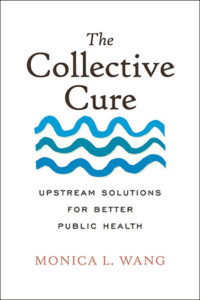
Excerpted from The Collective Cure: Upstream Solutions for Better Public Health by Monica L. Wang (Beacon Press, 2026). Reprinted with permission from Beacon Press.

Monica L. Wang
Dr. Monica L. Wang is an award-winning public health leader, researcher, and author committed to building healthier, more equitable communities. Her work bridges behavioral medicine and public health, combining data-driven research with community partnerships to turn evidence into action. Through innovative studies, storytelling, and education, Dr. Wang translates science into real-world solutions that improve population health and the systems that shape it.