







Here the walls are so thick, she said, gesturing vaguely, it would be impossible to hear sounds from a neighbouring room. We should be thankful for that. And as for these long empty corridors—ahead of us lay the dim stretch where a light continued to flicker and hiss—just think of what could be brought to life if only we had the right instruments, how we would benefit from this tension of space.
It was then that she told me about her collection. One of the greatest collections in the world, she said, of pre-cinema toys and instruments. You know, optical illusions and things like that. Someone once said that the German psyche has a tendency to endow the inanimate with a soul, and in my home that thought was illustrated one hundred times over. Just imagine: shelves and shelves of magic lanterns and peep boxes, long mirrors that returned sideshow reflections, zoetropes and phenakistoscopes, shadow puppets in every corner.
I tried, unsuccessfully, to imagine, my mind still on the comatose birdsong impersonator.
Do you even know what a magic lantern is?
I sensed she’d asked this question many times before. An old-fashioned device came to mind, figures that spun when the thing was given a whirl.
Does it spin?
No, that’s a zoetrope, where you peer through the slits of a spinning cylinder and see images come alive. Or perhaps you’re thinking of a phenakistoscope—discs that when spun also merge a sequence of images to create a sense of motion. Both beautiful forms of early animation. As for the magic lantern, my favourite of all, it casts images onto a wall or screen. If you’ve ever walked down Bloomsbury Way, which I imagine you have, you may have spotted one in the window of the Swedenborg bookshop . . . Once you’ve seen one you won’t forget. I owned dozens of them: tin, wood, porcelain. Half were male in aura, squatting with their long lenses and beckoning confidence, always ready to pontificate, and the other half were female, a demure box into which a slide could be slipped, bringing the room to life. Of all the conjurors of reverie the magic lantern is perhaps the most basic, almost rudimentary. Its optics are no mystery. A box with a set of lenses and a light source. Sometimes the lantern anchors the magic, other times the magic grants the lantern flight, sometimes it is neither magic nor lantern, simply a dormant eye. When we’re both back in London I can tell you more.
The prospect of meeting her again in an entirely different context, in another city, was more than a little thrilling, and I sensed in her too a quiet refusal of the lethargy that tried to impose itself there at the hospital.
I’d like that, I said.
I wish I could show you more than a lantern but there’s little left of my collection. I once had a kingdom. For decades I scoured the flea markets, went to the fairs, engaged in long correspondences with other collectors, even people I didn’t care for, and over the years I found things no one else had even dreamt existed. And I shared it all with my husband Jan, the gentle Dutchman they called him, who sailed rather briskly through my life. You’ll see when you’re older that currents quicken when you’re happy . . . But I’m going on, as usual. Tell me about yourself. Begin with your name.
Flora, I replied, but at that very moment the nurse came to wheel her away, leaving my two syllables suspended in the air.
Who was I? Self-portraits must often be drawn in hospital beds, perhaps more accurately than in the outside world. Mine was hardly noteworthy. Early forties. Phlegmatic, melancholic, yet prone to occasional acts of daring, a flat line interrupted by the sudden jump. If pressed, probably more centripetal than centrifugal in nature. The hermit in me liked to stay home, the little vampire loved to step out. Sometimes they remained locked in battle for hours. Romances: plentiful in number, short in duration. I was drawn to the chilliness of some people and to the warmth of others. People are not composed of your thoughts, a counsellor once said to me. Yes they are, I’d insisted, and had never been able to stop constructing stories in my head, especially at times when reality fell short of expectations. Friends came and went. I preferred animals to most fellow beings and often wished I’d been born another species. The main constant seemed to be my home, three gusty rooms on the top floor of a house belonging to a retired couple and their cats. After a degree in history I’d yearned to do something contemporary and creative—painter, writer, photographer, dancer—and sought part-time jobs while attempting to develop my skills. But nothing came naturally (you have to believe in yourself at least a little, I realised, in order to create), and I was endlessly haunted by a Manuel Manilla engraving of a skeleton seated at a table with all sorts of tools of trade laid out before it: scissors, saw, hammer, trowel, comb, knife, revolver, books, wooden foot, and, teetering over its shoulder as a warning to that boundless community of the adrift, a miniature sarcophagus. Someone had later added the caption: Jack of all trades, master of none.
Just as I was on the verge of handing myself over to full-time poverty and despair I took a metals course at an arts centre and discovered I was very good at something: polishing. Ever since I was a girl I’ve been drawn to shiny things, little magpie my mother would call me, not because I ever nicked other children’s toys but because my eye and hands would gravitate towards whatever sparkled, a sequin scarf or a glittery hair clip, and I always held to the idea that most things had the potential of being enhanced, of being given a small lift out of their matte existence. After hours and hours of practice—friends would lend me their silver and I’d return it, transformed—I became a polisher at a jewellery shop in Soho. Our little shop was the perfect sanctuary after years of disappointment. And not only was I a polisher, but a master polisher, and to be master of anything is something to be proud of.
Furthermore, polishing is not an art to be taken lightly. We add shadow or lustre to an object, remove some of its history or stealthily add a make-believe one, and if Wilhelmina were to ask again who I was I would omit the dead ends and mention only the silver.
__________________________________
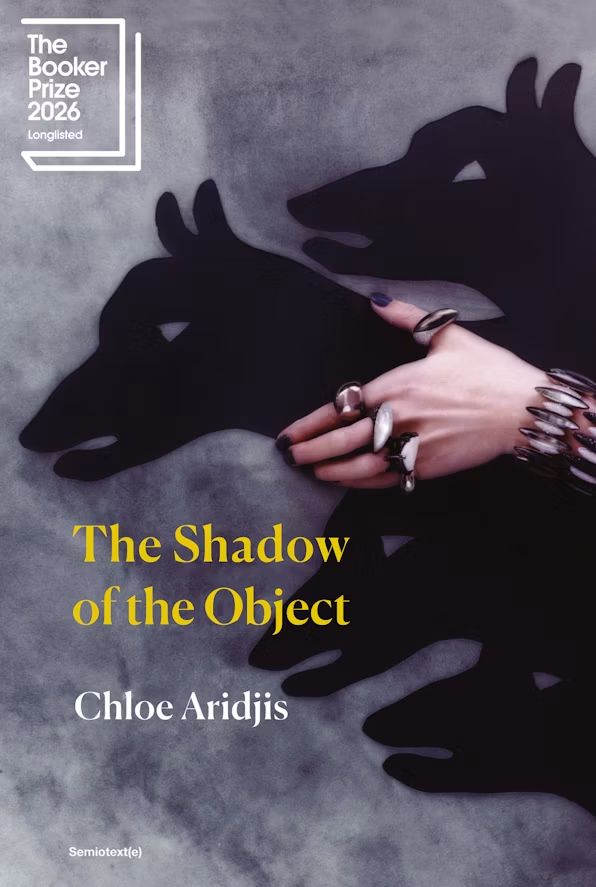
From The Shadow of the Object by Chloe Aridjis. Used with permission of the publisher, Semiotext(e). Copyright © 2026 by Chloe Aridjis.