The Sea Otter and the Abalone: On the Intertwined Fates of California’s Wildlife
Joseph Ogilvy Explores the Impact of Colonization, Trade and Westward Expansion on the Environment
Like the meteorite that killed the dinosaurs, European contact with the Americas was a single, ecologically random, earth-shattering event that completely reshaped land and sea. Disease and violence devastated Native populations, while their concentration into missions changed how survivors lived. The reordering was total. The very grass changed underfoot. As cattle overran the country, native plants were grazed out and European grasses, long adapted to the grinding teeth of livestock, took their place. Salmon runs, suddenly unfished, bloomed to levels never seen before. Carefully set fires no longer swept through the chaparral, bringing new life in their wake.
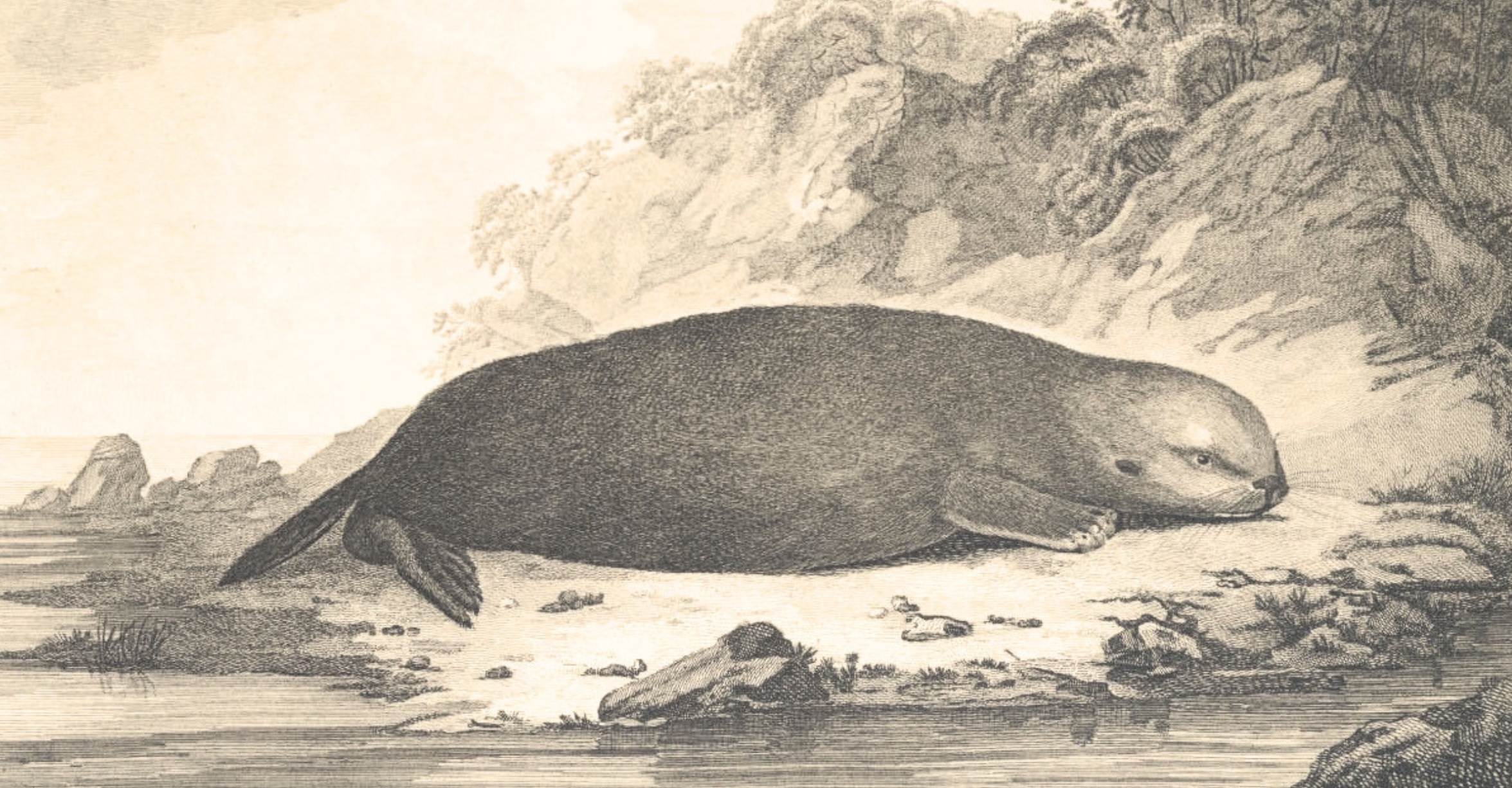
In the kelp forests, abalone were taking over the seafloor, their massed shells paving it over like cobblestones. The shell of a good- sized adult abalone is more or less impregnable to most of the kelp forest’s predators, too strong and too thick for penetration. Indeed, the only real threat to their ruminant existence comes from tool-wielding mammals: sea otters and humans. The fur hunt and the Spanish missions had relieved the abalone of its two main predators in the flicker of an evolutionary eye. With otters almost extinct and the much-reduced Native Californians’ abalone harvest discouraged by the mission fathers, the sea snails began to die of nothing but old age.
In all their millions of years of existence, there has never been a better time or place to be an abalone than California in the mid-nineteenth century, and there likely never will be. It was a golden age of flourishing gastropods. They grew and spawned and spawned and grew until the shoreline was swamped with them, a freak eddy of history engendered by the carnage of the Columbian Exchange the world over.
*
The abalone were thriving in peace, but the otters could not rest easy. Fur hunters could still make a living in the gap between ecological extirpation and commercial extinction. A lot of the actual hunting was done by American fur trappers, either as subcontractors or as newly naturalized Mexican citizens with their own permits. Former beaver hunters crossed into California, saw the ocean, often for the first time in their lives, and almost immediately began killing sea otters.
In all their millions of years of existence, there has never been a better time or place to be an abalone than California in the mid-nineteenth century, and there likely never will be.
The new hunters found themselves in a Mexican territory that was fast becoming a source of basic animal commodities for an industrializing globalized economy. New England whalers boiled down grays and humpbacks. Cattle were run on the old mission lands. Merchant ships headed to Boston shoe factories, and the soapmakers of Lima stacked their holds full of cattle skins and vats of rendered beef grease. The coast was busy and entrepreneurial, integrated into the transoceanic flow of trade and information. There were ships coming from or registered to Hamburg, Honolulu, and Hartford; Canton, Callao, Sitka, Sydney, Sardinia, and San Blas; Boston, Baltimore, and Bengal.
Amid the oceangoing vessels bound for all four corners of the world was a little twenty-ton schooner built in Monterey, the Peor es Nada. In 1835 it sailed to San Nicolas, on the request of the padres in Los Angeles. Its crew of otter hunters were to pick up the last Nicolenos, the handful who had lived through the massacre and survived the two intervening decades, and bring them to the missions. It doesn’t seem anyone asked the islanders what they wanted.
The sea was getting up as the Nicolenos boarded the schooner. Suddenly a young woman ran from the ship, perhaps to fetch a child who had been left behind. The otter hunters were getting twitchy. The Peor es Nada didn’t wait. The Nicolenos were delivered to Los Angeles, where they slipped out of historical sight. According to the schooner’s crew, the islanders were glad of the rescue. It’s a bitter irony; Peor es Nada means “better than nothing.”
The Nicolenos were some of the last Native Californians to come to the missions. The Island Chumash had all been removed from the Northern Channel Islands by the 1820s, when the friars’ power was already in decline. The Nicolenos disembarking the Peor es Nada saw the last gasps of a mission system that was already being dismantled by the Mexican government.
Like so many Californian utopias to follow, the missions had become a tragedy. The Chumash rebelled in 1824, the latest in a chain of Native Californian revolts against the friars. Toward the end of a life spent devoted to the missions, one friar wrote that “it pains and saddens our Christian hearts exceedingly because where we expected a beautiful and flourishing church and some beautiful towns which would be the joy of the sovereign majesties of heaven and earth, we find ourselves with…a people miserable and sick, with rapid depopulation of rancherías which with profound horror fills the cemeteries.” In the padres’ careful records, burials far outstripped baptisms.
With Mexico now independent, the missions’ days were numbered. By the time the Peor es Nada was dispatched to the islands, government commissioners were disposing of their holdings, breaking up mission complexes and scattering neophytes. But there was no way for the natives to return to their old lives. Free-grazing cattle had grazed on many of the traditional plant foods and pushed out the native game. Pigs uprooted the acorns that had been a winter staple in California. Epidemics had also hit those groups that stayed out of the missions, tragically weakening them, as had punitive raids by the soldados. The mission lands, though theoretically earmarked for former neophytes, always seemed to end up in the pockets of Mexican-Spanish Californios. The new rancheros had bought up the mission lands when the government secularized the missions and kicked out the friars. The Native Californians were left with nothing, no land and no more of the missions’ cruel shelter. The few survivors found work herding and skinning the cattle that had overrun their former hunting grounds.
The Peor es Nada ’s next trip was to Santa Rosa Island, where its crew joined up with Allen Light and George Nidever, a pair of American hunters who had acquired licenses to kill otters. Light was a Black sailor from Philadelphia who made the call that life held more for him in Mexico than in the United States. He rounded Cape Horn as an ordinary seaman and around his thirtieth birthday jumped ship in Santa Barbara, clutching his seaman’s protection papers to prove to the U.S. authorities that he wasn’t a fugitive slave. In Santa Barbara, Light joined Nidever’s otter hunting outfit. A German from Tennessee, Nidever was one of the many mountain men who had come west in search of otter and never made it back.
Light and Nidever struck camp in Santa Rosa and took sixty skins, then found themselves in a New Year’s Day gunfight on the northeast shore of Santa Rosa. It was not a new experience for any of them. The interlopers were contrabandistas, Native Pacific Northwesterners brought by American merchants operating out of Hawaii and heading to the Mexican coast to hunt otters without a license. The Mexican government didn’t have the boats to stop this illegal hunt. Instead, it was left to the licensed hunters to enforce their own rights. Nidever and Light killed three contrabandistas and wounded another four or five.
For Nidever, Light and the rest, the rafts were an easy way to make a fast buck. They were happy to turn their rifles to other things. They moonlighted as ranch hands, cattle skinners, and schooner pilots, or moved on to new pastimes like killing sea lions for their “trimmings.” All of Nidever’s schemes were interlaced with otter hunts. The hunters never tied themselves to the mustelids. They were just another way to squeeze a dollar from the Golden State’s natural bounty. If the otters were wiped out, it was no problem. California would provide.
Besides, the British and American merchants had finally found a superior trade good, one that would cement their access to the Chinese market. Like sea otter fur, it was light, portable, dense in value, and lusted after. Even better, there were no supply issues, seemingly no risk of depletion or overkill. Opium was far superior to otter pelts. It literally created its own demand. That it was illegal to sell in China was a minor obstacle that a few artful bribes could easily overcome. After the First Opium War, the British simply forced the Chinese to accept more goods. The unreliable supply of otter skins was destined for the fur markets of London and Leipzig. The best buyers were Russian noblemen, high rollers who used the glossy fur to line the collars of their winter overcoats. They claimed it was the only fur that didn’t ice up with their breath.
*
It’s a long way from the fur-kissed throat of a rakish count in St. Petersburg to the rock pools of the California foreshore, but every otter-skin collar spared dozens or hundreds of abalone from an early death.
Abalone are simple animals: a hard shell, a muscular “foot,” and a selection of vital organs sandwiched in the space between the two. Their shells are tough, shallow, and lightly domed. At first glance, they appear to be a rough oval in shape, but slight corrugations like contour lines hint at the shell’s gentle spiralization, its apex a thumb-like whorl at its back. A series of holes curving away from the front left side of the snail is another tell. The shell’s function is straightforward, protecting the abalone’s soft body from the teeth of predators.
It’s a long way from the fur-kissed throat of a rakish count in St. Petersburg to the rock pools of the California foreshore, but every otter-skin collar spared dozens or hundreds of abalone from an early death.
The foot is the bulk of the abalone, the muscular, toothsome mass of tissue that harvesters coveted. (The guts and other viscera surrounding the foot were trimmed and tossed.) In isolation, an abalone foot doesn’t look like much of anything. Globular and simple, it varies in color from jet-black to tan depending on the species. It has two functions: moving and not moving. What the foot is really good for is gripping things and staying there, vacuum-sealing the ab to a substrate with a force many times its own bodyweight. When it’s time to travel, waves of winking contraction move up the foot from back to front, alternating left and right, almost as if waves flowed through it. It’s fast for a snail, indeed among the fastest of any snail, but a top speed of one meter per minute is not much to write home about.
Adhering to rocks and not getting eaten describes a lot of an abalone’s existence, perhaps the main part, which is why so much of it is shell and foot. But it’s in between these two fundamentals that the excitement lies. An abalone’s organs are simultaneously deeply alien and oddly familiar. Their gonads are wrapped around their guts, just in front of a heart pumping transparent blood that doesn’t clot. At the other end, beside its anus, is its head, made up of a muscular tentacled snout, a tangle of ganglia (a bunch of nerve tissue, a little less than a brain), and stubbily stalked eyes that see only in shaky black and white. Their best sense is chemoreception, sort of like smelling, albeit through a frill of tiny flickering tentacles that extend past a ruff of epipodial tissue between its shell and foot, like a skirt over a petticoat. Inside the snout is a radula, which scientists describe as sort of like a tongue, but also sort of like a chainsaw. It’s tongue-like in shape and location, but it’s also covered with teeth. Those teeth rasp against kelp and algae, an abalone’s favorite foods, and fall off when they wear down, to be replaced by more. Occasionally, when it’s dark, an abalone will relax, unclamp from its rock, and wander the seafloor a little, its almost sightless eyes peering gracelessly in the murk. It might crawl a yard or two, testing the water flow in the rock pools and kelp stands. For the most part, it simply waits for the current to bring the kelp to it.
There are abalone all over the world, anywhere with cool enough water. Most are small, somewhere between a big toe and the palm of one’s hand in size. Except in California. In California they can get as big as Frisbees. There are seven species in the California Current: black, red, white, pink, green, pinto, and flat. The shell doesn’t always help in identifying them. Green abalone shells are brownish; red ones can be white, pink, or gray; white ones can be red; black abalone are midnight blue with a green tint. Some species are named for their shells, some for the color of their epipodial ruff, others for the color of their foot. Regardless of name or coloration, all California abalone, if they’re lucky enough to avoid the predators that threaten small, thin-shelled juveniles, can reach seven inches in diameter, by which time their shell is thick enough to deter octopus, lobster, and the tusked California sheephead fish. The bigger they get, the fewer their enemies, until only humans and sea otters pose a threat. In the first half of the nineteenth century, both were out of the picture.
As the mollusks flourished in their submarine homes, they became, unbeknownst to them, American abalone. Onshore, an expansionist United States under President James K. Polk was butting up against a vulnerable Mexico. Alta California, the area north of San Diego, was an obvious target: lightly defended, far from the center of Mexican power, and home to increasing numbers of Americans like Nidever and Light. When smoldering tensions over Texas flared into the Mexican-American War in 1846, the Bear Flag Revolt was launched. Barely a month after the declaration of the Bear Flag Republic, the U.S. Navy sailed into Monterey and declared the annexation of Alta California. California, and its coasts, were now American.
Eyewitnesses tell of how many abalone there were, that they were impossible to miss. An 1853 story in the Weekly Alta California assumed that “all of our readers who have strolled upon the beach at any place along the California coast must have observed a large and nearly round basin shaped shell, with rough exterior but beautiful, mother of pearl, variously colored lining.” Pictures of the Channel Islands in the 1980s, after an analogous period of protection from human and otter predation, show huge herds of black abalone, shell to shell, covering patches of the tidepool like floor tiling. Another, taken in a particularly choice tidal chasm, shows them clambering over one another, stacked three or four high.
But nothing lasts forever. Their glorious half century was brought to an end in a roundabout way by a thin scale of soft metal about the size of an aspirin, found in a whitewater stream in the foothills of the Sierra Nevada on January 24, 1848.
____________________________
From Tin Can Coast: A History of Industry, Greed, and Fishing in the Golden State by Joseph Ogilvy. Available from Bloomsbury Publishing. Copyright © 2026 by Joseph Ogilvy. All rights reserved.

Joseph Ogilvy
Joseph Oglivy is a writer and chef. After graduating from Oxford University, he spent several years working in restaurants in both London and Texas, while writing on his days off. His experience in kitchens led him to research involving the tangled human and ecological history of food. This is his first book.