The Responsibility of the Critic: On Art, Honesty, and Introspection
Amie Souza Reilly: “A writer must look inward to determine how their own perceptions might project onto their theorizing.”
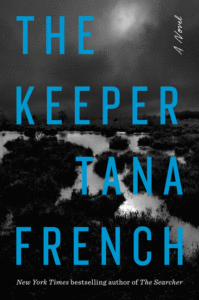
On my birthday, I read an essay wherein the writer expresses disappointment in another writer’s failure to explicitly address the ongoing genocide in Gaza in her book. The book is set in a very specific neighborhood in New England in 2014, and though it does not specifically address the crisis in Palestine, it is largely about all the ways violence is and has historically been tied to colonialism. The essayist also claims that although the book’s author admits to her own role in colonialism and the violence of white supremacy, that kind of admission has been done in books before and was, in her words, myopic. For the essayist, the book was both too little and too much.
The essayist admitted to wanting to write about Gaza herself and had hoped to find permission to do so from this other book, which made her critique feel less like an analysis and more like a broad application of her wishes, as if her essay was written to the work, rather than about it. Typically, I would read a piece like this and be largely unbothered by its watery stance, but this one hit me in the throat.
Because the book she had written about was mine.
I read most of this essay while standing in line for an elevator at the Metropolitan Museum of Art, waiting to go up to the fifth floor, which was about to close to the public for the next half decade. This daytrip was a birthday gift from my husband, Matt. He knows art reminds me of the good parts of humanity, that I like to be surrounded by art and people talking about art. A museum is a community sensory experience. (It is also often a place filled with artifacts obtained by colonial violence.)
We pressed into the elevator with at least twenty other people. At the top, the doors opened into a rush of hot, dry air. I took some pictures of the skyline, barely looking at my screen, too distracted by the essay. Matt and I circled the perimeter of the roof in silence, and then went back inside. We took the stairs down, exited at the hall of Rodins, hooked a left into the wing of Impressionists. The first few rooms were crowded, but further in, away from the Monets and van Goghs, it was a little quieter.
I stood for a long time in front Cezanne’s Mont Sainte-Victoire and the Viaduct of the Arc River Valley. I stood in front of it long enough to become acutely aware of my feet inside my shoes, long enough to become static to the people buzzing around. Someone stepped in front of me to snap a photo, then quickly moved on. A small group gathered behind me, part of a scavenger hunt or a tour, their voices a chorus of facts and interpretations.
When a writer combines the personal with the critical, their commitment to introspection might even be more important than their critique.
When I was very young, I took art lessons. They were held in the back of a framing shop, below a dance studio, and I knew, even then, that my parents did not have the money for extracurriculars, that these lessons were a sacrifice, so they must have really thought I had talent. The artist who taught me was patient, first teaching me to use charcoal, then pastels. She taught me about negative space and perspective, light and shadow. Her students chose what to draw from a cardboard box filled with magazine and calendar pages.
When I was twelve, I studied Monet’s The Artist’s Garden at Vetheuil while wearing a t-shirt screen-printed with The Artist’s Garden at Giverny. Then I copied Cassatt, then Renoir, my chalky dabs searching for softness on paper. I loved those paintings, those painters. Until I went to college, where a guy I liked, a pianist with a shaved head and Oakley sunglasses, laughed at the Monet prints I’d hung in my room. He told me I had no taste. That’s just calendar art, he said.
In another essay published on my birthday, American film critic Richard Brody says “A review by a responsible critic inherently involves introspection, looking into oneself to see whether unnoticed or unquestioned personal factors influence or deform one’s experience of the work at hand.” The comment that college guy made still lives in my head. (The guy, who, very late one night, broke us into the university’s art building and played the piano for me. I swooned for a day, until I met two other young women who’d had the same date.) I thought about his comment while I stood in front of that Cezanne painting. And I am thinking about him now as I continue to try and parse out what the essayist said about my book, as I continue to think about the relationship between personal essay and criticism, and the responsibility a writer has to the art they write about and the audience they write for.
Like the Oakley-wearing guy’s flippant comment about Monet, the essayist’s claims about my book came from of a failure of introspection. The guy hurled opinions about the relationship between popularity and validity, assuming art that is reproduced, commercialized, and capitalized for the wider public is not as valuable or worthy of study as art that is lesser known, or accessible primarily to artists, curators, and art historians. Similarly, the essayist’s claims are projections—she is putting her desires for her own work onto mine.
I am thinking now about bell hooks, who teaches us to “engage in a critical process of theorizing that enables and empowers.” I don’t think writing toward empowerment means a writer has a responsibility to niceness, (see Brandon Taylor on Rachel Kushner or Naomi Kanakia on Garth Greenwell) but hooks’ work does make me think there is an issue of care at stake. Anyone writing to make claims about art, regardless of whether or not they consider themselves a critic, influences the public’s perception of the art they write about, enabling and empowering readers to make their own connections. But before all that can happen, a writer must look inward to determine how their own perceptions might project onto their theorizing. Furthermore, when a writer combines the personal with the critical, their commitment to introspection might even be more important than their critique.
The responsibility of the critic, of the essayist, of any writer writing about art, is not unlike the responsibility of an artist, or a teacher, or a mother.
My childhood art teacher would ask me to stand back from my easel to resee my work before going to wash my hands and pack up my things. I can’t remember exactly what she said, though I can remember clearly her bending over so that she saw my work from my angle. She said something like Is what you’re making an accurate representation of what’s there? She wasn’t asking me if my work matched my model, but rather if what I what I was making was true to what I needed to share. She was not trying to push me toward her way of making art, (realism, often featuring horses and cowboys), she was teaching. A teacher and a critic/writer have, I think, very similar responsibilities.
Cezanne was a Post-Impressionist whose early work is catalogued alongside the Romantics, but whose later work helped bring us toward Cubism. In Mont Sainte-Victoire and the Viaduct of the Arc River Valley, the tops of tall trees are foregrounded. In the lower left corner stands a cluster of thinner trees, sun dappling their light-colored bark. In the center, though, a single tree cuts the canvas nearly in half. Behind that center tree, the land has been cleared (an act of progress or violence?) and squares of green and brown patch their way back toward dappled, lavender mountains.
Many of Cezanne’s works play with perspective, and this halving seems like a larger version of the chopping of the background. Once, in a different art class a long time ago, I painted this painting, using an image from a book as a reference. Now I was seeing it in person for the first time, I see that I completely missed the wall of the farmhouse tucked yellowly into the foreground in my attempted recreation. Unfiltered and up close, my perceptions changed.
As I stood in front of that Cezanne, I realized the essayist was correct. I had not written specifically to state my support for Palestine, or to condemn Israel or the US in its support of Israel. Nor had I (or she, for that matter) written about Sudan, or Ukraine. And I realized what further troubled me was another, smaller, claim later in her essay, where she tosses in a statement about the kind of dining room table I have. She writes, “…this can feel like an attempt to have her cake and eat it at the Shaker dining table in her colonial home.” I do not mention a dining room table in my book at all, and if I had, I would have described the slightly wobbly table we actually have, which my mom found on Facebook Marketplace and is sticky with the remnants of old homework and art projects.
This is a small detail, but her misrepresentation projects onto me a wealth I do not have, and therefore, through her words, I become someone I am not. Some of her earlier statements were factually correct, but she was not honest, not about my table, and not about my book, where my condemnation of imperialist powers enacting violence is there, on nearly every page, via the research and the story I was trying to tell about my neighbors, two white men who threatened, followed, and terrorized my family in an attempt to push out of our home. A home that is, of course, on stolen land.
I might have stood in front of that painting feeling sorry for myself for the rest of the day, but my phone rang. It was our son, so I answered it. His voice sounded far away. He said he felt sick and he needed us to come get him. Immediately, nothing else mattered. I could not leave the museum fast enough. We ran down the steps, maneuvered past vendors and dogs and people, rushing to our son, who had been with his girlfriend and her parents at a restaurant in Midtown. We got there quickly, helped him with his things, thanked his girlfriend and her family as we headed toward the train station, and then, finally, home. After a few days he was better. In every iteration of this essay I have drafted, it is this part that has been hardest to write. It is both the most important part of the day, and, it seemed, the furthest away from the question I was trying to answer.
Should I leave it out, these details of parenthood, of my racing heart? But when I cut it, it felt wrong. For months, I would write it, then delete it. Then put it back. Finally, I left it. And it was this process, this decision, where I finally understood. The responsibility of the critic, of the essayist, of any writer writing about art, is not unlike the responsibility of an artist, or a teacher, or a mother. They are, we are, all responsible to an introspection committed to honesty, because even when honesty doesn’t tuck neatly into our desired narrative, it still must find its way in.

Amie Souza Reilly
Amie Souza Reilly is a visual artist and multigenre writer from Connecticut. Her work has appeared in various journals, including Wigleaf, HAD, The Chestnut Review, The Atticus Review, Catapult, SmokeLong Quarterly, Barren, Pidgeonholes and elsewhere. She holds an MA in English Literature from Fordham University and an MFA from Fairfield University, and is the Writer-in-Residence and Director of Writing Studies at Sacred Heart University.