The Real Cancel Culture: NYU Has Put an End to Live Student Graduation Speeches
“The ruling class knows that if you give the smartest person in the room a microphone they’re probably going to say Free Palestine.”
Though New York University contingent faculty’s ongoing strike is the biggest news of late from campus, the institution’s suspect labor practices aren’t the only recent damning headlines: NYU is also attempting to silence its students.
On March 5, Washington Square News editor Leena Ahmed broke the story that NYU has canceled all live student graduation speakers for all of its upcoming commencement and convocation ceremonies this spring.
Ahmed reported that:
Graduation speakers will no longer give live remarks at school-based ceremonies and must instead record their statements for a video, in compliance with a policy NYU is rolling out this year.
Instead, in what sounds like hostage videos, graduation speakers will be “professionally recorded” beforehand… and the “university will now play a video of selected speakers’ pre-recorded remarks as they sit on stage.”
Seeing “speakers” sit on stage, mute, while a video of themselves is played for their parents will make them seem, I imagine, as if they are presenting a “proof of life” video from their kidnappers before being allowed to get their diplomas or leave the stage.
NYU costs about $75,000 year in tuition alone, with food and housing rounding it out to a cool $100,000 annually. The average student will have forked out the better part of a half-million dollars by the time they finish a bachelor’s degree. And year after year, NYU has routinely been ranked with the dubious distinction of burdening its graduates with more debt than any other university in the United States.
And yet, when students finish their studies (and, increasingly, during their studies), the university wants them to shut up, take their paper diploma, and get the fuck off the stage with nary a one of them saying anything not pre-approved by the powers that be.
Asking students to march into an auditorium, and parents to fly from all over the world to sit and watch a hostage video, is a bizarre (if somewhat predictable and highly disturbing) step in NYU’s years-long assault on student freedom of speech in general—and of student graduation speakers in particular.
And it’s being done to try, in vain, to protect the reputation of Israel.
This is not a baseless accusation on my part, nor something I have learned second-hand through the WSN’s excellent reporting, nor is it simply from keeping up with news from the alma mater where I earned three degrees over 24 years.
It’s something I know first-hand.
A few days before I gave my own convocation address to the 2019 class of NYU’s Graduate School of Arts and Sciences at the Beacon Theater, an NYU administrator came up to me out of the blue and warned me, “Just make sure you don’t say anything about Israel!”
(Of course I did, which caused me no shortage of grief. More on that below, and in my new book.)
NYU’s new fascist, cancel-culture policy—which a spokesperson told a student speaker who complained about it was “final”—does not merely affect the university- or school-wide celebrations; the WSN reports that NYU has “canceled 13 culture, identity and faith-based graduation ceremonies due to the ‘current political climate,’ prompting student leaders to circulate a petition condemning the cancellation.”
“This is not an isolated incident, together with the affinity group celebrations, it is an overall censorship of students. They’ve really turned our graduations into just their own political playgrounds.”
So, Black students, or LGBTQ students, or Hispanic or Jewish or Muslim students who have gotten through four tough years cannot even praise their efforts amongst one another. NYU wants every student thought not only approved, but totally controlled—lest anyone dare to say something about Israel. (Interestingly, NYU confirmed to WSN that “commencement will continue to host live speakers”…it’s only students who cannot be trusted to speak.)
Maddy van der Linden, a senior at NYU’s Steinhardt School, “was selected as her school’s student speaker on Feb. 6,” just four days, the WSN reported, before she was told that the remarks would be pre-recorded. When she complained, she was told “via email that the school must create a ‘respectful experience’ at the ceremony, and that in the past, attendees have ‘left events feeling disappointed or disrespected.’”
“They want us to sit on the stage as our video plays next to us, which I think is so dumb,” van der Linden told WSN. “This is not an isolated incident, together with the affinity group celebrations, it is an overall censorship of students. They’ve really turned our graduations into just their own political playgrounds.”
Last year, NYU Gallatin student Logan Rozos, who is Black and trans, was a student graduation speaker. In a viral video, Rozos bravely said (to great applause):
I’ve been freaking out about this speech, honestly, and as I search my heart today, in addressing you all, my moral and political commitments guide me to say that the only appropriate thing to say in this time, and to a group this large, is a recognition of the atrocities currently happening in Palestine. I want to say that the genocide currently happening is supported politically and militarily by the United States, is paid for by our tax dollars, and has been livestreamed to our phones for the last 18 months. I do not wish to speak only to my own politics today, but to speak for all people of conscience and all people who feel the moral injury of this atrocity. And I want to say that I condemn this genocide and complicity in this genocide.
He looked terrified, but clear and brave—and he was punished severely for his courage.
After asking him to model courage, and to be the container of everyone’s hope—and after so many of Rozos’s peers loudly cheered him on—NYU denied Rozos their diploma. Four years of hard work were taken away from him, for the “sin” of going off script to speak against genocide.
This is a dynamic I am familiar with.
In 2019, I was asked by NYU Graduate School Dean Phillip Brian Harper to give the speech at NYU’s PhD convocation ceremony. (There had been an application process, but I had not applied, and was asked to give the speech without any solicitation on my part.) I accepted.
You’ll have to read The Overseer Class to get the full story, as I have waited a long time to tell the sordid tale in its totality. But for now, I can share this: between the time Dean Harper asked me to give the speech and our convocation, a number of things happened at NYU regarding Israel and Palestine. For instance, when NYU students chose to honor Jewish Voices for Peace and Students for Justice in Palestine with an annual award typically presented by the president, then-president Andrew Hamilton skipped the ceremony and took to the Wall Street Journal opinion page to chastise the choice to honor SJP (a harbinger of what would happen to Jewish Voices for Peace and SJP in the years to come). Also, our student government and graduate student workers union had recently passed endorsements of the BDS movement, and my program, the department of Social and Cultural Analysis, had decided it would not participate in conferences at NYU’s Tel Aviv center, as many scholars would not be able to travel there.
I spent a week terrified that my job at Northwestern University would disappear over my stand on Palestine before it began…
Like Logan Rozos, I had been “freaking out about this speech” in the days before speaking at the convocation. But my anxiety ratcheted up after I had turned in remarks in advance (which did not address the controversies), only for Dean Harper to warn me a few days before my speech, out of the blue, “Just make sure you don’t say anything about Israel!”
Searching my conscience, I knew I couldn’t live with myself if I didn’t address these matters. I also knew many of my fellow graduates expected me to address what was going down on campus in my speech. So I made the decision to turn in a draft of my speech absent any mention of the controversies, and to then add a few sentences on the fly. I did this realizing that if I self-censored it would have ruined my day (over a speech I hadn’t even asked to give) and, ironically, to give Dean Harper plausible deniability.
So when I gave my speech, I went off script twice—once briefly referring to Trump as the fascist in the White House , and once again when I said:
And I am so proud—so proud—of NYU’s chapters of Students for Justice in Palestine and Jewish Voices for Peace, and of GSOC [Graduate Student Organizing Council], and of the NYU Student Senate, and of my colleagues in the Department of Social and Cultural Analysis for supporting the Boycott, Divestment and Sanctions movement against the apartheid state of Israel—because this is what we are called to do! We are connected in radical love! And we have a duty in our privileged position to head into the world together looking out not for the most popular of us, but for the most vulnerable amongst us! On every campus where we serve and in every place we work! And we must work together to vanquish racism and Islamophobia and antisemitism and injustice and attacks on women’s rights in Shanghai and Abu Dhabi and Tel Aviv and New York and throughout the United States of America! Because there is no time for anything less! Amirite?!
As they did for Rozos, my fellow NYU Violets cheered loudly in support.
And as with Rozos, I was denounced loudly by NYU (and even by a longtime mentor), though I was not punished as severely as he was. I spent a week terrified that my job at Northwestern University would disappear over my stand on Palestine before it began, but it did not (that wouldn’t happen for five more years). I also spent the summer terrified NYU wouldn’t send me my diploma. (Unlike Rozos, my diploma eventually arrived.)
NYU’s violent repression of free-speech, which has included several large-scale police assaults on faculty and students, is not limited to its convocations.
During the 2024 Gaza Solidarity Encampments, NYU called the NYPD at least twice to clear Gould Plaza—NYU’s only real outdoor space it controls—which resulted in the violent arrests of dozens of students and faculty. Gould Plaza has since been closed to the public altogether and NYU students have not been allowed to congregate there. (The last time I checked, NYU had walled off the plaza and posted construction plans to turn it into a tightly controlled space.)
NYU had also severely punished Ryna Workman, a Black law school student, who spoke out against the genocide in 2023. Workman was effectively removed from their post as NYU Student Law Association president, and later told me they’d been named “persona non grata” and barred from campus.
NYU is an example of how the American university has transformed into one of the more fascist institutional spaces in the United States. NYU doesn’t want students to learn or speak; NYU wants meat puppets who will unquestioningly reproduce the social order. Students are not supposed to learn about the world in its College of Arts and Sciences, or to learn how to express themselves at its Tisch School of the Arts. Students are not supposed to engage in any “unapproved” protests, or veer off script; they are not even to be trusted to speak at their own graduation ceremonies, lest they say something true from the heart, something they probably learned from their studies about the American war machine.
NYU expects students to be obedient, servile, docile stenographers who accept the world around them just as it is (while forking over $75,000+ a year).
There is no education without trust. What NYU is doing to students is trying to control them, which is the antithesis of education. As an educator myself, I do not want to control my students; I want to empower them with learning in ways which will liberate them to fly (and it delights me when they fly in ways I never could myself nor even have dreamed of). One of my favorite things to do in the classroom, back when I was allowed to teach regularly, was to begin each class playing a song as students settled in. Then, I would hand a dry erase marker to a student and have them go to the board to lead a brief discussion of their peers about what the song meant to them, while I stood at the back of the room. (And I learned so much from them!)
Education requires the risk of passing off the marker to your students—not making a hostage video of them to humiliate and mute them and to make sure they don’t fly in a way you can’t control.
*
As I explore in The Overseer Class, NYU’s assault on speech also feels directed explicitly towards Black LGBTQ scholars (a dynamic I have observed at many universities). Rozos, Workman and I are all Black; and Rozos is trans, Workman uses they/them pronouns, and I am gay. NYU wanted to tout our representation, but not actually hear what we had to say.
Then again, the assault could be an example of what librarian and writer Leila Walker observed: “The ruling class seems very aware that if you give the smartest person in the room a microphone, they’re probably going to say Free Palestine.”
I hope students like Maddy van der Linden, who was deceived into applying to give a speech only to experience a bait-and-switch offer to appear in a hostage video, refuse to participate.
But what happens if students do allow their hostage videos to be displayed and sit under them, only to jump up and say “Free Palestine?”
What if they pull a Palestinian flag from their robes and wave it?
What will NYU do, then?
Ban robes?
Make students walk across the graduation stage naked, to ensure no one is hiding a keffiyeh or a flag?
Cancel graduation altogether, like USC did in 2024, to stop the mere possibility of anyone discussing Palestine?
Hell, by this logic, universities should ban all classes and all lectures and all research—because classes and lectures and research might result in someone, somewhere, criticizing the US or Israel.
When I floated this idea to a professor friend, he said, “They already did.”
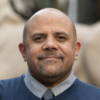
Steven W. Thrasher
Steven W. Thrasher, PhD, CPT, a journalist, social epidemiologist, and cultural critic, holds the Daniel Renberg chair at the Medill School of Journalism, and is on the faculty of Northwestern University’s Institute of Sexual and Gender Minority Health and Wellbeing. A former writer for the Village Voice, Scientific American and the Guardian, Thrasher is the author of the critically acclaimed book The Viral Underclass: The Human Toll When Inequality and Disease Collide. [Photo by C.S. Muncy]