The Radical Write: How a Medieval Catholic Mystic Inspired My Debut Novel
Janet Rich Edwards on Marguerite Porete and the Power of Unconventional Faith
The problem, the burr, that got me started writing Canticle was Marguerite Porete. I couldn’t figure out my attitude toward her. Unless you’re a medievalist steeped in the literature of the 13th century, you won’t have much of an opinion about Marguerite, either. She’s not one of the celebrity mystics, no Julian of Norwich or Hildegard von Bingen. I loved them, but Marguerite got under my skin.
Since I’m not Catholic, my fascination with medieval mystics might require some explanation. I’m the child of an atheist and a lapsed Episcopalian. Growing up, I attended the rare Unitarian service that my grandmother insisted upon when we visited Schenectady; a callow agnostic, I was unmoved by the dry services in the round and the bad guitar music. It was only later, in my twenties, a Peace Corps Volunteer trying desperately to fulfill my job title as ‘nutritionist’ during an African famine, when the children at our clinic started dying, that the bottom fell out of my birthright skepticism. I experienced despair for the first time.
I found myself without foundation, with no way and no words to make sense of what was happening. It was as if the universe (or maybe God) was calling my bluff. Suddenly, the Unitarians were looking good. I was forced to admit that I needed something–some grounding courage–that religion might offer.
In their joy and courage, in their insistence on faith even as they defied the Church, the beguines were inspiring. They showed me what I was missing.
Of course, I was going to choose a religion. By reading. I started with Huston Smith’s survey, The Religions of Man, which I studied by lantern deep into the night. I was moved that the great traditions seemed to point toward what felt like an essential underlying truth, as if one faith held the trunk, the other held the tail, of the elephant that no one could quite describe. But there was so much cultural overlay, a warp in every lens; how to pick the religion closest to the truth? Plus, there was the issue of the corrupt institutions, their abysmal track record of wars, self-righteousness, hypocrisy. It was hard to square the message with the messengers.
Then I read about the medieval women who claimed to have direct ‘showings’ of God. Over four centuries, roughly 1100 to 1500, a run of mystics wrote of their intimate conversations with the divine. In the midst of plague, war, drought, flood and a Church hell-bent on power and punishment, these women spoke of love. Nothing but love.
Those unfiltered mystics got me through the famine. I held tight to the notion that there was something bigger, something beautiful. After two years, I returned home to a landscape I hardly recognized. The first time I went to buy groceries, I froze in the cereal aisle. The rows and rows of garish boxes, the casual presentation of so much food, like a toy store. I fled, abandoning my cart. I couldn’t put it all together. My sense of bigger and better and beyond was not this. Confused again, I returned to read about the mystics. And there, in a footnote, I found the troublesome woman who spurred me to write.
At the close of the 13th century, Marguerite Porete penned an odd and profound manuscript in French, The Mirror of Simple Souls. In it, the personified characters of Love and Reason debate for the loyalty of the Soul. Reason represents religious orthodoxy, the medieval Church-with-a-capital-C. Love, on the other hand, speaks passionately about the soul’s potential for complete union with God, if only it can empty itself of vanity and self-will.
In The Mirror, Love vanquishes Reason. Love crushes Reason. And Love cost Marguerite her life. In 1310, she was burned at the stake for her book. She could have recanted before the Parisian inquisitors who interrogated her for eighteen months, spurred on by a bishop with an ax to grind. Marguerite understood she was a pawn in a political machine. Day after day, she stood silent, never uttering a word in her defense. They charged her with heresy. When the authorities laid her book at her feet and lit the pyre, it is said that witnesses in the Place de Grève wept at her courage.
But Marguerite must have secreted a copy of her book with a friend, because, against all odds, The Mirror survived. One copy, then two, then many were passed hand to hand. For centuries, the manuscript was attributed to a man, until its true author was revealed in 1946. So poor Marguerite had the distinction of being both executed and erased. I hope that, from the corner of heaven reserved for bold misfits, Marguerite sees that The Mirror of Simple Souls is widely available today, in three formats.
So here was my problem: I couldn’t understand why Marguerite didn’t save herself. The list of things I would die for is a very tight and unheroic circle that includes my children, maybe my husband, but probably not my country and certainly not any religion. I didn’t know that I held a belief strong enough to stake my life on. I was left puzzling: Was Marguerite unfathomably brave? Or was she–though it feels disrespectful to say, though I am deeply moved by her book–actually mad? Frankly, the woman scared me.
I read deeper and learned that Marguerite Porete was a beguine. In the Middle Ages, a woman had two choices: marriage or the convent. Faced with these meager options, women began to form their own communities. At first, beguinages were scattered households of women. Later, ‘court beguinages’ held hundreds, even thousands, of residents. By the close of the 13th century, there were almost a million beguines in Europe.
Beguines committed to live in simplicity, chastity, and charity, as long as they remained in the beguinage. They were free to leave at any time. Their pledges to each other have the ring of religious vows, with one big difference: beguines didn’t vow obedience. They refused the rule of the Church. I loved them immediately. Here was the religious resistance.
As you can imagine, the Church was very nervous about these ungoverned women. They read, they wrote, they taught, and some of them even preached on street corners, which was forbidden to women. It’s suggested that a few dabbled in illegal translations of scripture from the Latin to local vernacular, a practice frowned upon (to put it mildly) by the Pope.
Marguerite, the extremist, led me to acknowledge my own unfashionable, self-defined faith and my fellowship with people who have trouble with the church, but find something sacred in words.
These were medieval women forging their own way, taking risks, creating nonconformist communities. It made sense that Marguerite, with her impolitic and forthright Mirror, was a beguine. They were known for their mystical leanings and for dancing in church. Beguines existed on the edge of papal approval until, in 1311, the year after Marguerite died, Pope Clement V declared them heretics. And yet, like The Mirror of Simple Souls, they survived. The last beguine, Marcella Pattyn, died in 2013. She played the banjo for the sick.
In their joy and courage, in their insistence on faith even as they defied the Church, the beguines were inspiring. They showed me what I was missing. Community. I wasn’t yet ready to join one, but maybe I could write one.
A cast of characters began to form. Between the challenge of Marguerite and the comfort of Marcella, the beguines of Canticle stepped forward and raised their hands. At first, I thought my protagonist Aleys, a headstrong young woman prone to visions, was the hero. Aleys was my Marguerite. She joins the beguinage reluctantly, convinced that the other women are less committed to God than she is. But by the end of the tale, Aleys recognizes heroes–saints–in everyone around her.
As Aleys learned from the beguines, so did I. The wisdom of the magistra, the determined ferocity of the silent bellringer, even the exuberance of the flirt who fetches the small beer—all of it, I grew to see, was necessary to the quiet rebellion. Marguerite may have died for The Mirror of Simple Souls, but her pages would never have existed, much less survived, but for the women who sheltered the author as she wrote and later copied her radical words onto parchment by rushlight. In writing Canticle I discovered a world of courageous women who would teach you the alphabet or slip you an illegal text from a covered basket or defend the truth unto death. Women who fought to read and write. I am not as brave as all of them, but I might be as brave as some of them. Marguerite, the extremist, led me to acknowledge my own unfashionable, self-defined faith and my fellowship with people who have trouble with the church, but find something sacred in words.
If you visit Place de Grève in Paris, now Place de l’Hôtel de Ville, you will find a café with a striped red and white awning that bears the name Café Marguerite. I owe that woman a debt. Please raise a glass to Marguerite Porete, for all of us.
__________________________________
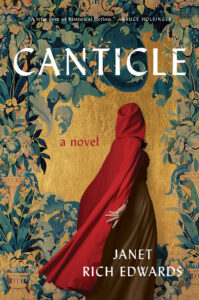
Canticle by Janet Rich Edwards is available from Spiegel & Grau.

Janet Rich Edwards
Janet Rich Edwards is a professor of epidemiology at Harvard University and works in the Division of Women’s Health at Brigham and Women’s Hospital. A graduate of GrubStreet’s Novel Incubator program, she lives in Brookline, Massachusetts.