The Profound Link (and Love) Between Humans and Dogs
Fatima Bhutto on Wolves, Dogs, and Writing About Love During Tragedies
If the covenant between humans and dogs is forty thousand years old, why does it feel trivial to me to speak of those bonds? Their beginnings are tied with wolves, with whom they share their social drive, animal instincts, physiognomy, anatomy, and 99.96 percent of their DNA.
As human beings we had contact with wolves long before we did much else. We interacted with them before we farmed, before we tilled land, before we became the industrious and organized creatures that we now are. It’s suspected that wolves began to circle us as we produced food waste—they not only hunt but also scavenge, and all that delicious food would have eased their fear of us enough for them to come and pick through our garbage.
And it was like this that an “accidental natural selection of wolves who are less fearful of humans would have begun.” The theory is that these more friendly, less skittish wolves were more scavengers than hunters and were the smaller and less alpha of their packs.
Using DNA analysis, scientists now know that dogs descended “almost entirely” from the Eurasian gray wolf, or Canis lupus. Where they were domesticated is open to debate, as it happened so early in human history—before we domesticated any other animal, before cattle or sheep or pigs—that there is little available evidence. It was, experts wager, likely across Asia, perhaps the Middle East, and possibly in Europe. Why we domesticated gray wolves over foxes or jackals or other canids is probably down to luck: they just happened to be at the right place at the right time.
Archaeological evidence of dog skeletons curled up next to human remains in ancient grave sites stands as further proof that we domesticated dogs before any other animals—even cats.
Over the years, humans began to adopt those smaller, doglike wolves and live with them as pets. Maybe they took them in as pups, and before they knew it, they were breeding these wolves, and so began the first part of domestication. It’s said that the next part of this process would have been more deliberate: our ancestors got rid of or abandoned or destroyed the animals they didn’t want living among them. The animals they kept, however, lost their more feral qualities, their more wolfish characteristics, and gave up hunting, pack living, and a strict observance of hierarchy.
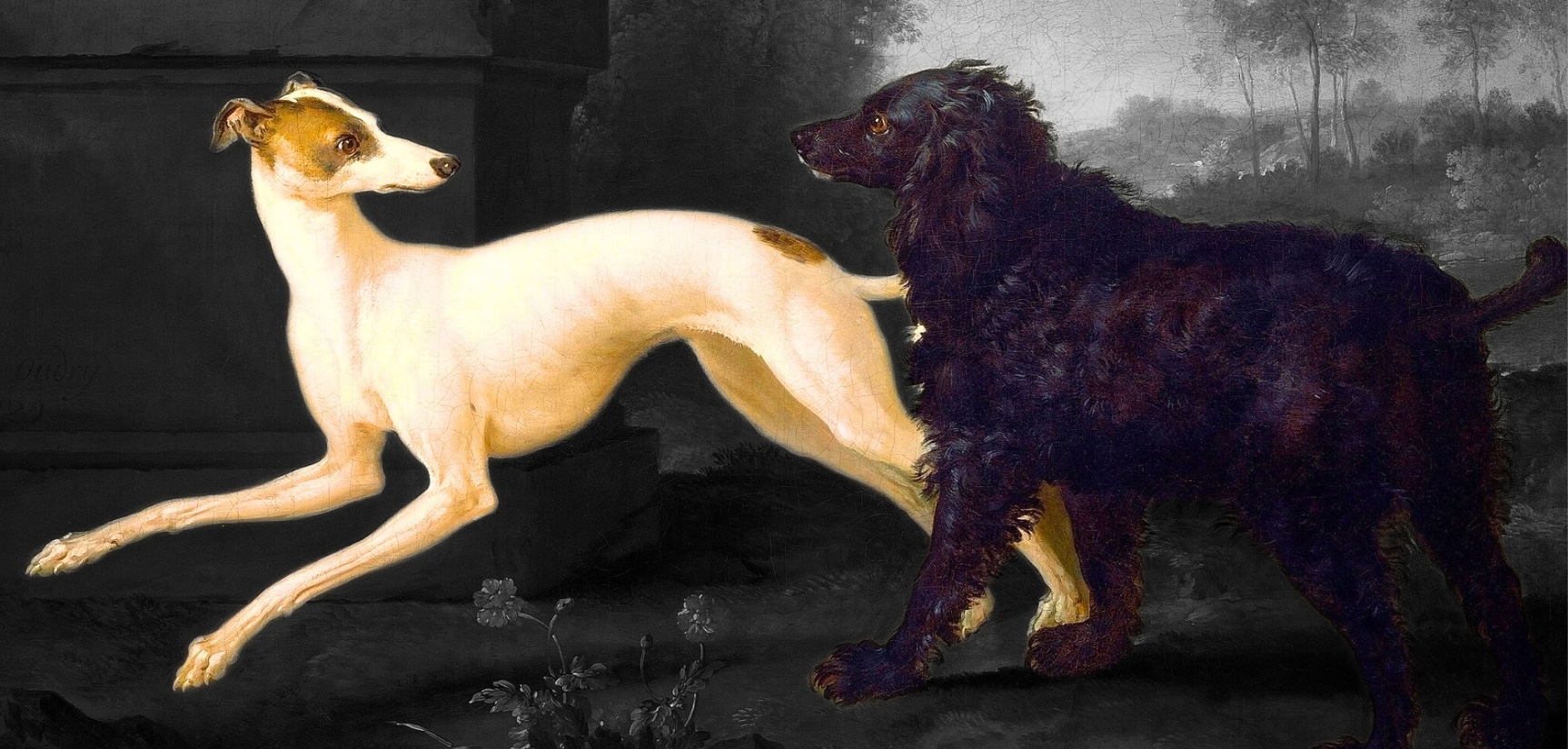
While dogs and wolves are genetically almost indistinguishable, the biologist John Bradshaw has studied how vastly different their behavior is. Dogs are not pack animals in the way wolves are. When they do form packs, they are messy and less coherent than wolf packs, and they tend to prefer forming relationships with us over other dogs, although still friendly to them. Wolf packs go out of their way to avoid meeting not only people but wolves from other packs, too. When they happen to encounter each other, they “almost always fight, sometimes to the death.” Additionally, puppies are able to form dual identities at the very start of their lives—part human, part dog—in a way that wolf cubs are simply incapable of doing.
Dogs kept some of their hierarchical instincts, replacing alpha wolves with their human masters. It was their ability to move between packs—leaving the pack they were born into to create their own pack once they had matured and found mates—that made them so perceptive and attentive to us.
“The openness of these early wolf dogs,” Alexandra Horowitz, a student of dogs, writes, “allowed them to adjust to a new pack, one that would include animals of an entirely different species.” She notes that dogs that are exposed to other animals—whether cats or wolves or horses or us— in their first few months of life form not just attachments but strong preferences for those species over any other. That bond is powerful enough to override their predatory or fear drives.
And they loved us as much as we loved them, pretty much from the start. And boy did we love them. There’s evidence of puppies being nursed alongside human babies in Polynesia, Melanesia, and the Americas. Aboriginals in Australia have a long history of taking dingo puppies from the wild to keep as companions purely based on their cuteness—we know this because the dingoes didn’t help their masters in any particular way.
On the contrary, they were kind of a nuisance—they stole food, made loads of noise, mated with other dingoes all the time, and besides, Aboriginal hunters found that they brought back more meat when they left their dingo pets at home than when they brought them along. Archaeological evidence of dog skeletons curled up next to human remains in ancient grave sites stands as further proof that we domesticated dogs before any other animals—even cats.
But dogs have evolved to look into our eyes for all sorts of cues: how we are feeling, what’s going on, where the food is.
The first known dog burial dates back fourteen thousand years—the partial skeleton of a dog was found interred alongside two humans in Bonn-Oberkassel, Germany. After which, dogs and humans being buried together became commonplace. Some other animals were laid to rest beside their humans along the way, but nothing close to how frequently we entombed our dogs with us.
We passed on so much of what is considered uniquely human to them too. Unlike wolves, who are exceedingly capable of independent problem solving, a dog will try to get its ball from under the couch for about a minute before it surrenders and comes to us for help. We gave them our desire for eye contact with intimates. Wolves take eye contact as threatening and avoid it because it signals a battle for authority.
But dogs have evolved to look into our eyes for all sorts of cues: how we are feeling, what’s going on, where the food is. Horowitz says this might even be “one of the first steps in the domestication of dogs: we chose those that looked at us.”
In a world of excess and power and all their rot, what besides love forces us to be pure?
In 2022, Japanese researchers found that dogs produced tears when reuniting with their humans. It was eye contact that made us want to care for dogs, for when they looked at us and we looked back into their eyes, we released oxytocin, also known as the “bonding” or “love” hormone.
Language acquisition was long considered to be the exclusive domain of humans, but recent studies have shown that dogs can remember the names of their old toys even if they haven’t seen them for years. We know dogs know what words mean—how else would they sit and fetch and wag their tails when we tell them we’re going to the park?—but a recent study found that dogs not only know the meanings of nouns, they know we are mistaken if we hold up a ball and call it a Frisbee. There is so much we share between us that scientists note dogs are attuned to human gestures so intimately, they catch cues from us that even chimpanzees, our closest living relatives, miss.
In a world of excess and power and all their rot, what besides love forces us to be pure? I feel numb for the first few weeks of lockdown, as though a formless nothingness has stretched over all my hours and days, but some things bring me immediately to tears. Shaheed Aitzaz Hassan Bangash, a fifteen-year-old Pakistani schoolboy, stopped a suicide bomber from entering his school, where the bomber would have killed two thousand students.
When he saw the bomber, Aitzaz ran to him and embraced him, pushing him away from the school. Aitzaz was in the ninth grade when he gave his life to save others. I call this young man Shaheed, which means “martyr.” I call him a martyr because he gave his life so others could live. I recite the names of our brave and defiant every day, like a rosary.
Another young man, Mashal Khan, a university student and poet, was lynched by a mob of fellow students who accused him of blasphemy. In Pakistan, there is no death sentence more inescapable—to describe an alleged act of blasphemy is to blaspheme, so accusers need not furnish their assertions with detail or proof. Just the accusation is enough.
Though I know it’s not the case, it feels like every day of this interminable year comes with a portent of horror.
Mashal was tall and stocky, with a gentle, pensive face. In the photos that newspapers printed after his murder, he is often hunched over, a long shawl draped across his broad shoulders, looking far into the distance. Days after his son was buried, his father spoke to the Pakistani press. Mashal was beaten by his peers from ten in the morning till three in the afternoon. He called his son a humanist.
I carry these boys’ names with me, keeping them close. On the anniversaries of their deaths, when I see their pictures, I mourn.
I check my Twitter routinely in the middle of the night and look at Instagram until I know an embarrassing amount about utter strangers. I start to post about animal cruelty, about what seem like daily failures of compassion. I follow a few shelters in Pakistan and am deluged with heart-stopping videos and pictures of the dark things people do to animals. Torture, abuse, abandonment; too many pictures, too much pain.
Glory to the hands that labor, the Puerto Rican poet and anti-imperialist activist Juan Antonio Corretjer wrote in his famous poem “Oubao Moin.” I am haunted by the thought of Indian migrant workers on death marches from cities to rural homes, where they will go into lockdown and their families will starve; the Pakistani farmers who are forced to throw entire harvests away because of government price gouging; and American prison populations laid waste to by the virus.
Though I know it’s not the case, it feels like every day of this interminable year comes with a portent of horror. In January, in the new year that still feels very much like the old, gunmen enter a coal mine near the town of Mach, Balochistan, and identify ten ethnic Hazaras. Hazaras originally hail from central Afghanistan, though over time they have migrated from the mountains down into Pakistan and Iran.
The voices reprimand me. Why are you sitting in the middle of nowhere—in gardens and forests with dogs—and writing about animals and a gaslighter only a fool would have believed?
Besides being ethnically and linguistically unique, Hazaras are Shias and so have been marginalized and persecuted by Sunni-led groups like the Taliban in Afghanistan and right-wing fundamentalists in Pakistan. They are very distinct looking, beautiful, with Asiatic features and light eyes. You can spot them in a crowd, just like the gunmen did. They marched the men out of the mine, took them to a mountaintop, and killed them.
After their murders, their families sat in the bitter cold and grieved, waiting for the prime minister, Imran Khan, to come and mourn with them. But the prime minister was too busy meeting YouTubers and Turkish television producers. He wouldn’t come.
The mourners defied Islamic convention and, in protest, refused to bury their dead, holding fast to the bodies of their loved ones, waiting. Still, the prime minister refused. He stated that he would not be “blackmailed.”
“What kind of times are these,” Brecht asked in a poem written just before the start of World War II, “when to talk about trees is almost a crime because it implies silence about so many horrors?” The voices reprimand me. Why are you sitting in the middle of nowhere—in gardens and forests with dogs—and writing about animals and a gaslighter only a fool would have believed? Explain yourself. Be true.
Did I tell you all the above so you will think I’m serious too?
__________________________________
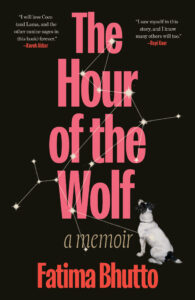
Excerpted from The Hour of the Wolf: A Memoir by Fatima Bhutto. Copyright © 2026. Reprinted by permission of Scribner, an Imprint of Simon & Schuster, LLC

Fatima Bhutto
Fatima Bhutto was born in Kabul, Afghanistan and grew up between Syria and Pakistan. She is the author of five previous books of fiction and nonfiction. Her debut novel, The Shadow of the Crescent Moon, was long listed for the Bailey's Women's Prize for Fiction and the memoir about her father’s life and assassination, Songs of Blood and Sword, was published to acclaim. Her novel The Runaways is available from Verso.