The Power of Narrative: How Stories Help Us Process Our Most Difficult Realities
Jiyoung Han on the Power of Fiction to Bring Historical Atrocities to Life
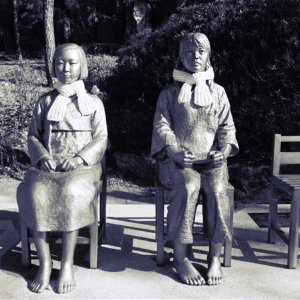
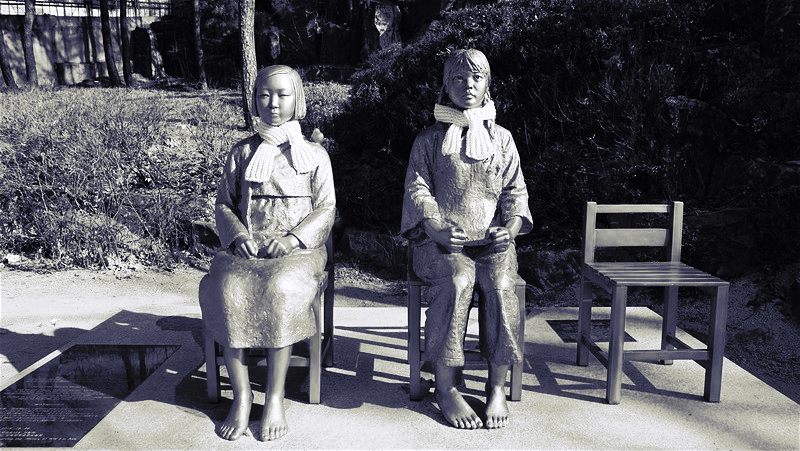
In the summer of 2023, I chanced on a headline that made my ears ring: only nine comfort women survivors remained in Korea. “Comfort women” refers to the hundreds of thousands of girls and women across Asia forced into sexual slavery by the Japanese military in the 1930s and 1940s. And in my birth country, they were down to nine. Nine is a number I can count on my fingers. Nine grandmothers, all in their nineties, staring down death without justice as a far-right Japanese government denies their history. That nine gripped me with urgency to get more people to call for truth and remembrance. But with no platform or influence, I turned to fiction.
Countless times novels have taught me history I didn’t learn in school. Salman Rushdie’s Midnight’s Children taught me about Indian independence from British rule. Yaa Gyasi’s Homegoing taught me about the Ashanti Uprising and the bloody legacies of the Gold Coast. Their example made me think about storytelling as an apt means to inform and understand. Although my primary goal was to shed light on the brutalities of Japanese imperialism, I knew I wouldn’t get far if it wasn’t done through an engaging narrative with emotionally resonant characters to root for.
So I started writing what I would gravitate to as a reader: the underexplored perspectives of everyday women, the metaphor-amplifying currents of magical realism, with dashes of folklore. From this emerged my debut novel, Honey in the Wound. Its story is my bid to amplify the voices of comfort women and bear witness to the Korean people who resisted colonial rule.
Fiction shows that our stories matter when history doesn’t believe we do.
By centering the experience of individual characters, narrative storytelling captures what historical records and textbooks cannot. Even as fiction, the structure of a narrative can render the real-life vulnerabilities—the fears and traumas, yes, but also the desires and joys—of fully fleshed-out people. It gives textual depth to their lived experience as individuals rather than as statistics, taking what is abstract in the aggregate and making it viscerally concrete. Many have used numbers and moral philosophy to fathom the vileness of slavery in America, for example.
But when Toni Morrison describes a tormented mother giving her beloved infant the release of death over the hell of enslavement—“drag[ging] the teeth of that saw under the little chin…squeez[ing] her so she could absorb, still, the death spasms that shot through that adored body”—we are shaken by the weight of our understanding. There is something universally illuminating in this intimate specificity.
Morrison has expressed disappointment at certain accounts of slavery, bemoaning the tendency to center the institution rather than the people it affected. For the Nobel laureate, focusing on characters’ interior lives put “authority back into the hands of the slaves, rather than the slaveholder.” In the Oscar-nominated docudrama The Voice of Hind Rajab, Director Kaouther Ben Hania never shows Israeli soldiers. She instead orbits the Palestine Red Crescent Society workers coordinating to rescue a girl trapped with the corpses of her family in a gunshot-riddled car. To keep the five-year-old calm, the aid workers ask about her siblings, where she goes to school. Young Hind pleads “come quickly” as military fire rattles overhead, adding that her school is called A Happy Childhood. By zooming in on the real-time distress of the Palestinians trying to save one child, the film patently demonstrates the costs of stymied aid to Gaza and the violence institutions can enact through bureaucracies. The narrative is undeniably powerful.
It’s no wonder then, that narrative storytelling is co-opted for power. But for every Trump who fearmongers with tales of violent immigrants, there are a million people who refute him with their accounts of resilience and community. Stories abound in every survivor of the Rwandan genocide, every Hmong refugee who fled the Laotian Civil War, every Iranian trying to protect their families from American missiles. Historical narratives are constructed to serve the most powerful, but even the most modest person-to-person storytelling can be a meaningful form of witness and resistance. We all yearn to say, “this happened to me,” to someone who’ll reply, “I hear you and I understand.”
Sometimes it’s enough to be understood by even one other. But if our story resonates with many, we can threaten those who seek narrative control. Before becoming the first Asian woman to win the Nobel Prize for Literature, Han Kang was blacklisted by the conservative South Korean government in 2014 for criticizing the bloody military suppression of student protests in her hometown of Gwangju. Bong Joon-Ho, the Oscar-winning director of Parasite, was also once barred from receiving government funding for his left-leaning films. LGBTQ-targeted book bans in the US, Chinese media censorship, and Nazi book burnings all stem from recognizing the galvanizing power of a good story.
Of course, not everyone gets to or even wants to tell their stories. They may believe their story is not worth telling, or that it’s too difficult to say aloud. So we, their loved ones, may help them turn to others who can speak on what they cannot. Someone else’s story might give them a safe distance from which to engage what they’ve buried. They can root for a character who confronts ordeals that would paralyze them in reality. They can glimpse the catharsis of another’s triumph they may never taste. And in seeing the stories of others who persist, they might one day find the courage to speak up, or at the very least, feel less alone. To commune with others in this way is why I write—why so many of us write. Honey in the Wound exists to acknowledge the fortitude of women who had to bear so much in silence for so long.
When history fails us, it’s up to us to tell our stories, to bear witness to the stories of others.
Whether it’s validation of a feeling or reassurance that something we experienced truly happened, acknowledgement is a core human desire and a necessary step to healing after trauma. Acknowledgment can also feel like the bare minimum, but the fight for it grows increasingly urgent when the American President is knocking down public memorials of slavery like tin ducks in a carnival shooting game. Too many governments bury inconvenient truths: Turkey regularly destroys evidence of the Armenian genocide, Japan denies the extent of its war crimes in twentieth century Asia.
Sometimes the culprit is public education: a 2018 survey made headlines for finding that two-thirds of American millennials could not identify what Auschwitz is. The battle against historical erasure can be fought in courtrooms and classrooms, but it’s also fought in our fiction. Colson Whitehead wanted more people to know about fatal and non-consensual medical experimentation performed on black men when he wrote the Tuskegee syphilis experiments into The Underground Railroad. Thanks to Min Jin Lee’s Pachinko, millions more people now know about the types of discrimination Zainichi Koreans face in Japan. Fiction shows that our stories matter when history doesn’t believe we do.
Pachinko opens with the line “History has failed us, but no matter.” When history fails us, it’s up to us to tell our stories, to bear witness to the stories of others. My grandmother isn’t in any textbooks, but her life brims with historical significance. She was once forced to speak only Japanese under colonial rule in Korea. She lived through the destruction of both World War II and the Korean War, raising four boys as a blighted South Korea transformed from one of the world’s poorest countries into the economic and cultural powerhouse of today.
In the United States, we live among neighbors, co-workers, and friends who can recall a time when they weren’t allowed to vote or marry their partners, when they fled unthinkable violence and rebuilt their lives in a new land. Most will never make it into a history book. But they are more than the politics that have violated them, and their stories are everywhere we look. It is our responsibility to take heed lest they be forgotten.
As of April 2026, only five surviving comfort women remain in Korea: four fewer than when I first typed the opening lines to my novel. It is now my deepest hope that Honey in the Wound serves as another record of these courageous women and invites new audiences to listen. For while their stories live on, history may not be doomed to repeat them.
__________________________________
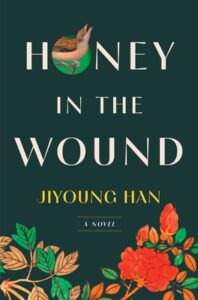
Honey in the Wound by Jiyoung Han is available from Avid Reader Press, an imprint of Simon & Schuster.
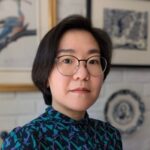
Jiyoung Han
Jiyoung Han was born in Seoul, Korea, and grew up in the American Midwest. She has lived and worked in four continents but now calls San Francisco home. When not writing, she conducts research in climate change and human decision-making. Honey in the Wound is her debut novel.