The Poetics of Repetition: In Praise of the Art of Replication
Lisa Low: “Poetry reminds me that repetition is evidence of life, and a way to see life differently.”
There are two kinds of writers—I learned implicitly in graduate school—the kind who repeats themselves over and over, in form, subject, or even beginnings or endings, and the kind who, miraculously to me, does not. I’ve heard the theory that poets write the same poem repeatedly over the course of their lives, which consoled me at the time yet didn’t seem to work in real life. I’d go to workshop, tired of my same-topic, same-form poem as last week, stuck in couplets or writing about my mom. Once, I brought in what I thought was a totally new poem to discuss with my professor, and he read it as a revision of an old poem. Trying to do something new but thought of as something old? This was a revelation I didn’t like.
Repetition has a bad rap in a “culture that privileges novelty and growth over the cyclical and regenerative” (Jenny Odell, How to Do Nothing), often signifying stuckness or a lack of originality—of not being your own person. In and beyond poems, I worried about life repeating itself. Negative associations of repetition first showed up in my writing as the fear of becoming my mother.
In many poems I wrote during my MFA program, my mom was the sad Asian mom archetype, a saintly figure who endures hardship only to have her daughter amplify these same hardships in writing. My mom’s silliness, her humanness, her imperfections seemed to disappear in the process of repeatedly writing about her struggles.
Repetitive acts of many kinds—writing, being—are a way to care for myself, and that repetition can offer insight over time.
The fear of repetition followed me as I started writing more intentionally about race. Audience expectations around canon events in the Asian diaspora—touchstones like being mistaken for the other Asian person in the room, the “where are you from from?” conversation, the smelly lunchbox—confused me because I wanted to write about these experiences that shaped me, but I also didn’t want to reinforce tired clichés. Art imitated life, because the reason why I was in this quandary in the first place was the real-life experience of being flattened into the masses, conflated with someone else, or just another Asian woman married to a white man—an interracial pairing that has become a stereotype.
In The Melancholy of Race, Anne Anlin Cheng writes about the problem of “the move from grief to grievance,” where racial minorities typically follow a trajectory of experiencing racial grief then expressing grievance about these experiences. I felt seen, but not in a good way, about this life path: “If the move from grief to grievance, for example, aims to provide previously denied agency, then it stands as a double-edged solution, since to play the plaintiff is to cultivate, for many critics, a cult of victimization. So the gesture of granting agency through grievance confers agency on the one hand and rescinds it on the other.” I saw this pattern happening in my writing, and I wanted an alternate fate.
At some point during the process of writing my poetry collection, Replica, I learned about the ars poetica, a poem about writing. Like the tv show Fleabag, which I’d watched recently, the speaker of an ars poetica looks directly at the audience. The moment is private, usually involving vulnerability of some kind, sometimes a confession. We learn backstory, intent, perspective. In Fleabag, the brief—wordless—look into the camera reveals conflicting emotions. This vulnerability isn’t always soft and can have a jarring effect; the speaker/character is often candid or blunt. The ars poetica gave me the ability to circle the same topic in new ways. When I started writing about the problem of writing about stereotypical experiences, I became interested in seeing the writing process from outside the poem, thinking of repetition as retelling rather than duplication.
Like repetition itself, replicas can seem static, but are interesting because of how human they are, how they live on the edge between life and art.
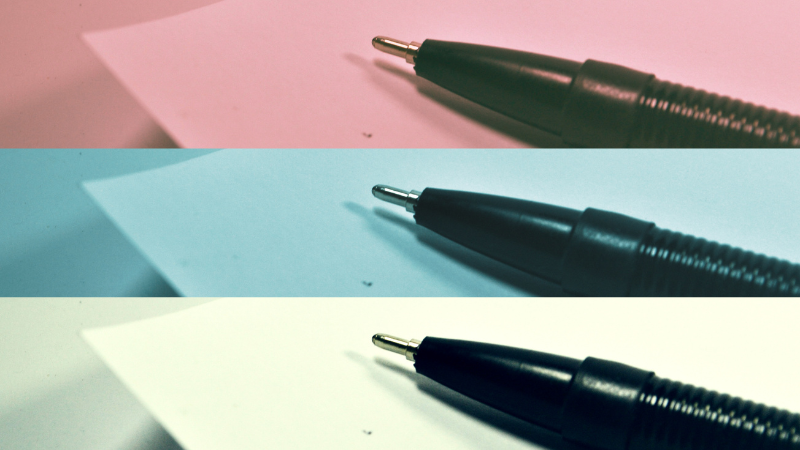
Rewriting about my obsessions through the ars poetica also reminded me that poetry is itself an art of repetition. The most traditional poetic forms are repetitive, with strict rhyme schemes and meter, but newer interpretations are also built around repetition, relying on slant rhymes, refrains, alliteration, and more. In Replica, my crown of sonnets “Crown for the Girl Inside” is unmetered and unrhyming, but it repeats the last line of the previous sonnet as the first line of the next like in a typical sonnet crown—spiraling inward as the speaker contends with a traumatic experience she does and doesn’t want to write about.
This framing reflects the iterative process of writing about grief, especially in today’s context of exposure due to social media. And in the freest of free verse poems, recurring images and motifs operate like punchlines in stand-up comedy, echoing earlier jokes in a routine. A good callback—in stand-up, at a party, in a poem—isn’t possible without repetition.
Like any art form, poetry is also cultivated through maintenance: the repetitive tasks of writing, editing, and revising. Post-graduate school and after having a baby a few years ago, I continue to struggle with the self-pressures of productivity and creating new work. But the most consoling advice I’ve heard is that writing life has seasons and cycles. It’s important to show up, yes, but it’s also fine not to show up for a long time. I know I’m not alone in sometimes believing I’ll never write another poem (or book) again. The writing process is connected to real-world rhythms, and I remind myself that despite feeling boring or unfruitful, repetitive acts of many kinds—writing, being—are a way to care for myself, and that repetition can offer insight over time.
My book title is a nod to the characters we make of ourselves: the idea that I turned my younger self into a consumable object in my writing, and the complexities that come with writing about vulnerable experiences. Not just related to the writing process, replicas and their cousins (mirror images, lookalikes, doubles/multiples) appear throughout the book across generations, and between friends and strangers. Like repetition itself, replicas can seem static, but are interesting because of how human they are, how they live on the edge between life and art. We already know that poetry can defy logic, making things alive that aren’t—a metaphor, a handful of words strung together on a line. Repetition can still sometimes seem like a bad thing, but poetry reminds me that repetition is evidence of life, and a way to see life differently.
__________________________________
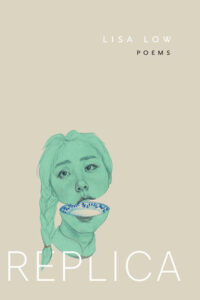
Replica by Lisa Low is available from University of Wisconsin Press.

Lisa Low
Lisa Low is the author of Crown for the Girl Inside, winner of the Vinyl 45 Chapbook Contest from YesYes Books. She is the recipient of a Pushcart Prize and a Gulf Coast Nonfiction Prize, and her poems have appeared in Copper Nickel, Ecotone, The Massachusetts Review, Poetry, The Southern Review, and elsewhere. She lives in Chicago.