The Pain of (Not) Paying: Debt as a Monetary and a Health Burden
Khameer Kidia Explores the Impact of Financial Pressure on Mental and Physical Wellbeing
The pain came out of nowhere, Sheila explained, sitting upright in the hospital bed surrounded by IV poles and bleeping monitors. She grimaced as she placed her fist over her chest, telling us that it ached across her breastbone.
“Ever had this pain before?” asked the intern.
It was one of my first clinical experiences in medical school, and I was rather alarmed by the responsibility of patient care.
“Never,” Sheila replied.
Sheila flinched as we placed the twelve sticky electrocardiogram (EKG) electrodes across her chest. “Do I really need this?” she asked. Sheila was in the hospital for a planned colonoscopy; she had no heart disease to speak of.
“We need to take a picture of your heart to make sure everything’s okay,” the intern said. The machine printed out a set of wavy black lines on pink graph paper. The intern took one look at it and handed it to me. “What do you think?”
The paper shook in my hands as I held it up to the light. I had only ever read EKGs in my cardiology seminars, but in front of me there was a woman who might be having a heart attack, and the intern was asking me to make a call.
“I, uh…” I scanned the document for the telltale tombstones that indicate a bad heart attack. “Um…I don’t see any ST elevations.”
Sheila was suffering because she had too much debt, and I was suffering because I couldn’t access debt.
“Correct,” said the intern.
I exhaled.
“We’re not out of the woods yet,” he said. “Let’s get tropes and repeat the EKG.” He logged in to the computer and ordered another EKG and a set of cardiac enzymes to be drawn by the phlebotomist. “I’ll be back soon to check on your EKG,” he told Sheila.
*
A year earlier, while I was at Oxford, I still hadn’t found the money for the fees for medical school at Mount Sinai, which, upon accepting me, reminded me that I was on the hook financially. Because I was an international student, I had no access to student loans. This is pretty common; many U.S. medical schools don’t even consider international applicants, and if they do, they often require the full four-year tuition (around $250,000) up front as proof to the U.S. government that you’re not going to use a student visa to slip into the country. Immigrants, poor people, and people of color are deemed untrustworthy when it comes to debt.
A study drawing from mortgage data between 2018 and 2019 from Los Angeles County showed that “Latino and Black applicants were less likely to be approved for a conventional loan and more likely to be approved for a high-cost loan or denied a mortgage.” Despite degrees from Princeton and Oxford, I could not be trusted to pay back what I owed, no matter how educated I was or what my future earnings might be. I couldn’t access debt purely based on citizenship; I was risky because I was Zimbabwean.
My parents, who had lost all their savings during hyperinflation and never had $250,000 to begin with, offered to sell their house. But I couldn’t bear the thought of forcing them out of their own home. So, I spent much of my free time in grad school strategizing about how to raise the funds. One of my friends offered to marry me so that I’d qualify for a green card and then a loan, but that felt risky. Instead, I spent hours on TigerNet, the Princeton alumni database. I tracked down wealthy alumni and sent them personalized emails explaining my predicament.
Eventually, someone reported me to the Alumni Association for abusing my access to the database, and the administrators threatened to revoke my privileges. So, I changed strategy and met with the parents of my rich friends to explain the problem. I’m not sure what I was expecting. Perhaps an introduction to a philanthropist? Maybe one of them would lend me the money? Or co-sign a loan? But charity usually serves a political purpose for rich people; they don’t just give money away.
As I kept looking for funding, scouring the internet for scholarships and meeting with anyone who might be able to help, my dreams of fulfilling my mother’s dreams were vanishing. I was thinking too much.
And then my mother called from the waiting room in Dr. Cowper’s office in Harare. “Dad’s gone.”
*
I wrote my father’s eulogy on the plane from Heathrow to Harare. I wondered what came next. Medical school seemed out of the question now. After three gin and tonics and an Ambien, I fell into a slumber. I dreamed of a new life in Zimbabwe, away from the alluring prestige of medicine or academia. A life with my family and community. Full of hope.
When the plane landed in Harare, I switched out my SIM card and turned on my phone. At the top of my inbox was a message from the dean at Mount Sinai. I had been given a $100,000 scholarship. I cried, but I wasn’t sure if my tears were from grief or relief.
The scholarship wasn’t enough, but it was a sign. My mother borrowed money from a friend, sold some stuff around the house, and gave me just enough for my first year at Mount Sinai. My mother and I were equally worried about finding more than $100,000 for the remaining three years. I wanted to go to medical school, and she wanted nothing more than to be able to send me. I would be fulfilling her dream. “We just have to get you there,” she said.
*
While we were seeing another patient, the intern got a page from Sheila’s nurse. “STAT: Pt. Missing.”
“I came in to do her EKG and she was gone,” said the nurse over the phone.
I joined hospital security looking for Sheila. I was always going the extra mile on my rotations. If I wanted to stay in medical school, I needed to prove that I was a good medical student.
Eventually, we found Sheila. She was sitting at a table in the atrium. She had changed out of her hospital johnny and into everyday clothes.
“I can’t get another EKG,” Sheila said, when the intern asked why she’d left her room. “The last EKG I got ruined my life.”
It turns out that Sheila was in medical debt. A few years before, she had breathing problems and visited an emergency department where doctors ordered a string of tests, including an EKG. She received a bill for several thousand dollars in the mail.
Sheila was unable to pay the bill, so she ignored it. When patients can’t pay their bills, hospitals set debt collection agencies on them like dogs on a thief. I’ve had patients walk into clinic in tears holding bills for thousands of dollars for services that are cost neutral. These patients spend sleepless nights worrying about the debt they incurred because a physician ordered a random test “just in case.” While patients ruminate in guilt and fear, corporations profit. It’s a different type of hardship from what patients in Zimbabwe like Chipo experience, but it’s hardship nonetheless. “In 2020 alone,” writes the physician-historian Luke Messac, “medical debt collection brought in $1.5 billion in revenue for America’s 7,000 debt collection agencies.”
With interest, Sheila owed nearly $50,000 to debt collectors. She was at her wit’s end working three jobs and caring for two children as a single mother in New York City. Her medical chart said that she was on an antidepressant and a benzodiazepine. People with unpaid loans are far more likely to suffer from depression and suicidal ideation. In a study of more than 7,000 people in England, those in debt were three times as likely to have a common mental disorder. Another study of 27,651 adults in the United States showed that people with depression and anxiety were much more likely (two to three times) to have medical debt, which doubled their chances of delaying or forgoing mental health treatment.
Sheila was suffering because she had too much debt, and I was suffering because I couldn’t access debt. Is debt good or bad? Depends on who you are.
Often marginalized people can access debt, just not the good kind. People of color are more likely to have “unsecured” debt—student loans, medical debt, credit card bills, or payday loans, which are short-term, high-interest, predatory loans that target vulnerable groups. A typical two-week payday loan that can’t be paid back right away gets renewed and can have an APR of 400 percent, meaning that an initial loan of $300 can ultimately cost the borrower $800. A Boston study of 286 people showed that payday loans were associated with inflammation, high blood pressure, and anxiety.
If you are a wealthy (white) American, you can access “secured” debt—the kind with low interest and favorable terms—only if you already have a significant asset (like a house) as collateral. It’s bizarre to think of this type of borrowing, which helps rich people hoard more wealth, as anything like the debt faced by marginalized communities.
*
Thankfully, Sheila’s EKG and cardiac enzymes were normal and the chest pain went away. It turns out that she didn’t need to worry about those individual costs; we were going to bill her the same amount for the hospital encounter no matter how many tests we ordered. But that didn’t clear the debt Sheila already owed. The debt that ate away at her mind and made her distrustful of doctors and health-care institutions. The debt that was squeezing her for everything she was worth. The debt that props some people up and keeps others down.
When I think of the harmful psychological effects of debt, I always come back to farmer suicide in India, where my ancestors were peasant farmers generations ago. From June to September 2008, in a small “suicide district” in Maharashtra, a farmer died by suicide every eight hours. Almost 400,000 farmers took their lives in India between 1995 and 2018. “The cotton price has fallen to Rs. 1,990 a quintal,” wrote a farmer in his suicide note. “We cannot manage with that. Which is why I am giving up my life.”
The Indian government responded by describing the farmer suicide crisis solely as a mental health crisis. It increased the distribution of antidepressants in rural areas and banned pesticides that farmers were swallowing to kill themselves. But these peasant farmers kill themselves because of debt, not depression.
To understand how debt, not depression, is the true diagnosis, we need to expand the history. During the green revolution of the 1970s, the global market was flooded with expensive, genetically modified seed from private companies such as Monsanto, a subsidiary of Bayer, the German pharmaceutical company. Farmers are forced into buying this seed for their crops to meet international harvest standards of cash crops like cotton, coffee, and tobacco for the export market. To afford this seed, farmers take out short-term, high-interest loans from lenders within their own communities.
This debt makes them economically precarious and susceptible to climate shocks and crop failure. On top of this, in the 1980s and 1990s, when the IMF and the World Bank issued structural adjustment loans to countries throughout the Global South, the Indian government was forced to cut subsidies to these farmers, making it even harder for them to pay their debts. When their crop fails and they can’t pay back their debt, farmers swallow pesticides they have been forced to purchase to protect their precious crops.
The farmers’ mental well-being is affected not just by the economic stress of debt but also by the disintegration of social ties that usually help them to cope. Because farmers had to borrow from family, friends, kin, and clan members, debt transformed the social relations that had previously protected their mental well-being. If, for example, a farmer can’t pay back his father-in-law, he risks losing an important source of social support for him and his family. “I am the son of a farmer,” begins another suicide note. “My father has turned me out of my home because my crops have failed—I have three children—friends I live in Rajasthan’s Dausa Zilla Bodli village—please tell me how to return home—Hail the soldier, Hail the farmer.”
The debt that was squeezing her for everything she was worth. The debt that props some people up and keeps others down.
Although more farmers have died by suicide in India than in any other country, the farmer suicide crisis is a global phenomenon. In the United States, between 2003 and 2017, 1,652 farmers died by suicide. An Australian study reported that a farmer dies by suicide every ten days. While researchers have implicated several factors that drive these farmers to take their lives, farm sector debt, which in the United States rose by 4.4 percent to $542 billion in 2024, is a leading concern.
In my experience as a clinician, immigrant, and mental health researcher trying to understand how poverty affects people’s mental wellbeing all over the world, I keep coming back to the diagnosis of debt. But debt isn’t “real”; it’s a construct that serves people in power and destroys the minds and lives of the marginalized. People should not be losing their minds or taking their lives because of global capitalism. “There’s no better way to justify relations founded on violence, to make such relations seem moral,” writes the anthropologist David Graeber, “than by reframing them in the language of debt—above all, because it immediately makes it seem that it’s the victim who’s doing something wrong.”
*
I was glad that we weren’t going to be compounding Sheila’s medical debt. But for me personally, the combined stress of financing and doing medical education was still too much. I was on edge and felt the stress tightening my neck into painful knots that would form chains of tension along my spine and between my shoulder blades. I was having daily headaches. I wasn’t sleeping. Eventually, a psychiatrist prescribed me Klonopin, which helped me sleep at night but didn’t fix my financial problem. I had exhausted all avenues for trying to find a co-signature on a loan, and even with my scholarship I couldn’t afford to come back for the second year of medical school. I planned to drop out of med school and return to Zimbabwe, where I was already directing a mental health nonprofit. I had found a grant that would fund my salary: I could support my family by making mental health research my full-time job. I was ready but disappointed. Caring for patients—the ability to intervene—is what was missing from my work as a researcher.
And then another email from the dean calling me into his office. He’d found a donor. I would receive a full scholarship.
“His name is John Stossel, the Fox News TV presenter,” the dean said about my donor. “He wants to meet you.” Turns out, Stossel was a Princeton alum and a donor to Princeton in Africa.
“Great,” I said. “I can’t wait.”
__________________________________
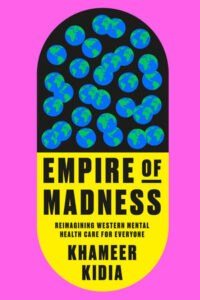
From the book Empire of Madness: Reimagining Western Mental Health Care for Everyone by Khameer Kidia. Copyright © 2026 by Khameer Kidia. Published in the United States by Crown, an imprint of the Crown Publishing Group, a division of Penguin Random House LLC.

Khameer Kidia
Khameer Kidia is a writer, physician, and anthropologist at Harvard Medical School and University of Zimbabwe. A Rhodes Scholar and 2023 New America Fellow, Kidia has worked on global mental health research, practice, and advocacy for the last decade. His writing has been published in New England Journal of Medicine, Lancet Psychiatry, The New York Times, Slate, Yale Review, and Los Angeles Review of Books. Born in Zimbabwe, Kidia lives between Harare and Washington, D.C.