The Origins of One of the Most Beloved Video Games of All Time
Keza MacDonald on How Super Mario Bros. Married Creativity and Playability
I wonder if Shigeru Miyamoto had any inkling that his early doodles of a mustachioed guy in a cap and overalls would become one of the most recognizable characters in the world. At the time Donkey Kong was released, the rules of video games were still being written; even the idea of a character jumping was new, as artists and programmers were just starting to feel out the possibilities of this nascent technological art form. From 1985 onward, after serving as Donkey Kong’s antagonist, Mario would help to define it. From the forty-year evolution of Nintendo’s most famous character, the one that has become synonymous with its name and with video games as a whole, we can learn a lot about the development culture and creative philosophy that has powered the whole company—and how it has changed alongside him.
Nintendo’s budding mascot had a couple of important life milestones between Donkey Kong in 1981 and Super Mario Bros. in 1985: first, another change of name, from Mr. Video to Jumpman to Mario; and second, a change of profession, from carpenter to plumber. The name was inspired by Nintendo of America’s warehouse landlord, Mario Segale. NOA’s president, Minoru Arakawa, claimed that Segale once turned up in person to loudly demand late rent.
The story spread back to Japan, where Shigeru Miyamoto decided that Mario was a fine name for his little Italian character. His career-swap came about as a result of 1983’s arcade game Mario Bros., developed by Miyamoto in partnership with Gunpei Yokoi, a subterranean action game that I’ve always found vaguely menacing. Horrible cartoon turtles, flies, and crabs emerge from green pipes in a sewer-like vertical maze, working their way down the screen until you bop them from below and kick them away. Like Space Invaders, the unpleasant creatures speed up as time goes on, creating a sense of urgency (or, for me, panic).
Even when you fail and Mario tumbles into the abyss at the bottom of the screen after a flubbed button-press, you always feel like you can make it next time.
In Donkey Kong, Jumpman was a carpenter with a hammer. But now, what with all the pipes, in the endearingly literal narrative logic of early video games, it made sense for Mario to be a plumber. “There were several reasons why we used pipes,” Miyamoto told me in a 2020 interview. “They were perfect for the mechanic in Mario Bros., where enemies disappearing at the bottom of the screen would appear again from the top after a short time; they had this comic book feel about them where they’d bulge and have something come out of them; and then there was the fact that I would always see them on my way to work.” (On his route to the office, Miyamoto would walk through a residential area that had some construction work going on, revealing drainage pipes sticking out of the walls.)
Mario’s unorthodox plumbing uniform of overalls and a red cap has a more functional explanation. In the minuscule eight-by-eight-pixel palette afforded him in the early 1980s, Miyamoto wanted to find a way to draw a character more appealing than the stickmen and blobs that early games typically used as the player’s avatar (characters surely devised by a programmer, not an artist, as Miyamoto asserted—just a little dismissively—in a 2009 conversation with Satoru Iwata). The mustache saved him from using pixels up on drawing a mouth, the cap meant that he didn’t have to draw hair, and the contrasting colors of his clothes delineated Mario’s arms, face, and body so that your eyes could parse his running animation.
As the title suggests, Mario Bros. also introduced Mario’s brother, Luigi, who at the time looked exactly like Mario apart from his green coloring. Pleasingly, ruiji means “similar” in Japanese, though whether Miyamoto noticed this enjoyable pun before or after the character had already been named in America is a detail lost to time. Mario Bros. was a hit in the arcades and on early game consoles, particularly in America, and it’s been rereleased as a hidden treasure in plenty of Nintendo games since, from Super Mario Bros. 3 all the way through to Animal Crossing on the GameCube. But when you play it today, although you can see the coins, pipes, and wide-eyed turtles that are still part of Mario’s iconography, you can’t feel the magic that has made him an enduring pop-cultural icon. For that, we must look to 1985’s Super Mario Bros.
*
Together with codesigner Takashi Tezuka, with whom he had worked on a 1984 Famicom maze game called Devil World, Miyamoto envisioned a chunky, cartoonish character moving through levels inspired by land, sea, and air, with scenery scrolling past. Given that most games at this time were still played on static one-screen levels, this was an ambitious idea. They sketched out level designs and characters on graph paper, and when they ran out of space to make annotations, they’d staple a page of tracing paper over the top and keep writing. These sheets of paper were then handed over to programmers who inputted the numerical values to make the pencil drawings come alive on-screen.
Those programmers would occasionally get furious with them, Tezuka recalls, because any experimental changes they made on paper created a huge amount of work in the code: Upon handing over some freshly annotated sheet, Tezuka and Miyamoto would sometimes be firmly told that they weren’t about to change it again. Toshihiko Nakago, a programmer on The Legend of Zelda, Donkey Kong, and Mario Bros., remembers Miyamoto presenting him with a sheet of paper showing five worlds for Super Mario Bros.; after getting Nakago to agree to that, Miyamoto revealed another three worlds on a folded-over part of the same page.
They had to test out their levels themselves, as they went. Tezuka remembers playing his own courses over and over, considering altering them any time he failed a jump. “I don’t have that many memories of playing it after it came out, but I do still have memories of playing it endlessly during its development,” he told me in a 2023 interview, a little ruefully.
The development team’s ambition paid off. Super Mario Bros. is an enduring classic, and its first level, 1-1, is such a perfect example of intuitive game design that it is still dissected and taught in game-design courses at universities. Fifteen seconds after you press Start, you’ve learned everything you need to know about how to play.
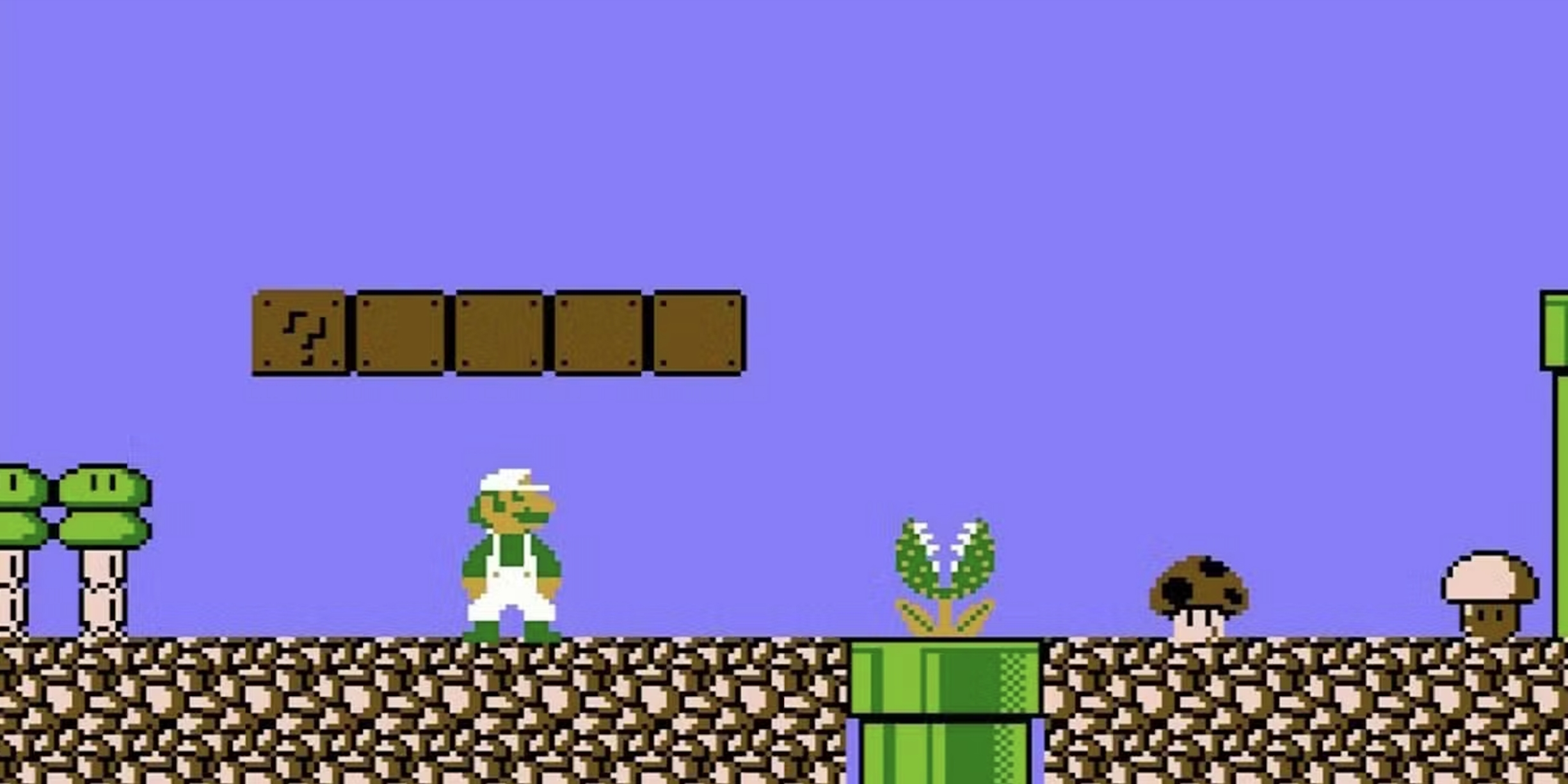
That first level drops squat little Mario into a cartoon world of blue cloud-studded sky and brown-and-yellow brick. Ahead of you, a mysterious arrangement of floating ? Blocks glints enticingly. A frowning mushroom is walking toward you; press a button, and you’ll either jump over it or land on its head, and now you know how to avoid or conquer the enemies you’ll see throughout the game. Run to the right, and the screen scrolls with you. Jump up underneath one of those ? Blocks, and a coin emerges with a satisfying chime when Mario’s fist collides with the brick. Try it again on the next block, and this time a suspicious-looking mushroom rises from within and chases you, a symbol for transformation that the designers hoped would be globally recognizable. It’s impossible to get away, but when Mario touches the mushroom he doubles in size, and now you know how power-ups work. Also, most important, you’re probably smiling.
It is exquisitely elegant, and it gets you to learn through playing: a Nintendo hallmark ever since. Play 2010’s Super Mario Galaxy 2, 2013’s Super Mario 3D World, or 2023’s Super Mario Wonder, all of which shower the player with hilarious and delightful ideas like color- flipping platforms or shimmering orbs of water that Mario can swim through, and you’ll see the same principle in action. The first few seconds of a level will let you try out the new idea in a safe environment where nothing can go badly wrong, and then you’re let loose to use what you’ve learned. “Once the player realizes what they need to do, it becomes their game,” said Miyamoto during a run-through of Level 1-1 with Eurogamer in 2015. “After that, we want them to play more freely. That’s the approach we’ve taken with all the games we make.”
Playing freely is what Mario is all about: He embodies the joy and playfulness of movement. Super Mario Bros. replaced Jumpman’s stiff barrel-hopping leap with a skidding, freewheeling momentum that makes moving around as Mario a joy in itself. Take away the weight of the character, and running and jumping just doesn’t feel good, as you’ll know if you played any of the average-to-terrible copycat platform games that came out in 2D Mario’s 1980s and 1990s heyday, with their floaty jumps and annoying lack of precision. Few games have ever captured physical movement this well, and though different Mario games have played with the finer physics of his run and the height of his jump, every one of them makes embodying him feel natural and fun. Even when you fail and Mario tumbles into the abyss at the bottom of the screen after a flubbed button-press, you always feel like you can make it next time. “Mario is about being able to feel yourself improve to the extent that you learn the moves by heart. And then using those moves, thinking about what to do next, and trying different things out,” Miyamoto agrees. “Creating all kinds of different reactions to this player experimentation has been the core of these games.”
Apart from Mario’s freedom of movement, the other thing that defines these games is the way in which they stimulate and reward a player’s curiosity. In the Mushroom Kingdom, as Mario’s home came to be known, what you see is not necessarily what you get. Any pipe might be a passageway, any seeming dead end a secret route through a level. It fosters the sense that the extraordinary could be anywhere, like the secret world that lurks at the back of a coat cupboard in the Narnia novels. That feeling when we see that mysterious ? Block or a platform only just within sight at the corner of the screen, when we press down on a pipe to see if it’s a secret path to a bonus level full of coins or hear some playground rumor about a flute that warps you between levels in Super Mario Bros. 3? It’s a microdose of wonder.
Something I’ve heard from every Mario developer I’ve ever spoken to over the years is this: Whenever you press a button, something fun should happen. Whenever your curious human mind goes, “I wonder what’s over there?,” the answer should be: Something fun. It can be something amusing, like the planet that looks like a Pokéball in Super Mario Galaxy, or something properly awe-inspiring, like when you look up at the ceiling of Peach’s Castle in Super Mario 64, directly into the sun at the center of its decorative mosaic, and you’re transported to a secret level where Mario soars through the clouds in a winged cap. Your curiosity should always be rewarded. Mario’s world is equal to the imagination of even the most daydream-prone child, and this sense that anything might happen contributes to an enjoyable surrealism, especially in those early 2D Mario platformers. But then, when you think about it, all games are quite surreal. When we play them, we inhabit two worlds at once.
If you give developers the time and space to follow their creative instincts, and they come up with something really good, it will sell forever.
A lot of early Mario’s hallucinogenic vibe, with its bug-eyed naked turtles and hillocks and bright blocks of color, was a by-product of the tech of the times—a case of design following function. “In the era of eight-bit hardware, the number of colors we could use was limited, and a lot of games used black for the background,” Tezuka explains. “However, to create a world where the background would scroll, we made use of these limited colors and came up with a design based on black outlines filled with single colors. Mr. Miyamoto drew rough sketches for the Super Mushroom and Super Star, and it seemed perfectly natural to add eyes to them.” The ambling Koopa Troopa turtles were the first enemies to be created, and with the minuscule amount of NES memory left to them near the end of development, Miyamoto created one more: a frowning mushroom with eyes. One programmer joked that his early sketches of the Goombas looked like chestnuts— kuri in Japanese, which is why Goombas are known in Japan as kuribo.
Plenty of observers over the years have drawn a link between the Koopas and their king, Mario’s eternal archenemy Bowser, and the reptilian kappa creatures of Japanese mythology, untrustworthy trickster water spirits with a passing resemblance to turtles. This observation has always seemed rather too neat for me, but if you decide to look for them, it’s not difficult to see aspects of Shintoism in the Mushroom Kingdom. Japan’s indigenous religion embraces the idea that all things and all creatures are inhabited by spirits, or kami, an animistic belief that explains quite well why it might feel perfectly natural to put eyes on a mushroom.
Objects often become something living in Mario’s universe. Flowers and feathers and leaves and bells bestow transformational powers, turning him into a tanuki (a Japanese raccoon dog) or granting him the ability to fly or hurl fireballs from his hands. Enemies are plants and rocks and even weapons brought to life: Think of the Piranha Plant, the grumpy Thwomp, the deceptively cute Bob-omb, and the Bullet Bill, literally a grinning missile. Even the background of Mario’s world pulses with life. As technology progressed, Nintendo’s designers stuffed each new game with more and more of it. Super Mario Bros.’ direct successor The Lost Levels bestows eyes on clouds and mountains; one of Super Mario 64 ’s many masterstrokes was making the camera a living thing: Lakitu, a bespectacled turtle riding a cloud, with a camera dangling from a fishing pole. (That way, you didn’t get so mad at it when it got stuck on a bit of scenery.) In Super Mario Wonder (2023), the pipes themselves wriggle into sentience.
*
The original Super Mario Bros. became a timeless bestseller, lighting the touch paper on the modern era of video games. It has been rereleased countless times since 1985, on pretty much every console that Nintendo has ever come out with, and sold 40 million copies on the NES alone. (Despite its ubiquity, one collector paid $2 million for a sealed mint-condition NES copy in 2021.) And it set a precedent for Nintendo: If you give developers the time and space to follow their creative instincts, and they come up with something really good, it will sell forever. This distinguishes the company from other video game publishers and developers, most of whom are focused on getting games out on tight, often annualized schedules to maximize short-term profits and shareholder returns.
__________________________________

From Super Nintendo: The Game-Changing Company That Unlocked the Power of Play by Keza MacDonald. Copyright © 2026 by Keza MacDonald. Published by arrangement with Alfred A Knopf, an imprint of The Knopf Doubleday Group, a division of Penguin Random House LLC

Keza MacDonald
Keza MacDonald is video games editor at The Guardian, where she writes the “Pushing Buttons” newsletter. Having previously held editorial roles at IGN and Kotaku, two of the biggest specialist games websites in the world, she is also the coauthor of You Died: The Dark Souls Companion with Jason Killingsworth and regularly appears on TV and radio as a video games expert.