The Origin of Prince’s Iconic Sound
Rashad Shabazz on the Black Music Scene in Mid-Twentieth Century Minneapolis
The rise of rhythm and blues and funk in Minneapolis grew out of the apartheid system put in place in the first half of the twentieth century. The network of Black clubs, bars, and music venues created during this period left remnants of the new sounds that emerged in the late 1950s and throughout the 1960s. By the mid-1950s, Minneapolis, with a population of half a million, had a Black and white jazz landscape with different venues housing music in the city’s racially segregated geography.
The new musical environment taking shape overlapped and evolved as Prince came of age. In addition to being the most gifted performer to come out of the city, Prince is the through line that connects the decline of jazz, the rise of new music, and its growth in the city’s Black communities. In this chapter, we’ll see how R&B, soul, and funk grew and thrived in Minneapolis alongside a kid genius from the city’s North Side.
Prince Rogers Nelson, son of Mattie and John, grew up in a musical household. When Prince was just a few years old, Mattie noticed her little boy could bang out rhythms on pots and pans, and he curiously eyed the large object—John’s piano—perched in the living room. Prince knew at an early age that he liked its sound, but stern John made clear that it was off limits. When Prince was born in 1958, mid-twentieth-century America’s expectations that women set aside their ambitions and personal wants to raise children bore down hard on Mattie, who became responsible for rearing Prince and Tyka. Being the primary caretaker ended her musical career.
Mattie was the vocalist for John’s band, the Prince Rogers Trio, but after Prince was born, she left the group to rear their children; she suggested John do the same. According to Prince’s longtime “scribe,” journalist Neal Karlen, the image of John in the semi-autobiographical film about Prince, Purple Rain, drew from Prince’s observations of his home life. The movie depicted his father as a “frustrated jazz man” whose professional aspirations were dashed by the demands of family life. “Never get married,” John’s fictional character told his son, The Kid (played by Prince), in the film’s most dramatic scene.
The kind of music the self-described jazzman played made his departure from that family even more head-scratching.
This scene in the movie is based on a real-life incident that ignited the conflict between Prince’s parents. John saw Mattie and Prince as obstacles to his musical career, which led to his aloofness, anger, bullying, and hostility toward the family. In interviews with Karlen in the 1980s, Prince recalled, “See, my father didn’t have the talent to be the Fabulous Prince Rogers,” referring to the moniker the Louisiana-born musician adopted in the 1950s. According to Prince, John blamed Mattie, “who helped ruin his life,” and their son, whose “first breath” represented the end of “the Fabulous Prince Rogers.”
With Mattie doing the child-rearing, John threw himself into music. He worked at the Honeywell Corporation molding plastic during the day and played at strip clubs like Augie’s along Hennepin Avenue at night. Occasionally, he played out-of-town gigs on the weekends. Despite the negative impact of John’s musical ambitions on Mattie and the family, he nevertheless was a “legend in his mind,” according to Prince. He refused to relinquish his pretense as a jazz musician, even though he couldn’t make a living playing jazz or his compositions at the strip clubs.
The resentment this produced in Mattie, combined with the demanding work of single parenting and John’s physical abuse of her and Prince, unleashed toxic rage. When Prince was seven, Mattie and John’s marriage fractured beyond repair. John left the home and moved into a one-bedroom apartment on the Near North Side. John had become estranged from two families, leaving a gulf between him and his children, especially Prince.
The kind of music the self-described jazzman played made his departure from that family even more head-scratching. John’s brand of music was on the edge of jazz. It was “spectral” and experimental. It leaned toward Thelonious Monk and Sun Ra. Prince’s childhood friend and frontman for the funk band the Time, Morris Day, said John’s music was “avant-garde, spacey jazz,” but if you listened closely, “you’d catch a groove.” Prince’s former fiancée, Susannah Melvoin (twin sister of Revolution guitarist Wendy), said John’s music was “written in his mind . . . sometimes you’d have no idea what he was playing.”
But Susannah also recognized that “there was a mad genius” in him. Prince respected John’s experimental sound, which he reproduced in the 1980s. With some mixed feelings, he even gave his father songwriting credits on “Around the World in a Day,” “Scandalous,” and “Computer Blue” from Purple Rain.
John Nelson was a self-taught musician who learned to play piano while working as a doorman at the Andrews Hotel. He cut his musical teeth in Black clubs on the North and South Sides. Sometime in the mid-1950s, he formed the Prince Rogers Trio, a name inspired by his interest in musical royalty, Duke Ellington, and the family dog, Prince. The band found work performing at places like the Phyllis Wheatley House on the Near North Side and the Labor Temple on the South Side. The trio’s mix of jazz standards and original compositions set them apart from other groups, as did their avant-garde leanings and fondness for minor keys.
Like many musicians, John’s music career ended not by his hand. Perhaps he suspected this would be the case when he bestowed the band’s name on his and Mattie’s new baby boy. “I named him Prince because I wanted him to do everything that I really intended to do,” John admitted. The son would outpace his father in ways no one could imagine.
In that sense, Prince was correct; his birth did mean the death of his father’s musical career, not just because of the resentment John harbored against his family but also because John’s son represented the sonic transformations wafting from the Plymouth Avenue record store and blaring from the city’s Black musical geography. This Oedipal struggle burrowed deep into the marrow of their relationship. John fueled his son’s desire to surpass his father. Prince was a sign of changing times and new sounds.
Rhythm and blues, a danceable, vocally driven music, and funk, a vampy sound that put its accent on the first beat of a musical measure, became the soundtracks of this movement and filled the ears of kids like Prince.
Indeed, he was a twentieth-century musical version of the cannon fire that exploded in the eighteenth-century Minnesota soundscape. Every year of his son’s maturation, John’s chances of being the Fabulous Prince Rogers became less attainable. Jazz’s popularity in the early 1960s was threatened by rhythm and blues and soul music despite the brilliant innovation of Miles Davis, John Coltrane, Art Blakey, and others. This sobering reality forced John to find peace with the twilight of his creative career and with his banal job at Honeywell. The new sound that deposed John and elevated Prince emerged alongside the civil rights movement.
This second Reconstruction was sparked by the abduction, torture, and murder of a young Black Chicagoan, Emmett Till, after he allegedly whistled at a white woman in a store in the summer of 1955 while visiting family in Money, Mississippi. The Montgomery, Alabama, bus boycott erupted the same year after Rosa Parks refused to comply with segregation laws and give up her seat to a white man. Dr. Martin Luther King Jr., an Atlanta-born minister, emerged as the movement’s spokesman.
Rhythm and blues, a danceable, vocally driven music, and funk, a vampy sound that put its accent on the first beat of a musical measure, became the soundtracks of this movement and filled the ears of kids like Prince. But these new sounds didn’t emerge in a vacuum; they developed from roots in decades-old music.
Rhythm and blues (R&B) came to Minneapolis in the late 1950s, finding space along the Near North Side’s Plymouth Avenue. Many musical and social antecedents are responsible for its birth. Sonically, the genre is indebted to blues and gospel music, but echoes of other kinds of Black music—like work songs, string and jug band music, Black vaudeville, boogie-woogie, and even minstrelsy—can be heard in it.
Rhythm and blues is Black music created in Black Southern communities during the 1940s. Its roots reach back to the recording of Mamie Smith’s “Crazy Blues” in 1920, when white record companies discovered there was an audience for Black music after her single sold 750,000 units. Some of the early innovators of R&B were Nat “King” Cole, who found a sweet spot between R&B and jazz; bandleader Johnny Otis, who was responsible for establishing the tenor saxophone as part of rhythm and blues bands; and Dinah Washington, who blended the blues and jazz. We might also add the likes of Billie Holiday, Ella Fitzgerald, the Drifters, John Lee Hooker, the Cadillacs, the Five Keys, the Flamingos, and many regional groups as artists who influenced the development of R&B.
But if R&B has a standout pioneer, it’s Ray Charles. After losing his sight as a child to glaucoma, Charles, born in 1930 in Albany, Georgia, studied at the Colored Department of the Florida School for the Deaf and Blind from 1937 to 1945. School is where his musical ambitions grew. Young Ray learned to read braille, including for music notation, under the tutelage of his music teacher, Mrs. Lawrence. He rapidly excelled and was as comfortable playing Bach, Beethoven, and Mozart as he was with boogie-woogie.
Ray Charles’s new sound resonated with Black migrants leaving the South during the second phase of the Great Migration.
This training helped him innovate a new form, R&B, combining jazz, blues, and gospel while playing with and arranging for Quincy Jones, Dizzy Gillespie, and Cole Porter. His 1954 breakout hit, “I Got a Woman,” adapted from “It Must Be Jesus” by the Southern Tones, shot him into the musical stratosphere and carved out a new space where the secular and the carnal would meet through a twelve-bar blues structure, complex vocal arrangements, and the intense emotion and rich harmonies of gospel music.
Although he was not the first to bring these elements together—Dinah Washington and Big Maybelle blazed this path before Charles—his experiment pushed R&B in new directions. Charles used this style to dominate the pop charts throughout the 1950s. In 1959, he reached number six on the Billboard chart with “What I Say,” the most erotically charged blues/gospel combination of his career. But some Black folks didn’t appreciate Ray’s mashup, and the backlash was swift. They saw his innovation as blasphemous. As blues singer Big Bill Broonzy said, “He’s mixin’ the blues with spirituals. That’s wrong.”
Ray Charles’s new sound resonated with Black migrants leaving the South during the second phase of the Great Migration. As in previous decades, steady Black in-migration was changing urban sounds. Between 1950 and 1970, Minneapolis’s Black population increased by an astonishing 436 percent even though the statewide population, at just 1.2 percent, was “small enough to be ignored.” These migrants, like previous generations, radically altered the sounds of Minneapolis, bringing with them Southern-born styles like gutbucket (an early type of jazz practiced by early New Orleans and Chicago musicians), the twelve-bar blues format, and gospel vocal arrangements.
Willie Walker, a Mississippi-born gospel singer, visited Minnesota three times in 1959 and decided to stay “because I liked the place.” Walker was a seasoned singer, having spent eleven years singing in the Redemption Harmonizers gospel group. While he was doing his laundry on a summer day in 1960, another teenager named Timothy Eason approached him and said, “You really do look like you can sing.”
Walker said he could, and they started to harmonize in the laundromat. Eason grabbed a few friends from the neighborhood, and by the end of the day, the boys had formed a group. Music critic Andrea Swensson’s seminal research on the Minneapolis Sound in her book Got to Be Something Here (2017) established the link between the national growth of R&B and Black Minneapolis, tracing the influence of early migrants who used their Southern gospel and blues musical training to create R&B in their new city.
Sonny Knight, like Walker, also found himself thrust into the city’s burgeoning R&B scene post-migration. The soul singer left the stifling Mississippi heat for cool Minneapolis in 1955. Gospel singer James Martin, who also managed two well-known Minneapolis-based singing groups—the Avengers and the Exciters—left his native South Carolina and arrived in Minneapolis the same year as Knight. Perhaps the migrant from this period who had the greatest impact was the Florida-born Maurice McKinnies.
The singer, guitarist, and organist, who landed in Minneapolis in 1960, carried the city’s R&B community on his sharply dressed shoulders for nearly a decade until he departed for the Bay Area in the 1970s. Three years after McKinnies arrived, another Memphis-born musician appeared: “harmonica ace” Mojo Buford, who became a member of the Minneapolis-based Chi-4.
Walker, Knight, and two other friends, Jimmy Crittenden and Joe Dibiaso, formed a singing group, the Valdons. With the help of local promoter Dick Shapiro, the Valdons quickly found an audience among the Jewish population that remained on the North Side. The group performed at birthday parties, graduations, bar mitzvahs, and synagogues. Their music relied on repeated chords centered on vocal harmony, a far cry from the big band sounds of jazz. Unlike their parents, who listened to Cab Calloway, Duke Ellington, and the Dizzy Gillespie orchestra, Walker and his group-mates listened to “the Isley Brothers . . . The Drifters, Platters,” and other rising R&B acts like those coming out of Detroit. Ray Charles, whose touring pianist would teach Prince music in middle school, influenced the Valdons and many other Black R&B acts.
By the early 1960s, Charles had a string of hits and was touring the nation. He performed at the Minneapolis Auditorium in 1963 and then the Minneapolis Convention Hall in 1966. Charles’s music was pushing R&B into the mainstream. A survey of Minneapolis teens in 1966 cited the genre as one of their favorites. The Isley Brothers scored high among local teens. Their 1969 hit, “It’s Your Thing,” was one of the most popular R&B songs in the city.
In addition to chains like Musicland, small shops that served Black Minneapolis were also vital to the growth of R&B. Dee’s Record Shop on Hennepin (which became Musicland) was a must-stop. Prince, who began playing music when he was eight or nine, would ride his bike to the store and buy the latest hit records; he would transcribe the lyrics and sing along.
Despite the growing popularity of R&B, it didn’t get much radio play in Minneapolis because local stations catered to white listeners, playing only Top 100 hits and just a handful of Black artists. KDWB, which began broadcasting in 1959, was the center of pop radio and played white artists exclusively. Even top national performers like Sam Cooke, the Supremes, the Four Tops, and the Marvelettes didn’t get airplay in Minneapolis.
Black music wasn’t absent from radio, however. One of the places where it lived was on a former religious station that became an R&B haven. In 1964, Universal Broadcasting Company, based in Shreveport, Louisiana, purchased KUXL. Universal’s president, Marvin Kosofsky, saw “ethnic programming” as an essential market. “Out of the first sixty-five to seventy-five top markets in this country,” noted Kosofsky, Minneapolis “is the only one that doesn’t have a rhythm-and-blues-station.”
Within weeks of Universal’s purchase of KUXL, the station hosted a two-hour rhythm and blues show broadcast on Saturday and Sunday, hosted by the only Black radio disc jockey in town, Rio Pardo. In July 1965, Tina Turner visited the station to promote her show with then-husband Ike at the Minneapolis Auditorium. Other R&B acts, like the Four Tops, the Impressions, and the Temptations, also visited the station. Even though the low-wattage KUXL, located in an old motel on Plymouth Avenue, had a limited reach, it gave Black Minneapolitans access to Motown and Stax records and interviews with well-known Black artists. In short, KUXL connected Minneapolis to the rising sounds of Blackness.
The music on the KUXL airwaves was a boon to the Minneapolis R&B scene. It gave Black teenagers like Walker, Knight, Crittenden, Dibiaso, and Prince access to Black music, helping to spur the growth of a local R&B scene. The station played a significant role in making Minneapolis the “funkytown” that the Minneapolis-based Lipps Inc. sang about in their 1980 hit of the same name. In addition to connecting Black kids to new music made in other cities, KUXL inspired Minneapolitans to grow their local sound.
Despite providing downtown with the funkiest music the area had ever heard, the politics of apartheid did to King Solomon’s Mines what it did to the Apex Club in the 1930s.
One man ran KUXL: a Chicago-born DJ and musician named Jack Harris. For the six years the station was in operation (1964–70), Harris, in his on-air persona Old Daddy Soul, filled listeners’ ears with the best R&B and soul music. He also used his show to promote performances at local Black venues, places like downtown’s only club specializing in Black music, King Solomon’s Mines.
Minneapolis’s first downtown, Black-centered music venue was in the Foshay Towers. This lavish office building was a marvel of architectural innovation when erected in 1928. It was adorned with Vermont marble walls and ceilings, French-inspired interior design, terrazzo floors, and mahogany-trimmed hallways. At thirty-two stories, with fifty-mile views from its peak, it was the tallest building in the city for decades.
Musically, King Solomon’s Mines was a sign of its time; it replaced a jazz club in the mid-1960s as R&B was climbing the national charts. Dean Constantine, a well-dressed, handsome, “white-dance instructor-turned-bar-owner,” ran the club. Named after the 1950s film that reproduced racist stereotypes of Africa and Africans, the venue was decked out in safari-inspired décor.
Andrea Swensson’s research on the Mines provides a picture of the percolating Black music scene in the mid-to-late 1960s, the years Prince was coming of age. In that period, the Mines was a hotbed of gutbucket sweaty grooves from local R&B groups like Gene William and the Backsliders, Gwen Matthews, and a St. Paul–based group from that city’s oldest Black neighborhood (Rondo). The Amazers’ five Black members, Napoleon Crayton, John Price, Billy Barnes, Joe Moore, Charles Singleton, and their white drummer, Bill Lordan, sported slick suits and pompadour hair. They were considered “the number-one group in the Twin-Cities,” according to their manager, James Martin. In 1967, soul superstar Curtis Mayfield invited them to record on his label, Thomas Records. Their single, “It’s You for Me,” is a ballad filled with flawless harmony and falsetto vocals that reach for the sky.
Another group that appeared at King Solomon’s Mines and influenced the local scene was Maurice McKinnies and the Champions. McKinnies, a Pensacola, Florida–born singer and guitarist, moved to Minneapolis in the early 1960s to connect with family members who’d migrated there. He was the city’s first R&B, soul-man superstar, and its first incarnation of funk. His husky yet velvety voice and electric stage presence made him a favorite at the Mines. They also brought him to the attention of Jack Harris at KUXL. After seeing McKinnies perform, Harris, who had become the station manager, launched Black and Proud Records, Minneapolis’s first Black-owned label. Maurice McKinnies and the Champions’ records were the first on the new label, with “Sock-a-poo-poo ’69” the its inaugural recording.
Despite providing downtown with the funkiest music the area had ever heard, the politics of apartheid did to King Solomon’s Mines what it did to the Apex Club in the 1930s. The city had become concerned about the rising popularity of the club and the fact it was attracting white women. Minneapolis Star reporter Jim Klobuchar wrote that “the joint was fully integrated, the dancers being largely white women and Negro men.”
“While applauding the Negro’s resolute rise in American Society,” Klobuchar continued, “I had to acknowledge that these latest attainments do not leave the white honkies much beyond ice hockey, a few moldering country clubs, and the press agent work for Sammy Davis Jr.” Black popular culture was becoming national popular culture, which made white Americans uneasy. As Swensson observes, the “generalized anxiety about black artists’ increasing relevance in a largely white world, made places like King Solomon’s Mines more open to criticism.” The increasing prevalence of Black culture opened the door for the city to portray any disturbance as a justification for closing the Mines. As the best place in town to hear Black music, the Mines attracted a diverse swath of Black life, from hustlers to teachers and entrepreneurs.
One patron said, “Everybody came down to Dean’s place.” When, for example, street fights between Black patrons happened outside the club, and a woman was arrested for weed possession, it not only made the news but gave the city a reason to be punitive. In 1968, the Mines was threatened with revocation of its liquor license for underage drinking. Police license inspector Harvey Everson called the mixed-race club “the worst run place in the city.”
Dean Constantine organized patrons and musicians to fight the attempt to revoke the club’s liquor license. They showed up at a city council meeting to defend the Mines’ importance to the city’s music scene and circulated a petition to support it. These efforts resulted in a minor victory; rather than revoking the Mines’ liquor license, the city council suspended it for two months. The lighter punishment and the gallant fight only put off the inevitable. King Solomon’s Mines closed its doors after a year and a half in operation. In February 1969, Constantine sold the club to Bill Roslansky and Stu Swartz. They opened a new place where the “entertainment policy will consist of rock music by local bands.”
__________________________________
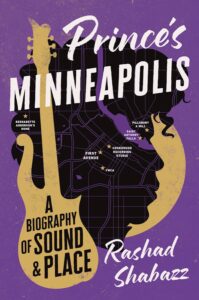
From Prince’s Minneapolis: A Biography of Sound & Place by Rashad Shabazz. Copyright © 2026 by Rashad Shabazz. Published by the University of North Carolina Press.

Rashad Shabazz
Rashad Shabazz is associate professor of geography and African and African American studies at Arizona State University and author of Spatializing Blackness: Architectures of Confinement and Black Masculinity in Chicago.