The Origin of Our Species: How Grains and Grasses Fed (and Still Feed) Humankind
David George Haskell In Praise of a Versatile, Life-Giving Plant
As I walk through the broomsedge in June, dozens of grasshoppers clatter away with every footstep. Bees and wasps wing past, leafhoppers spring, and beetles scurry for cover. This productivity is why so many birds depend on grasslands for their breeding or wintering. Grasslands, especially those in humid areas with good soil, provision their local food webs as richly as do forests.
Grasses also build soil. Their leaves send about two thirds of all the food they make to the underworld. There, roots tunnel many meters down. As they grow, they break up clay and rock, exude sugars and other molecules, and interweave their cells with fungi. When the roots die, they add spongy organic matter to the soil. This soil‑building process is so productive that it lifts the ground. When a degraded grassland returns to health, the ground heaves up, as if inhaling with relief. In old grasslands, the soil can be rich with organic matter to a depth of several meters. When prairie goes under the plow, most of the organic matter disappears, turning living water‑holding, nutrient‑rich soil into mineral dust. Today, despite widespread degradation of grasslands, one third of all carbon stored on land is still locked up in grassland soils.
As fellow volunteers, the staff of Birds Georgia and I sow grass seed, we enact the grassland ethos: Build community, one species helping another. Grasses are creators. They use cooperative partnerships to build their homes, places that, in turn, open possibilities for others. They hoard soil carbon, create habitat for other plants, and feed animals.
Grasses are creators. They use cooperative partnerships to build their homes, places that, in turn, open possibilities for others.
Although we don’t often imagine ourselves in this way, we are a prime beneficiary, a species built by grass.
*
What’s for dinner? Grass. Wherever you live, some kind of grass is probably feeding you.
When the prophet Isaiah proclaimed that “all flesh is grass,” he intended a commentary on the fleeting nature of human life, but he also spoke an ecological truth. In Isaiah’s time and in ours, grass sustains us. If we stacked in 50‑kilogram sacks the total cereal harvest in 2023, the pile would reach to the moon forty times. That’s 2,836 million metric tons of grass flowers matured into seed. Three grasses—rice, maize, and wheat—account for 90 percent of this superabundance, supplying us with two thirds of food calories. The juices of sugarcane, another grass, supply another 1,900 million metric tons. Barley, sorghum, oats, millet, rye, and wild rice are grasses, too.
Livestock fattens on grass from pasture and the maize‑filled troughs of feedlots. While our great ape cousins feed on forest fruits, leaves, and animal prey, we depend on grasses. If we named ourselves for our primary food, we would be grass apes, Homo poaceae, for Poaceae, the scientific name for the grass family, from the ancient Greek for “fodder.”
It is the nutritive gifts of grasses, with help from oil‑rich fruits like mustards and oil palms, that caused the increase in food calories available to humans over the last millennium and, especially, the last century. The cereal harvest in 2023 was 50 percent higher than that of 2000 and three times that of the 1960s, outpacing human population growth on all continents. Famines are rarer than they were and now largely emerge from human injustice and war, not the failure of plants to yield food. Such productivity comes with severe costs: felled forest, mined and synthesized fertilizer, among many. But those who in the nineteenth and twentieth centuries made erroneous predictions of imminent mass starvation erred by underestimating the world‑changing potential of grasses.
These global patterns are evident in kitchens. At home, the bottom drawer of our kitchen cabinet grinds when I pull it open. The poor thing has worn sliders and is loaded with bags and tubs. Bread flour, whole wheat flour, all‑purpose white flour, masa, purple cornmeal, medium‑ground yellow cornmeal, plain fine cornmeal, semolina flour, barley flour, and sorghum flour. Some are baking staples, ingredients for pancakes, loaves, and corn breads.
Others are aspirational, plucked in moments of enthusiasm as Katie and I push our cart through the aisles of the Dekalb Farmers Market, a bustling warehouse near our home stocked with bulk dried goods and fresh produce from across the globe. Regardless of their origin, every one of the flours in our kitchen drawer is ground‑up grass seed, the product of a mature grass flower. Other kitchen drawers hold rice and pasta, also made from grass seed. Our kitchen, like kitchens over much of the world, is a bouquet of grass.
From the three hundred thousand species of flowering plants on Earth, we’ve plucked a handful of grasses and founded modern agriculture on their productivity. What made grass so special? The answers reveal not only why we latched onto them so firmly, but also how grasses managed to take over much of the planet long before humans evolved.
Grass flowers are super‑mothers, giving their embryos ample provisions. Under a magnifying glass we can see how. I pull open the complaining kitchen drawer and dip a teaspoon into some bags, retrieving flours that I dust onto scrap paper under a bright counter light. What looked to my unaided eye like powders of different colors reveal themselves under the lens as diverse and beautiful. I expected white flour to look fluffy, but magnified it looks like coral sand. I smooth the tiny pile with the back of my spoon and the flour becomes a miniature tropical beach, a gleaming expanse enlivened with a scattering of darker grains.
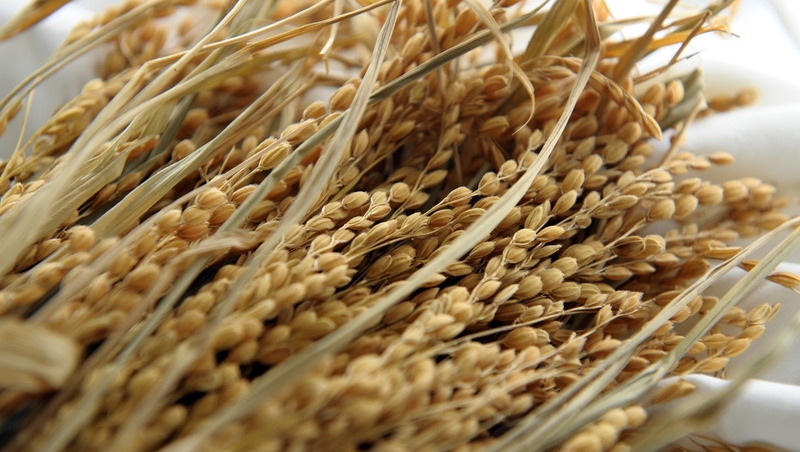
Whole wheat flour seems made of tan‑colored sand mixed with shredded cardboard, as if a hurricane had passed through a shipping warehouse on its way to the beach. The grains of purple cornmeal are larger than those of the wheat flours and are intermixed with white‑blue pebbles and chunks of broken obsidian. Uncooked rice grains loom over these sands. They are slightly translucent and etched with lines, as if ancient Egyptians had built their obelisks from milky glass. Who needs magic mushrooms when we have 7× hand lenses?
Most of what I’m admiring under the lens are not the tissues of the seeds’ embryos, but the ground‑up remains of the lunch box that the mother flower carefully packaged and gave to each of her departing children. White, tan, and purple “sand” and the glassy bulk of the rice grain are all what botanists call “endosperm,” a tissue that feeds the embryo when it germinates. Endosperm is only found in flowering plants, although a few close relatives like the nonflowering shrubby joint fir, Ephedra, have its rudiments. The evolution of endosperm was one of the innovations that gave early flowering plants an edge.
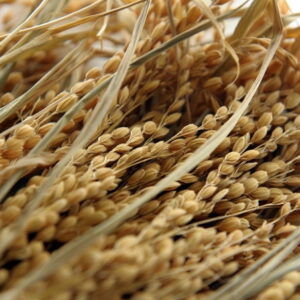
Orchids and a few other flowering plants secondarily lost or reduced their endosperm when they evolved tiny seeds. Without endosperm, orchid seedlings are entirely dependent on fungi. Grasses went the opposite way, swelling the endosperm to such an extreme that the embryo looks like an afterthought, a bundle squashed into one end of the seed. Such ample provisions give grass seeds a measure of independence, at least at first. If you’ve ever sprouted wheat grains, you know that grass seeds can lance roots and baby leaves with no help from fungi or other partners. Later in life, community building becomes more important for grasses, but their seeds can go solo.
It takes strange sex and disturbing sibling relations to make endosperm. When pollen grains hatch on the female stigma of a flower, each pollen grain first grows a tube toward the egg, then sends a pair of tailless sperm down the tunnel. If the female part of the plant decides to accept them, both merge with the female tissues. One sperm unites with the egg, making an embryo. The other unites with ladies‑in‑waiting cells nestled alongside the egg. This second fertilization forms a sibling that never develops root or stem, but instead fattens with starch and other food, all drawn from the mother flower. This is the endosperm. Every seed of a flowering plant carries two genetic individuals. One, the embryo, can grow into a new plant. The other, the endosperm, is an undifferentiated mass of cells whose fate is to feed its sibling and die in the process.
I look on my piles of flour with horror. Not only am I admiring pulverized embryos, most of what I’m seeing are the remains of creatures that, thanks to evolution, grew into starchy blobs destined to be devoured by their siblings. The mushroom trip just took a bad turn. At lunchtime, hunger overrides my qualms. Endosperm makes excellent bread, rice, or tamales. Thank you, doomed siblings.
Among agrarian humans, endosperm left its mark on our genomes. People whose ancestors ate a lot of endosperm have extra copies of the genes that make starch‑digesting enzymes. Evolution has built dependence on wheat, corn, and rice into some human DNA. Grass lives inside us. It also linked us into new mutually beneficial relationships with other creatures, as flowering plants so often do. Fermentation by bacteria and fungi is central to many grass‑based human foods, including wheat bread, beer, and dozens of fermented rice and corn dishes. Grass, microbes, and humans are a powerful trio of cooperators.
Endosperm reserves made grasses especially good at thriving in challenging conditions. Once tucked inside the seed coat, the starches, oils, and protein in endosperm keep for months. Endosperm is the original dry pantry. Grass seeds can bide their time, waiting for the right conditions to germinate. When rains and warmth arrive, the endosperm digests itself and shunts food to the growing seedling. Powered from within, grass seedlings lance out roots and stems, beating any competition.
It is no accident that many of the most successful recent transcontinental transplants of modern plants are grasses, often causing problems in natural habitats and agricultural fields as they push out local species or desirable crops. Looking further back in time, the fossils and family trees of grasses show that they’ve been colonizing new lands for millions of years, largely thanks to the endosperm in their seeds. These Vikings are successful not because they are warlike, but because their mother flowers sent them out with food hampers.
Like a duckling that emerges from the egg ready to feed itself and scurry away from predators, grasses are ready to take on the world from the moment they “hatch.” Unlike the mostly undifferentiated embryos of their close relatives, grass embryos have roots, miniature stems and leaves, and a placenta‑like structure connecting to the endosperm. Once conditions are right, the embryos are ready to burst into action. A rice grain or wheat kernel in your hand might look passive, but you’re holding a time capsule with a sprinter coiled inside.
Our dependence on grass far predates the origins of agriculture or written scriptures. Without grasses, we’d still be small‑brained apes living in the trees.
What I’ve called “seed” or “grain” is technically the fruit of the grass flower. Like all other flowering plants, grasses wrap the embryo and endosperm in layers of maternal tissue. Unlike fleshy fruits like plums or mangoes, the fruit tissues of grasses are thin and papery. In whole wheat flour, these fibrous coverings are called the “bran,” the cardboard‑like material that I saw under my lens. The “wheat germ” is the embryo, little flecks of chewy brown. White flour is nearly pure endosperm. Like drinking cow’s milk, when we eat white bread or pasta we’re getting a slug of energy and nutrients built by evolution for the rapid growth of infants. Perhaps pasta or pizza with cheese is so comforting because we’re literally being mothered by flowering plants and bovines?
Not content with a tightly bundled fruit, grasses add extra papery layers around the seed, like gift wrap gone mad. A swarm of botanical terms describe the details of these wrappers—floret, glume, lemma, awn, palea, lodicule—but we usually refer to them as mere chaff, the fibrous junk that stands in the way of our hunger for endosperm. This name belies the intricacy of each species’ arrangement of parts. Some look like nested canoes, others like sheathed javelins. Many are arranged in geometric patterns of fans or rows.
Each arrangement serves to launch the young on a journey suited to the ecology of its species. Many have wind‑catching bristles. Some are grappling hooks for mammal fur or bird wings. I once made the mistake of wearing wool socks to walk through grassland at Panola Mountain and later spent hours unpicking hundreds of sharp, grippy grass seeds, a reminder of how well they cling to fur. Other grass seeds twist as humidity changes, drilling seeds into the soil. The collective term for all these fruit wrappers built by the mother flower is “spikelet,” a feature that evolved in the ancestor of modern grasses that has literally carried them, by wind and animal bodies, to worldwide success.
These winning characteristics of grass seeds were lately helped by a few quirks that made them especially alluring to humans. We have delicate guts, unable to tolerate the poisons and tannins that lace the seeds of many other flowering plants. For example, a few seeds of larkspur would kill you by alkaloid poisoning. Without repeated soaking in water, acorns sicken us with bitter tannins. Our saliva has only weak levels of the tannin‑neutralizing chemicals that other mammals use to tolerate bitter food.
Compared with the seeds of almost every other plant, grass seed is highly palatable, especially for a dexterous ape whose hands can slough off the chaff. Many grasses evolved to be partly dispersed by herbivorous mammals, the seeds passing through guts with the bulky leafy tissue. For millions of years, then, it has been in the interest of grasses not to have poisonous seeds, although many have tough or bitter coats to deter fungi, insects, or overenthusiastic grazers. When our ancestors started to gather and replant seeds, grasses were the obvious choice: edible, portable, rot resistant, and stuffed with easy‑to‑digest food.
When grass fruits mature, they usually detach from the parent, hitching a ride on an animal or the wind. Botanists call this process “shattering,” because a single touch of a ripe seed stalk can cause all the fruits to snap and tumble, like shards of broken glass. The mother plant encourages this fracture by killing and partly digesting the cells where the mature fruits attach to her stalk. In some grass species shattering can be turned off by just one or two gene mutations. The mother fails to cut the umbilicus and the fruits cling tight. In the wild, these mutants are hopeless, failing to send offspring into the world.
But when clever bipeds evolved, our ancestors, the doomed mutants became, literally, the seeds of the agricultural revolution. By not falling to the ground, the shatterless mutants stayed on the stalk until we were ready to harvest them. By selectively keeping and replanting the mutants, ancient humans gained the first cereal crops. Today, when we bite into a wheat sandwich, a corn tamale, or a rice curry, we’re eating descendants of these shatterless mutants.
Other mutations, random genetic changes that humans noticed and kept for planting the next year, helped along the way, notably those that multiplied the number of fruits on the stalk and fattened each seed. Many cereal crops also went through repeated rounds of genome duplication and hybridization, just as goatsbeard did. But without early shatterless mutations, our species would never have enmeshed its fate so deeply with grasses.
Imagine a world where rice, wheat, or corn remained minor, “wild” foods. Agriculture would be vastly less productive. Human population size would be a fraction of what it is today. Few genetic changes have been as consequential for the story of life on Earth. The shatterless mutations launched humans on our present trajectory. We’ve been clearing forest and tilling fields for grasses ever since. The book of Genesis, the origin story of a grass‑based agrarian culture, tells us, “In the sweat of thy face shalt thou eat bread.” God decrees: Humans toil on behalf of grass. But our dependence on grass far predates the origins of agriculture or written scriptures. Without grasses, we’d still be small‑brained apes living in the trees.
__________________________________
From How Flowers Made Our World: The Story of Nature’s Revolutionaries by David George Haskell. Published by Viking Books, an imprint of Penguin Publishing Group, a division of Penguin Random House, LLC. Copyright © 2026 by David George Haskell.

David George Haskell
David George Haskell is a biologist acclaimed for his lyrical explorations of the living world. His books have twice been finalists for Pulitzer Prize in Nonfiction, in 2012 for The Forest Unseen and in 2022 for Sounds Wild and Broken. His 2017 book, The Songs of Trees won the John Burroughs Medal. Other literary honors include an Award in Literature from American Academy of Arts and Letters, two-time finalist for the PEN/E. O. Wilson Literary Science Writing Award, and winner of the Acoustical Society of America’s Science Communication Award, the National Academies’ Best Book Award, Iris Book Award, Reed Environmental Writing Award, and National Outdoor Book Award for Natural History Literature. He is a Fellow of the Linnean Society of London, a Guggenheim Fellow, and is Adjunct Professor of Environmental Sciences at Emory University. He was previously William R. Kenan Jr. Professor at the University of the South in Sewanee, TN. Haskell lives in Atlanta, Georgia.