In a patch of sunlight Verla sits on a wooden folding chair and waits. When the door opens she holds her breath. It is another girl who comes into the room. They lock eyes for an instant, then look away to the floor, the walls.
The girl moves stiffly in her weird costume, taking only a few steps into the room. The door has closed behind her. The only spare chair is beside Verla’s, so Verla gets up and moves to the window. It is too much, that she be put so close to a stranger. She stands at the window, looking out through a fly-spotted pane at nothing. There is bright sunlight coming into the room, but only reflected off the white weatherboards of another building just metres away. She presses her face to the glass but can see no windows anywhere along the length of that building.
She can feel the other girl behind her in the room, staring at her peculiar clothes. The stiff long green canvas smock, the coarse calico blouse beneath, the hard brown leather boots and long woollen socks. The ancient underwear. It is summer. Verla sweats inside them. She can feel it dawning on the other girl that she is a mirror: that she too wears this absurd costume, looks as strange as Verla does.
Verla tries to work out what it was she had been given, scanning back through the vocabulary of her father’s sedatives. Midazolam, Largactil? She wants to live. She tries wading through memory, logic, but can’t grasp anything but the fact that all her own clothes—and, she supposes, the other girl’s—are gone. She blinks a slow glance at the girl. Tall, heavy-lidded eyes, thick brows, long black hair to her waist is all Verla sees before looking away again. But she knows the girl stands there dumbly with her hands by her sides, staring down at the floorboards. Drugged too, Verla can tell from her slowness, her vacancy—this runaway, schoolgirl, drug addict? Nun, for all Verla knows. But somehow, even in this sweeping glance, the girl seems familiar.
She understands fear should be thrumming through her now. But logic is impossible, all thinking still glazed with whatever they have given her. Like the burred head on a screw, her thoughts can find no purchase.
Verla follows the girl’s gaze. The floorboards glisten like honey in the sun. She has an impulse to lick them. She understands that fear is the only thing now that could conceivably save her from what is to come. But she is cotton-headed, too slow for that. The drug has dissolved adrenaline so completely it almost seems unsurprising to be here, with a stranger, in a strange room, wearing this bizarre olden-day costume. She can do nothing to resist it, cannot understand nor question. It is a kind of dumb relief.
But she can listen. Verla strains through her sedation. Somewhere beyond the door is the judder of some domestic motor—a fridge, maybe, or an air-conditioning unit. But the place is stinking hot, primitive. She has no idea where they are. The room is large and light. There are the two wooden folding chairs—empty, the other girl did not sit—against a wall painted milky green, and a blackboard at the other end of the room with a rolled vinyl blind high up at the top of the board. Verla knows without knowing that if she tugged on the ring dangling from the centre of the blind she would pull down a map of Australia, coloured yellow and orange with blue water all around. The map would be faintly shiny and faintly creased from all the years of rolling up and down, and would somewhere contain the truth of where she has travelled to all those hours. When her mind is in order again she will be able to think. She will work it out, she will take charge of herself, will demand information and go to the highest authority and not rest and somehow get to the bottom of this fact of appearing to have been abducted right into the middle of the nineteen fucking fifties.
Outside, a single white cockatoo shrieks, closer and louder until the sound of it fills the room like murder. She and the girl lock gazes again, and then Verla peers back outside, up at the slot of sky. The bird flaps across the space between the buildings and then is gone.
She tries again, and this time through her sticky, jellied recollection Verla drags up the looming shape of a vehicle in the night. Is this recall, or dream? A bus. Gleaming yellow in the gloom. Purposeful, firm hands lifting and pushing at her. Waking at some time in the dark, unfamiliar velour of upholstery against her cheek. Headlights illuminating a long, straight, empty road. Did she stand up, swaying? Did she shout, was she pressed down? She rubs her wrist at the dream-memory of handcuff and rail.
Impossible.
Another dream sense—being hauled from the bus, held up, trying to speak, rough hands gripping, tasting dust in the dry and staticky night. She was far from home.
*
Now here she is, in this room.
Verla listens hard again. It now seems listening might be her only hope. She hears the creak somewhere of a door, a bird’s cheeping. There will be a car engine, a plane, a train, something to locate them. There will be footsteps, talking, the presence of people in other rooms. She stares out the window at the weatherboards. There is nothing. The motor jerks—it is a fridge—and clicks off.
Now there is no sound at all but the other girl’s slow, solid breathing. She has moved to sit, on one of the chairs. She sits with her legs apart, her forehead in her hands, elbows on her knees. Her black hair a curtain, reaching almost to the floor. Verla wants to lie down on the floorboards and sleep. But some ancient instinct claws its way to the surface of consciousness, and she forces herself to stay upright. Minutes pass, or hours.
At last the other girl speaks, her voice thick and throaty. ‘Have you got a cigarette?’
When Verla turns to her she sees how fresh the girl is, how young. And, again, familiar. It seems to Verla she has known this girl once, long ago. As if Verla had once owned then abandoned her, like a doll or a dog. And here she is, returned, an actor on a stage, and Verla there too, both of them dressed in these strange prairie puppets’ clothes. It could all be hallucination. But Verla knows it isn’t. The doll opens her mouth to speak again and Verla says, ‘No,’ at the same time as the doll-or-dog girl asks, ‘Do you know where we are?’
There are voices beyond the door in the hallway and in a sudden rush of clarity Verla realises she should have asked the girl where she has come from just now, what is outside the door, realises she has squandered her last chance to know what is to come. But it is too late. The voices are men’s, loud, cheerful, workaday. Just before the door opens the other girl darts across the room to Verla’s side, so they stand together facing the door, their backs to the window. As the door opens the two girls’ hands find and close over each other.
A man clomps into the room. Sounds of life and movement bloom up the hallway behind him: another man’s voice, the sound of moving cutlery, or knives. Delicate metal sounds, instruments clattering into a sink or bowl.
Verla’s legs weaken; she might drop. The other girl’s grip tightens over hers and Verla is surprised to learn this: She is stronger than me.
‘Hey,’ the man calls mildly, as if he is embarrassed to come across them there. Thick brown dreadlocks fall to his shoulders, framing a hippie boy’s vacant, golden face. He shifts in his blue boiler suit, big black boots on his feet. The suit and the boots look new. He is uncomfortable in them. He stands with his arms folded, leaning back now and then to look out the door, waiting for someone.
He looks at them again, appraising them in their stiff, weird clothes. Curious objects. ‘You must feel like shit, I s’pose.’ A husky, lazy, pot-smoker’s voice. He stretches, raising his arms high above him with his palms together, then dropping from the waist, head touching his knees, palms on the floor, he breathes, long and smoothly. Salute to the sun, Verla thinks. Then the man straightens up and sighs again, bored.
‘It’ll wear off soon, apparently,’ he murmurs as if to himself, glancing out the door again.
The girls stay where they are, hands gripping.
Now another boiler suit strides into the room. Bustling, purposeful.
‘Right,’ he says. ‘Who wants to go first?’
__________________________________
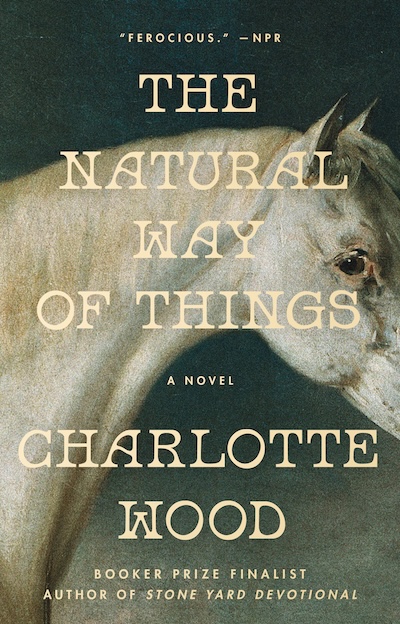
From The Natural Way of Things by Charlotte Wood. Used with permission of the publisher, Riverhead Books. Copyright © 2026 by Charlotte Wood.