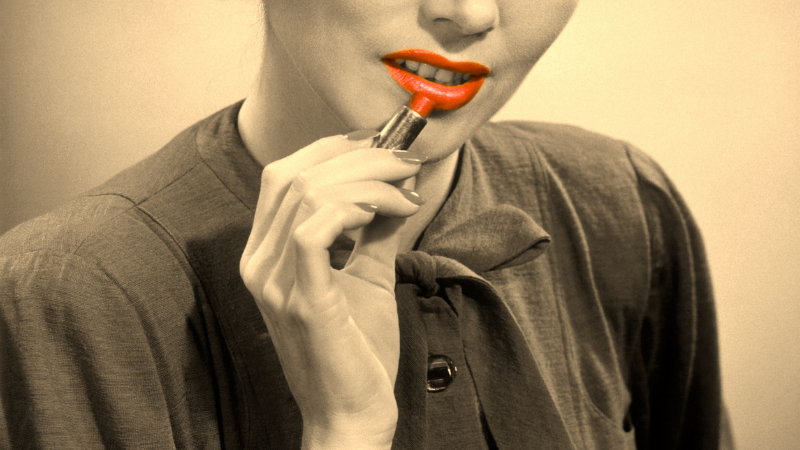
The Myth of the Red-Lipped Suffragette
Eileen G’Sell on “Femvertising” and Fashion as Feminism
Google “red lipstick” and “suffrage,” and pages of links will spill from a number of credible outlets, all recounting—and usually extolling—the penchant among First Wave American feminists for a lacquered pout. Most of these modern-day news sources reference the May 4th. 1912, suffrage rally in Manhattan, when some 15,000 women marched from Washington Square to Carnegie Hall. It’s a pretty, and pretty provocative, picture: women in white dresses and white parasols storming Fifth Avenue on a spring day, their chanting mouths an urgent red.
And it’s almost certainly a total lie—and not a white one.
One book asserted Elizabeth Cady Stanton, Charlotte Perkins Gilman, and “other notable feminists” all attended the rally in “painted lips as a badge of emancipation.” But Stanton had passed away a decade earlier, and try as I might, I have failed to locate one photograph of Gilman appearing in lip color of any kind (though she does look chic in a newsboy cap).
Revisionism infuses the past with today’s fashionable ideology.
As historian Lucy Jane Santos has recently noted of the May 1912 suffrage march, “there was a great deal of interest in what the women were wearing by the press and a great deal of planning by the organizers.” In other words, were women boasting crimson mouths, it would have been written about in the press at the time. Santos explains, “Whilst the reports may have varied on how successful the march was in terms of rallying people to their cause, there is one thing that all of them have in common. Absolutely no mention of lipstick, red or otherwise.”
How would such a myth proliferate? Blame Elizabeth Arden. Not Elizabeth Arden the person—otherwise known as Florence Graham, pioneer of American beauty culture—but Elizabeth Arden the powerhouse brand that has circulated the myth.
What we do know is that, in 1912, Graham joined the New York rally, shocking staff at her 5th Avenue boutique. Having previously scoffed at feminist gusto, the enterprising Welsh-Canadian businesswoman likely saw the suffrage movement as a sure way to rub shoulders with the white, educated, Protestant elite, a group which she was both desperate to infiltrate and cater to in her tony skincare “salons.”
As Santos points out, Graham’s 5th Avenue flagship store had only been open two years at the time of the 1912 suffrage march, and even though “cosmetic use had gained in popularity and acceptability in Europe … it was very much not a thing in New York.”
About a century later, as femvertising came to dominate the beauty industry, twentieth-century revisionism followed suit. What better way to encourage women to embrace a brand—or a lipstick shade—than to link it to a right that virtually all Western women cherish, whether or not they call themselves feminists? After all, if you’re already apt to feel powerful wearing red lipstick, how much more powerful will you feel if you reckon yourself a suffragist who brazenly took to the streets?
While this fantasy is seductive, it obscures the much more complicated history of lipstick, feminism, and the so-called “lipstick feminism” of the late twentieth century. Revisionism infuses the past with today’s fashionable ideology. It can also hold the past to unfair scrutiny among those who already know how everything turned out.
Was Elizabeth Arden an ardent feminist? No. Did she give out red lipstick to the masses? Almost certainly not. Has this legend made the brand a lot of money? Unquestionably.
In 2019, the brand dredged up its supposed suffrage legacy for its “March On” campaign. A limited-edition lipstick (“signed” in red by spokeswoman Reese Witherspoon) was sold globally to benefit women’s rights. “Moved by our founder, a woman dedicated to empowering women,” the ad declares, “we are donating 100% of the proceeds to UN Women. Join us as we march on to empower women everywhere. Wear the lipstick as a sign of solidarity.”
I also don’t see the point in turning every successful woman in history into a bona fide feminist or conflate something like lipstick with a cause as noble as voting rights.
Solidarity with whom, exactly? Visiting the webpage of UN Women, I found a host of striking female faces from across the world—from Sierra Leone, Sudan, Afghanistan, and Gaza. Some are young, some are old; some are smiling, some are somber. None, however, are wearing visible lipstick.
Lest I seem to finger-wag at all femvertising, I am not. If one feels powerful wearing red lipstick (as do I!), go for it. But the founder of Elizabeth Arden wasn’t looking to “empower” women so much as climb the social ranks and become fabulously rich. (Which, to her credit, she did.) When the words “march” and “solidarity” are directly linked to her legacy, her self-serving ambition is conflated with the goals of actual feminists who risked jail time and even their lives for the cause of suffrage. Sorry, Reese, that’s not the same.
But, just as it’s best to avoid revising the past to pull a profit, it’s best to resist judging historic actors by today’s ethical standards. I don’t judge Florence Graham for cynically glomming on to the suffrage movement, any more than I judge my late grandmother for smoking while pregnant with each of her nine children.
I also don’t see the point in turning every successful woman in history into a bona fide feminist or conflate something like lipstick with a cause as noble as voting rights. Given that women in other countries do wear lipstick as an act of resistance today, suggesting that American feminists did so in 1912 conflates their wildly different cultural contexts, and blurs one’s sense of what constitutes public dissidence.
An object like lipstick can be rich with meaning, even political implications, without itself being a revolutionary tool. Overstating the case only warps our vision of where we came from—and where we are today.
__________________________________
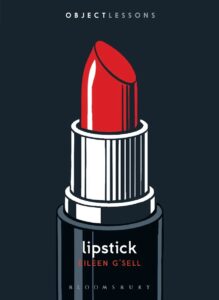
Excerpted from Lipstick by Eileen G’Sell, from the Object Lessons series published by Bloomsbury Academic.

Eileen G'Sell
Eileen G’Sell is Teaching Professor of College Writing at Washington University of St. Louis, USA. She is also the film critic for The Hopkins Review, an award-winning literary and culture magazine published by Johns Hopkins University. Her writing has appeared in The Chronicle of Higher Education, The Baffler, Jacobin, Los Angeles Review of Books, Current Affairs, Film Quarterly, and Hyperallergic, among other publications. In 2023, she received the Rabkin prize in arts journalism.