The Most Scathing Book Reviews of 2025
“Historians will study how bad this book is.”
Pans, glorious pans. No end-of-year roundup would be complete without them.
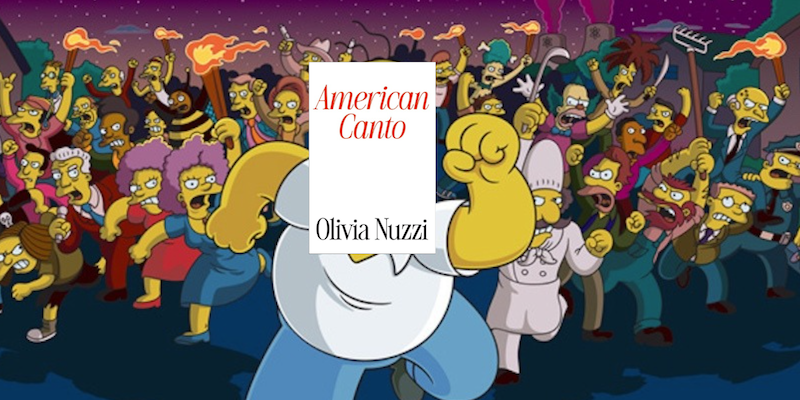
Among the books being driven into the woods by pitchfork-wielding villagers this year: Louis C.K.’s masturbatory debut novel, Olivia Nuzzi’s delusional fortune cookie, Woody Allen’s autofictional kvetch-fest, and Kamala Harris’s 304-page excuse for ineptitude.
So here they are, this year’s dirty dozen, in all their grimy glory: the most scathing book reviews of 2025.
Brought to you by Book Marks, Lit Hub’s home for book reviews.
*
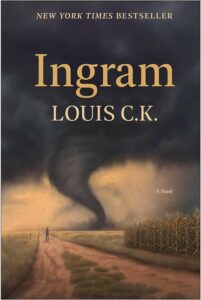
“In truth, C.K. really isn’t interested in Ingram’s childhood and how it might have shaped the boy, what would naturally be the concerns of a ‘literally literary’ novelist. That’s because Ingram is driven by concept rather than character, and C.K. aspires only to concoct a narrator as naive and transparent as possible without worrying too much about how he got that way … It doesn’t help that C.K.’s rendering of rural poverty feels inauthentic. Children on struggling farms don’t spend their days sitting in the dirt, staring at animals … A writer with a particularly fierce vision and style can command a reader’s belief in a fictional world despite some ramshackle world-building, as Cormac McCarthy did in The Road, a work that seems to have influenced Ingram. But C.K. is not that novelist. Which is not to say he couldn’t be. Ingram seems most of all like the kind of first novel that ends up in a drawer and stays there until its author dies, whereupon, if the writer’s fully realized works have won over enough readers, it might get dragged out and published by the artist’s heirs. But C.K. is famous and still has many fans despite his scandals, and what ought to have been cashiered as mere juvenilia winds up printed between hardcovers, with a slipcover photo of its author sitting at a manual typewriter, and listed for $27.95. This choice does no one any favors, most especially C.K., who might have a genuinely worthwhile novel in him if he had the incentive to work harder and longer at the craft. Instead, he’s just sitting in the dirt.”
–Laura Miller on Louis C.K.’s Ingram (Slate)
“American Canto was the last real opportunity for Nuzzi to talk about what happened: tangibly, what she did to torpedo her career and personal life. It could have been a pulpy tell-all that explains how she fell in love with the worst Kennedy or a political book opening up her reporter’s notebook to share from a vantage point few people ever reach. After these brief weeks around Christmas, already a chaotic time to publish a book, the interest around her will ebb. American Canto could have helped redeem her if only it were interesting. Instead, it is illegible in ways you can’t imagine. Historians will study how bad this book is. English teachers will hold this book aloft at their students to remind them that literally anyone can write a book: Look at this, it’s just not that hard to do. Three hundred pages with no chapter breaks, it swerves back and forth through time, from Nuzzi’s interviews with Donald Trump over the years to her combustible relationship with fellow annoying journalist Ryan Lizza to her alleged affair with Robert F. Kennedy Jr. as he was running for president himself. Reading it is like spending time with a delusional fortune cookie: platitudes that feel like they were run through a translation service three times. Written in a stream-of-consciousness flow, the book offers almost no insight into Kennedy as a person, as a politician, as a figure helping guide our collective political moment, or even into Nuzzi herself as a journalist once widely lauded and now largely seen as embarrassing. If you have not studied the intricate details of the pre- and post-exile life of a broadly connected 32-year-old reporter, the book’s contents are nearly incomprehensible, like hieroglyphics written in dust. For those who have been locked in on the Nuzzi gossip of late, it’s merely ham-fisted and tedious.”
–Scaachi Koul on Olivia Nuzzi’s American Canto (Slate)
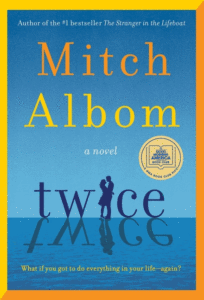
“Mitch Albom’s new novel, Twice, is about a man with the miraculous ability to travel back to any point in his life and make a different choice. A few hours after starting Twice, I knew exactly which choice I would make differently. But alas, here we are. … This is the kind of novel that a guard in a locked room must force you to keep reading … for all his godlike ability to relive time, Alfie enjoys an adolescence furnished with modular events picked up from Ikea’s fiction department: friends daring him to ring the doorbell of a scary woman’s house; bullies taunting his sensitive Black friend; a cute girl kissing him during Seven Minutes in Heaven. These generic moments skim by like we’re watching The Wonder Years at triple speed … As Alfie gets older, he gets bolder, but Albom grows no more interested in making his experiences engaging. It’s as though Alfie’s ability to cheat consequences has drained urgency from the prose … Absolved of the possibility of death, the novel suffers the ennui that vampires endure. Alfie’s memory of taking ‘a bullet during a Mexican bank robbery’ feels less vibrant than my memory of dinner at the Olive Garden. It’s astonishing that a man who’s sold tens of millions of copies, an author who presumably has access to the finest editors in the business, can continue to produce lines that feel so synthetic and recycled … The truth I learned in Twice is that once is more than enough.”
–Ron Charles on Mitch Albom’s Twice (The Washington Post)
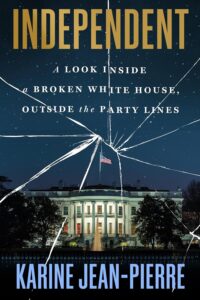
“Unsurprisingly, Independent is a fascinating book for all the wrong reasons. It was dated before it arrived at the printers, perhaps before it was even written; no doubt it will be studied by the historians and anthropologists of the future. Jean-Pierre is an artifact of an age that looks recent on paper but feels prehistoric in practice—the age of pantsuits, the word ’empowerment,’ the musical Hamilton, the cheap therapeutic entreaties to ‘work on yourself’ and ‘lean in’ to various corporate abysses. Independent is written in the outmoded register of one of those lawn signs proclaiming that ‘in this house, we believe kindness is everything,’ which have been firmly planted, to no tangible electoral effect, since 2016 … at no point in Independent does she articulate a serious critique of Democratic policies. Instead, in an unsubtle attempt to elevate her gripes to the status of more principled objections, she peppers the book with platitudes about the need to ‘tap into out of the box thinking’ and reject ‘an out-of-touch leadership working from an outdated playbook.’ It is hard to take these exhortations seriously when Jean-Pierre’s own thinking remains so decidedly in the box, and when her version of in-touch leadership is an 80-something darling of the establishment who can’t make it through a debate after 9 p.m … She could often be mistaken for a motivational instructor in a Soul Cycle class: ‘I ask you to try, to flex your individuality like a muscle, standing firm in your purpose, holding fast when others push you to just go along.’ It is incredible—and emblematic of the Democrats’ total aesthetic and intellectual driftlessness—that someone who writes in such feel-good, thought-repelling clichés was hired to communicate with the nation from its highest podium.”
–Becca Rothfeld on Karine Jean-Pierre’s Independent: A Look Inside a Broken White House, Outside the Party Lines(The Washington Post)
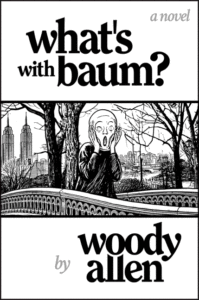
“There are many things that the world needs in 2025, but I’m not sure that the debut novel by 89-year-old Woody Allen is one of them … There’s a lot going on there and it all sounds perfectly chucklesome, but the story—what there is of it—seems fueled by a deep undercurrent of nastiness … Is the joke here on Baum for getting so wound up by a talented younger man? Perhaps. But there’s something distinctly uncomfortable, even obscene, about so much hateful scrutiny of a character who is likely to be seen as like the author’s son. We are told that Thane, with his icy blue eyes, looks like ‘a young Alain Delon.’ Allen has created a hall of mirrors, then, in which we’re supposed to stroke our chins and perhaps wink-wink at Baum’s meta commentary about the dangers of confusing the artist with the man … But so what? It’s autofiction. The question should be: is the writing any good? Well, no. All the best sentences have been crammed into the first page and all the drama happens in the last 20. In between, there’s a nice use of ‘zombie’ as a verb and an interesting paragraph involving Goebbels. But most of it is kvetching and ogling … Writing, as with all art forms, is an act of noticing, and writers are judged on where and how deeply they choose to train their gaze. What’s with Baum? is an absolute failure of noticing. Place Allen in any room, he’ll see less than anyone else.”
–Johanna Thomas-Corr on Woody Allen’s What’s With Baum? (The Times)
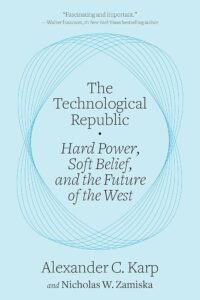
“While all this was going on—while he was becoming America’s highest-paid CEO and facilitating a growing police state at home and a genocidal campaign in Gaza—Karp somehow managed to squeeze in writing a book. Or perhaps it would be more accurate to say that he managed to dictate one…Karp deployed his own legal counsel in much the same manner as an ordinary person who didn’t want to put in the work might use a generative AI chatbot like ChatGPT, throwing out a mess of half-formed ideas to be put into serviceable prose … as I made my way sluggishly through its pages—through its business-casual banalities, its pallid apologias for Western civilization and imperial violence—I found myself increasingly preoccupied by a single question: Why did Alexander Karp want to write this thing in the first place? I suspect that his reasons are at least partly related to the Silicon Valley cult of the tech-founder-as-philosopher-king, and have to do with Karp’s desire to be viewed as not just a businessman but also a public intellectual. This book exists, in other words, in order for Karp to have written a book … The book is filled with this sort of sanctimonious guff. If it were just another denunciation of cancel culture, it would be merely boring and belated. But coming from Alexander Karp, the CEO and cofounder of Palantir Technologies, this concern-trolling about a growing censoriousness in ‘the culture’ feels almost intentional in its absurdity. At times I approached the book, perhaps to preserve my own psychic integrity, as an avant-garde exercise in narrative unreliability, an experiment in the dizzying extremes of dramatic irony that I associate most with Charles Kinbote, the comically oblivious narrator of Nabokov’s Pale Fire. Again and again I found myself responding to some sententious lament about Silicon Valley’s lack of moral values by scrawling ‘You run Palantir!’ in the margin.”
–Mark O’Connell on Alexander C. Karp’s The Technological Republic: Hard Power, Soft Belief, and the Future of the West (The New York Review of Books)
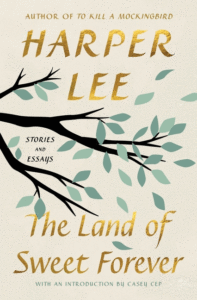
“A rejection letter from the New Yorker was discovered among Lee’s manuscripts. I’m not surprised. Reading these fragmentary pieces of juvenile fiction is a little like hearing a young pianist play scales: ask yourself if that is a pastime you’d enjoy … Lee, I am sure, would be embarrassed by the publication of this book … The collection ends with a few slight pieces of journalism that, again, hardly deserve the name. The book is padded out by big type, airy leading and slight, vacuous tributes to the likes of Gregory Peck and Truman Capote produced for organs like the American Film Institute or the Book of the Month club. You will not learn anything substantial, or even very interesting, about these folks – or indeed about Lee – from reading it. Harper Lee was not slight, was not vacuous. To Kill a Mockingbird is an artifact of its time – a white savior story, as we call it now, and rightly so – but it had its place in moving the arc of history and still does. Lee understood her own significance; it does her a disservice to release this work.”
–Erica Wagner on Harper Lee’s The Land of Sweet Forevers (The Observer)
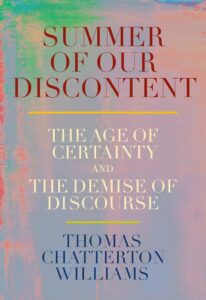
“He styles himself as casting a plague on both American political houses, bemoaning ‘the ill-conceived identity politics of the left’ and ‘the spiteful populism of the right.’ In fact, though, he fixates on mere blemishes dotting the house to his left and too often neglects the unmistakable stench of decay emanating from the house to his right. He portrays the reactionary mood in our politics as arising largely in response to the left’s supposed excesses, rather than also endeavoring to probe its independent animating forces … He does not seem to grasp that the left’s illiberalism occupies a marginal position in mainstream Democratic politics and the right’s illiberalism possesses a stranglehold on the Republican Party … Bizarrely hyperbolic … He does not summon the energy to treat Trump with the sustained attention that the dominant political figure of our age demands. A book that purports to examine the last decade of racial politics but refuses to confront fully Trump’s political ascent and career cannot help providing a myopic vision of our era … Williams’s book is impaired by slapdash prose. His writing abounds with interminable, convoluted sentences that teem with digressions and then awkwardly limp toward disorienting conclusions.”
–Justin Driver on Thomas Chatterton Williams’ Summer of Our Discontent: The Age of Certainty and the Demise of Discourse (The New York Times)

“I have wrestled with a Frey-like dread through the writing of this review—I’m afraid that I’ll describe his book and no one will believe me. The two main characters, Devon and her husband, Billy, are a swarm of status signifiers stuffed ungrammatically into a Burberry trench coat … It’s tempting to imagine that the author’s caressing treatment of so much wealth and hotness and success is, in fact, a slap. Maybe Frey is mocking materialism? But if lines like ‘They got married at the Dallas Country Club in front of eight hundred guests in what Texas magazine called the Wedding of the Decade’ are meant critically, it’s hard to know what, exactly, they’re criticizing. Does Frey intend to take aim at the emptiness of money and status as metrics for the good life, for human flourishing? If that’s the case, the book’s obsession with niche signifiers is so extreme that he seems to be targeting no one but himself. Likewise, the intensely retrograde gender politics—and the text’s out-of-control, onanistic eroticism—seem fairly personal and specific. As satire, Next to Heaven is unintelligible, as though someone is universalizing their own hangups and then skewering them for clout. Writers of autofiction have been accused of trying to preëmpt criticism by couching their work in self-awareness. That’s not the play here. What preëmpts criticism of Next to Heaven is simply how bad the book is…On the other hand, a goal of autofiction, which often attends closely to small details, is to cultivate exquisite awareness in the reader. And it’s true that, while reading Next to Heaven, I sometimes thought I could feel individual cells in my body trying to die.”
–Katy Waldman on James Frey’s Next to Heaven (The New Yorker)
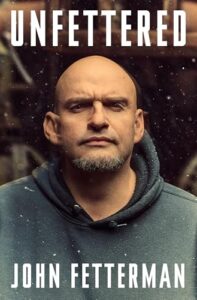
“After Fetterman returned to the Senate in April 2023, he went from being a center-left populist with gross views on Israel to a full-on genocidal contrarian who has much higher approval ratings among Pennsylvania Republicans than Pennsylvania Democrats. He has no political future, but the rest of us are stuck with him for three more years. There is no audience for Unfettered, and I do not think Crown will get its money’s worth on this memoir … Unfettered is boring. It is 213 pages of what the country already knows about Fetterman: that he’s driven by interpersonal grievances, insecurities, and immaturity. He’s only reflective in bouts and fits. He spends all of four paragraphs talking about Israel, even though Israel dominates his social media feed. He has very little to say about President Trump, except that he is the president and so we must respect him … As one former Fetterman advisor texted me, ‘I think what comes across is the reality of who he is, which is a petulant child who never became a man and is always the victim of his own narrative—even though he’s never had a real job and lives off his dad’s money. It’s all pretty sad and pathetic.’”
–Alex Shultz on John Fetterman’s Unfettered (Defector)

“You might think that a book as trite and self-aggrandizing as this one would appeal to someone like me. Perhaps I just wasn’t in a good mood. Or perhaps it’s not a very good book … You can fly through the short, sunscreen-greased chapters in an afternoon. But that’s not good enough for a behemoth like Reid, whose previous books I have enjoyed. A beach read (which given the release date is clearly what the publishers are gunning for) should slip down like a tangy, frosted cocktail. Whereas Atmosphere is like eating a bowl of broccoli—in space … Part of the problem is Joan, a protagonist so maniacally accomplished…and alienatingly nice that you sympathise with her girlfriend for running off to space. Then there’s the progressive political messaging, which is about as subtle as a piece of moon rock to the skull … So perhaps we could have survived without the Nike-style motivational slogans…and tortured metaphors … When I interviewed Reid in 2022, she told me that ‘fun is not antithetical to substance.’ In Atmosphere, just to make sure, she gives us neither.”
–Susie Goldsbrough on Taylor Jenkins Reid’s Atmosphere (The Times)
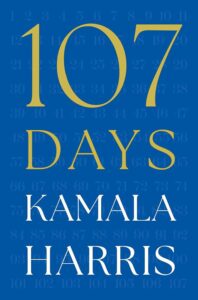
“Kamala Harris’s 304-page excuse for why she lost … The book is one long cast list for a film with Harris as the star. This is politics as celebrity, not policy. It eerily suggests that Harris thinks the process by which America decides who wields power is little more than a Hollywood performance … The surreal tone, and the unwillingness to ponder what the voters actually wanted —except as monolithic categories such as black women—is so vast that it becomes clear her only aim is to defend her reputation, not reflect on the consequences of her and Biden’s cowardice and solipsism … Harris is in many ways the embodiment of woke capitalism, which one might define as the use of social and ethnic positive discrimination in order to sanitize economic inequality … She is incurious about the populist age in which we live … Having offered this contentless, self-exculpating analysis, she concludes that politics is so broken that she no longer thinks working inside the system can solve anything. That’s probably an affectation. But her refusal to investigate why the system is so broken is the natural outcome of her studied vacuity. The book’s conceit is that the Democratic Party had 107 days to stop Trump, and not a decade or two. Any politician who thinks this is true is probably more interested in excusing themselves from the consequences of the loss. The entire premise of the book is a revealing self-deception: that Washington’s personality politics is what determines elections—never mind the economy or, for that matter, the voters.”
–Freddie Hayward on Kamala Harris’ 107 Days (The New Statesman)
*
Pining for the pans of yesteryear?
Take a walk down memory lane with the most scathing book reviews of 2017, 2018, 2019, 2020, 2021, 2022, 2023, and 2024.

Book Marks
Visit Book Marks, Lit Hub's home for book reviews, at https://bookmarks.reviews/ or on social media at @bookmarksreads.