The Magic in the Cards: How Tarot Helped Inspire My Latest Novel
Jennifer Murphy on the Long History of a Card Game Turned Spiritual Practice
I was maybe nine years old the first time I saw a deck of tarot cards. One of my babysitters brought them to our house. She waited until my parents left before whispering to me, “Would you like me to tell your future? These cards contain magic.” She added, “Don’t tell your parents.” This of course made whatever it was she was about to do even more intriguing. I went to what some of my neighborhood friends called “God School” meaning parochial school, so there was no way my parents would have allowed fortune telling or any otherwise “heathenistic” practice in our house. She lit candles, turned off the light, shuffled the deck, and laid out the cards in what I would later learn was the Celtic Cross spread.
I don’t remember what she said about my future, but I do remember being mesmerized by the beauty of the cards themselves. While old and worn, they appeared illuminated like the stained-glass windows at church and included highlights of gold. My young mind was convinced that anything so shimmery and secretive must contain magic. She became our regular sitter for a while, and every time she came, she read the cards. I had completely forgotten about the cards until years later when my college roommate and I were at a small café that served Russian Tea. A woman wearing vibrant colors, flowing fabrics, and bold jewelry was reading tarot at a nearby table.
A feeling of happiness washed over me as I remembered my babysitter’s cards. I asked the woman where she got them. The next day after classes, I went to that store and described my babysitter’s cards to the owner. She told me she wasn’t familiar with them, but she did know the woman I spoke of, and pointed to the deck she’d purchased, the Rider-Waite-Smith.
While I no longer believed the cards contained magic, at least in the sparkly wand sense, they always made me feel happy.
In the years that followed, I would accumulate many unique and beautiful tarot decks, and I would become proficient at reading the cards. While I no longer believed the cards contained magic, at least in the sparkly wand sense, they always made me feel happy. One day, while walking through the San Lorenzo Market in Florence, Italy, I came upon a merchant whose wares included homemade candles, incense, and several decks of tarot cards.
“I’ve never seen so many unique decks,” I said, and as I had done many times by then, I described my babysitter’s cards to her.
“I have a deck that sounds similar,” I remember her saying as she opened an ornately carved box. “It’s called the Visconti-Sforza.” The cards were larger than any deck I owned and the images were both intricate and gilded. Though I couldn’t be certain they were the same as my babysitter’s, for a moment I felt that same sense of magic. She proceeded to tell me that the deck was a facsimile of the original ones once used by aristocratic families in 15th century Italy when such cards were individually hand-painted by artists of the Renaissance. Then she said this, “Back then the cards weren’t used for fortune telling. They were used to play a game called Tarocchi.”
“A game?” I asked.
She nodded.
“How much are they?” I asked.
Let’s just say they cost way more than I could reasonably afford.
When I returned home, I researched the history of tarot.
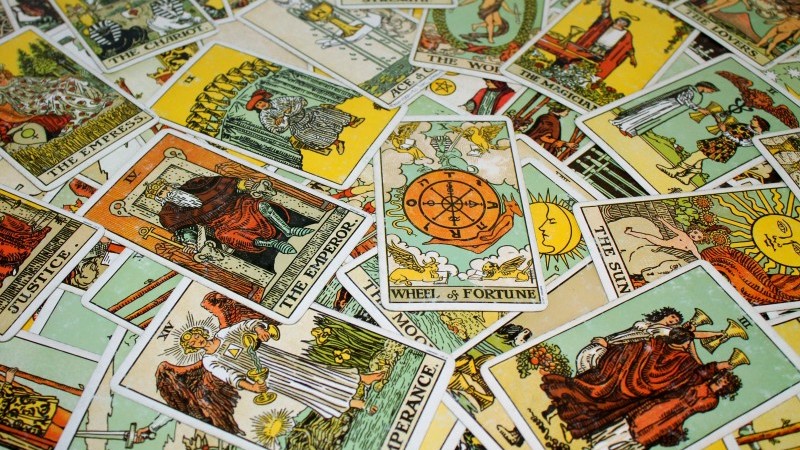
As the earliest known tarot cards, the decks called Tarocchi were created for trick-taking games like modern day bridge. Commissioned by noble 15th century families such as the Visconti and Sforza, the cards were lavishly illustrated by court artists, each hand-painted and gilded, making them luxury items rather than tools of mysticism. The structure of the decks included four suits—Cups, Coins, Swords, and Batons—alongside a series of trump cards known as trionfi. These trump cards depicted allegorical figures such as Justice, Temperance, Death, and The World, reflecting Renaissance ideals of virtue, morality, and cosmic order.
By the 16th century, Tarocchi had spread beyond Italy into France and Switzerland, where the game evolved and standardized. The number of cards stabilized at 78, including 56 in the four suits and 22 trump cards later known as Major Arcana. While the game remained popular among the elite its ornate imagery also continued to fascinate artists and intellectuals, laying the groundwork for symbolic interpretations. During this period, the cards were still devoid of mystical associations. They were objects of leisure, not prophecy.
The transformation of Tarocchi into a divinatory tool began in the late 18th century, driven by the rise of occultism in France. In 1781, Antoine Court de Gébelin, a Protestant pastor and Freemason, published Le Monde Primitif, a multi-volume work claiming that tarot cards preserved the wisdom of ancient Egypt. Though historically unfounded, this assertion electrified European esoteric circles. He argued that the cards’ imagery encoded universal truths, linking them to astrology, numerology, and the Kabbalah. This speculative leap marked a turning point. Tarot was no longer a game but a symbolic system capable of revealing hidden knowledge. Soon after, Jean-Baptiste Alliette, known as Etteilla, published the first book on tarot divination and created a deck explicitly designed for fortune-telling. Etteilla’s innovations included assigning meanings to each card, introducing reversed interpretations, and correlating the cards with elements and zodiac signs.
The 19th century witnessed an explosion of interest in esoteric traditions, and tarot became a cornerstone of this mystical revival. French occultists such as Éliphas Lévi integrated tarot into a grand synthesis of magic and alchemy. His influential work, Dogme et Rituel de la Haute Magie (1854), framed tarot as a universal key to spiritual wisdom. This period also saw the emergence of secret societies like the Hermetic Order and the Golden Dawn, which codified tarot symbolism within elaborate systems of ritual magic.
Tarot was already becoming popular in the 20th century when in 1909 Arthur Edward Waite, a British mystic and member of the Golden Dawn, collaborated with artist Pamela Colman Smith to produce the Rider-Waite-Smith deck, that initial deck I purchased when I was a freshman in college. The deck revolutionized tarot by introducing fully illustrated Minor Arcana cards making the system more accessible for divination. In addition to fortune-telling, Waite’s deck emphasized spiritual development and introspection. The Rider-Waite-Smith deck became a template for countless modern variations, influencing both their art and aesthetics.
Because tarot offers a rich language for finding and articulating it has become a powerful tool for creatives including writers and artists.
Today, there has been a resurgence of tarot especially among Gen Z and Millennials. Sales of tarot decks have doubled in the past five years. This boom is less about magic and more about meaning. Platforms like Tik Tok and Instagram offer readings and insights. Once used primarily for fortune-telling tarot has also evolved into a tool for other forms of mysticism such as storytelling, symbology, holistic reflection, spiritual exploration, and therapeutic self-discovery. Psychological concepts for personal growth focus on card patterns, symbols, and archetypes. Because tarot offers a rich language for finding and articulating it has become a powerful tool for creatives including writers and artists.
It was this historical transformation from Tarocchi to tarot that gave me the inspiration to write a novel in which two seemingly disparate stories occur at the same monastery six centuries apart. The Ghost Women begins with a young woman being burned at the stake during the misogynistic gendercide of the 15th century. It then jumps forward to the 20th century and a prestigious art academy where a group of girls calling themselves witches are using modern day tarot cards and other forms of divination to find meaning and effect change during the systemic patriarchy of the 70s. And where someone is using the images on ancient Tarocchi cards as inspiration for a game of murder.
While I love the idea of tarot being used to find meaning and effect change, especially in these uncertain times, I will always believe in the pure mysticism of the cards and I will remain an avid collector of tarot decks for their art and beauty alone. To this day, I remember the wave of recognition that passed through my body that day at the San Lorenzo Market in Florence, Italy. And something else. Some might call it a chill. Others, a frisson. But that day, I decided to believe that what I felt was magic. And what about those cards that cost way more than I could reasonably afford? Well, I bought them of course. And every time I prepare to read them, I light candles and dim the lights just like my babysitter did when I was nine years old. I take a moment to admire their shimmering beauty and open myself to their wisdom and possibility. Then I shuffle, cut the deck, and layout the cards.
__________________________________
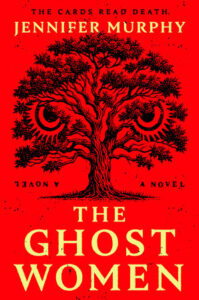
The Ghost Women by Jennifer Murphy is available from Dutton, an imprint of Penguin Publishing Group, a division of Penguin Random House, LLC.

Jennifer Murphy
Jennifer Murphy holds an MFA in painting from the University of Denver and an MFA in creative writing from the University of Washington. She is the recipient of the 2013 Loren D. Milliman Scholarship for creative writing and was a contributor at the Bread Loaf Writers’ Conference from 2008 through 2012. In 2015, her acclaimed debut novel, I Love You More (Doubleday, 2014), won the prestigious Nancy Pearl Fiction Award. Her love of art led her to start Citi Arts, a public art and urban planning company that has created public art master plans for airports, transit facilities, streetscapes, and cities nationwide. She hails from a small beachfront town in Michigan and has lived in Denver, Charlotte, Seattle, and Charleston. She currently lives in Houston, Texas.