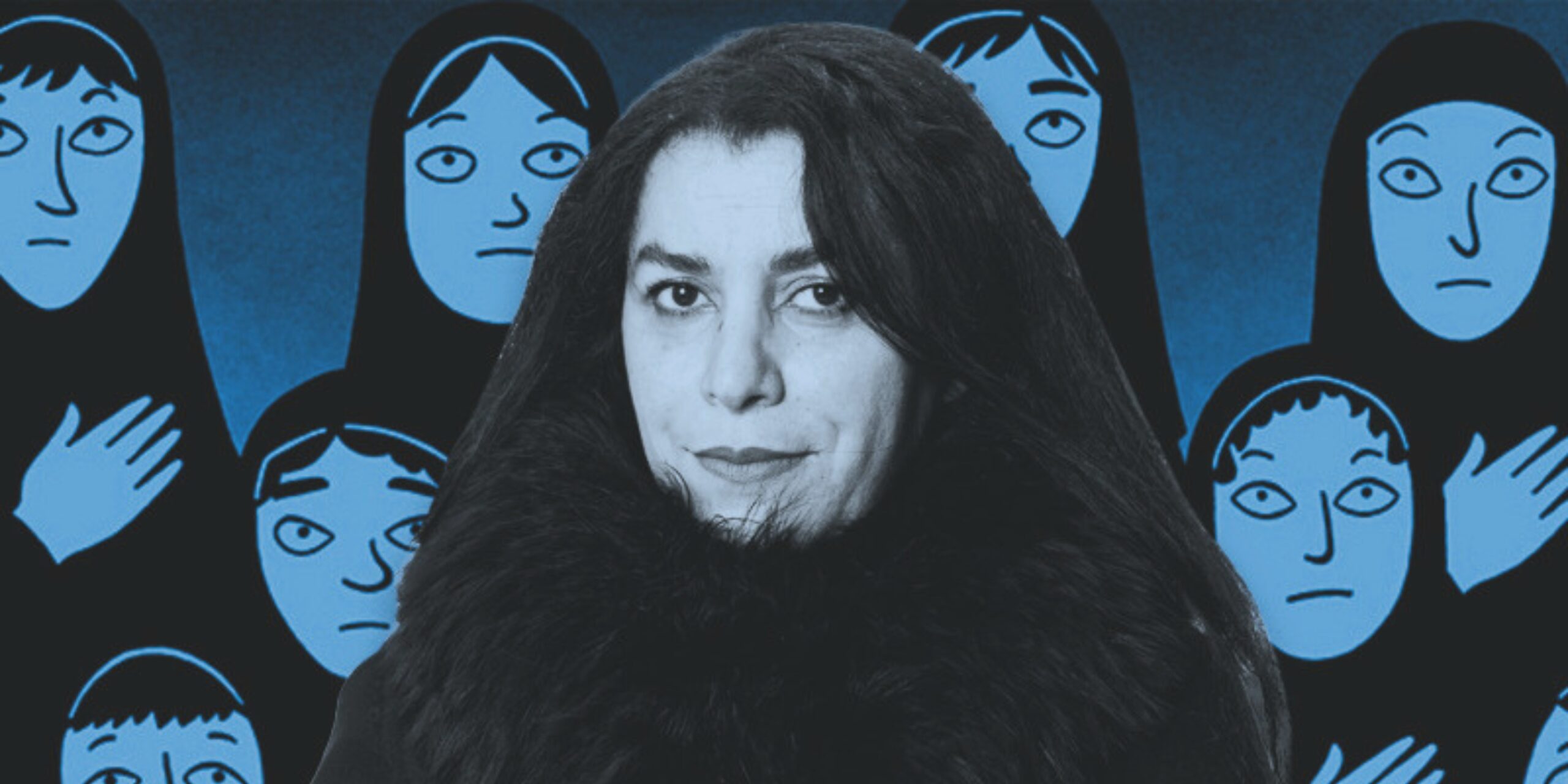
The Losses that Carry Us: A Tribute to Marjane Satrapi
Fatemeh Shams on Loss, Veil, Exile, and the Passing of a Literary Giant
On Thursday morning, June 4, I woke to the tragic and shocking news of Marjane Satrapi’s death. It was not the first time I had learned of a loved one’s loss in exile in the most mundane, alienating way: half-awake in bed, phone in hand, scrolling through messages and headlines, confronted by yet another immeasurable catastrophe. The news of my father’s passing reached me in a similar way seven months ago. Suddenly, everything felt darker, more fragile than it had the day before.
I sat in my Philadelphia apartment, still in pajamas, as grief arrived in waves: first numbness, then denial, and finally tears that blurred every word and memory at once. I scrolled through news feeds, searching for answers I knew would not compensate for her loss. On Narges Mohamadi’s foundation page, I read her family’s note: “she died of sorrow.” Four devastating words echoed the Persian compound we use for this kind of death: degh kardan: to die of sadness so deep it shatters your whole being. In English, they call it “Broken Heart Syndrome,” a phrase too clinical, too far removed from the untranslatable ache that sorrow leaves in the body in its wake.
Marjane’s husband, Mattias Ripa, the Swedish actor and filmmaker, had died just fourteen months earlier. Afterward, no matter how hard she tried, she could never quite return to herself. On the day of Mattias’s funeral, she told a close friend, “I think I’m dead already. I will not be able to live after this.” A phrase she repeated often until she, too, left this world. The fierce woman who always wore black, who could light up a room with her sly jokes and smoky laughter, grew quieter and more fragile after losing her lover. Her sadness sometimes showed at the edges, in the way she looked away or stubbed out a cigarette a little too hard. When she lost Mattias, followed so quickly by a massacre and a war in the homeland she loved so fiercely, something in her seemed to give way. It wasn’t only the loss of her partner; it was the darkness creeping over Iran and the pain of watching her country suffer that finally shattered her heart.
It wasn’t only the loss of her partner; it was the darkness creeping over Iran and the pain of watching her country suffer that finally shattered her heart.
As I wove through the layers of devastating loss she had endured, her sorrow felt intimately familiar. From that 5 a.m. in November 2025, when my sister’s shaken voice reached me from Mehrabad Airport with news of my father’s passing, to attending his funeral in exile over Facetime, to a bloody massacre forty-five days after his death, and a destructive war forty days after the massacre, I too became lost in the dark maze of time, bearing loss and grief, wave after relentless wave. Over the past seven months, there were many moments when I wondered if my body could bear any more pain or horror. Suddenly, Marjane succumbing to sorrow became achingly comprehensible. How much loss can a human carry before, finally, it is the losses that carry us?
On the morning of June 4, I recalled, as I so often have, a line from Mahmoud Darwish’s Memory of Forgetfulness: “Do you have any weapons on you? I have a longing that’s killing me.” That morning, longing felt like a weapon: silent, sharp, and devastating in its reach.
*
I first read Satrapi’s Persepolis in the summer of 2007, a year after I left Iran for the United Kingdom to begin a graduate degree in the history of Muslim Civilizations. That move, for all its promise and excitement, was also a small death; a shedding of one life and the tentative birth of another. In the classroom, my worldview was being unmade and remade as I relearned the history of Islam, questioning everything I thought I knew. At home, I argued with my then-partner over the fundamentals of our faith, above all the veil. Those arguments, unresolved and intensifying, eventually broke our marriage.
Satrapi’s story of mandatory veiling, of girls and women forced into a double life in the wake of the 1979 Revolution, deeply resonated with my own experience. But unlike her, I grew up in a religious yet conflicted environment and a conservative Shia city, Mashhad, where I had to fight for every inch of personal freedom since the age of seven. As I paced through Persepolis at the age of twenty-four, I found myself envying the support and empathy that Satrapi received from her family. In the face of external censorship and control, her home was a shelter while mine mostly felt like a battleground. It was after reading Persepolis that I realized how deep my wounds ran, how many scars I carried from fighting the ones I loved most.
What struck me most in Satrapi’s rendering of the veil—and of Islam itself—was her refusal to settle for the literal or flattened stereotypes that so often populate Western narratives. Through a frank and daring personal account, she showed how state-sponsored censorship and mandates imposed on Iranian bodies after the revolution inevitably seeped inward, leading to self-surveillance and restraint. I could not help but think of my own mother, a secular, leftist student activist before the revolution, who, in the aftermath of the revolution, was briefly banned from university and only allowed to return after signing away her political beliefs. The revolution was a metamorphosis for her: it shattered her daily life, led her to a marriage she might never have chosen, disappeared and purged her friends, broke her trust in others, and cast her into a deep silence about her past life.
What struck me most in Satrapi’s rendering of the veil—and of Islam itself—was her refusal to settle for the literal or flattened stereotypes that so often populate Western narratives.
As Satrapi brilliantly accounts, the state’s imposition of veiling and bodily regulation after 1979 did not end at the public threshold; it traveled inward, generating a choreography of self-censorship—an endless negotiation between the self shown to the world and the self hidden in private. My mother’s life was the embodiment of that censored self. Satrapi returns to this quiet coercion in Persepolis, especially after Marji’s first return to Iran: the double life, the careful calibration of speech and silence, the endless inner negotiations that become second nature in a society built on watching and being watched. In every detail, I saw the contours of my own post-revolutionary life.
But Persepolis, for me, was never just a personal memoir. Rereading it now, seventeen years into my own exile, I see it as a map of estrangement; a narrative shaped by the trauma of leaving and the uneasy hope of homecoming. Satrapi shows us that under authoritarian rule, exile is experienced not only in leaving home, but in the slow erosion of the self from within. The state-mandated rules reach far beyond public and private life, imposing borders not only on the map, but deep within the psyche to quietly shape how a person moves, speaks, even dares to imagine.
When Marji returns from Vienna in Persepolis, she faces not only the strangeness of her homeland, but the shock of being a stranger to herself. Rereading those pages, I am reminded of a recurring nightmare I’ve had over these years in exile: what if I return one day and feel even more alienated from the place I once called home? It’s a fear that haunts many exiles—a sense that the true distance is not always measured in miles, but in the silent, widening gap between memory and return.
*
In 2010, a year after the rise of the Green Movement, I publicly denounced hijab. The consequences were far more dire and devastating than I could have imagined. Beyond the daily arguments and tensions at home with my then-partner and our families, I became the target of a vicious smear campaign orchestrated by the regime’s hardliners. Some mornings, I would wake to find blurred photographs of me, my uncovered head, and my neck and arms pixelated, circulating on their websites. Among religious reformists and intellectuals, people I once considered allies, I was suddenly branded a traitor to their values. Male guardians of this ideological camp circulated defamatory letters from prison, denouncing me for unveiling and rebelling against mandatory veiling. In their eyes, unveiling meant succumbing to Western influence and abandoning my authentic self. Somehow, they felt entitled to know me better than I knew myself. Among the hardliners, I was condemned as a seditious woman. The experience of unveiling and being viciously denounced by all sides was a brutal lesson at twenty-seven. But it also steeled my resolve; and after my painful divorce at twenty-eight, my commitment to resistance had only deepened.
In the years since, I have come across critics in the West who accuse Satrapi of orientalism, or even Islamophobia, as if her willingness to expose the contradictions and cruelties of life under authoritarianism were mere performance for a foreign gaze. I have read academic arguments that Persepolis risks reinforcing Western fantasies about oppressed Muslim women, or that her voice somehow betrays an “authentic” Iranian experience. In her interviews, Satrapi’s position on the veil has been clear: “I have nothing against the veil. I have something against being forced to wear a veil… For me, prohibiting the veil and forcing it is the same. You cannot just go and tell people what they should and should not do.” Her words cut through the easy binaries that often shape Western debates, reminding us that “the world is made out of black and white and bad and good, and if you want to make the story just a little bit more complicated it doesn’t please anyone.”
Like Satrapi, I have been accused of “Islamophobia” by some critics in the Western postcolonial camp, merely for refusing to reduce the hijab to a binary symbol that can be either just good or evil, oppression or liberation. What so often gets lost in these polarized debates is the complexity of women’s lives and the fact that the meaning of the veil cannot be dictated from above or imposed by the state or society. What is often lost in polemical arguments about the hijab is that it is not a monolith; for some, it is a marker of faith or belonging; for others, a tool of resistance or a site of struggle; and for some, simply an article of clothing. To honor its intricacies is to defend a woman’s right to choose for herself, free from coercion, stigma, or prescriptive narratives about how she wishes to appear in the world. For Satrapi, me, and many Iranian women, writing about the veil is to bear witness, to speak the truth of one’s own life, even when it unsettles others. It is not an act of betrayal or bigotry but a profound fidelity to self and history. Satrapi’s life and vision remain a testament to that rare courage.
*
I met Marjane and Mattias in March 2019, two years after immigrating from the United Kingdom to the United States to assume a professorship in Persian literature at the University of Pennsylvania. Our encounter took place at the height of the Trump era, when closed borders and the Muslim travel ban made returning to the UK–a country I had adopted as my second home after leaving Iran–impossible. An executive order suddenly rendered the UK, where I’d lived for a decade, inaccessible and cost me the chance of British citizenship. Disillusioned and adrift, I found the very concept of belonging suspended and unattainable.
During that period of double exile, caught between homes and identities, I met Marjane, who arrived in Philadelphia as the featured speaker for the Levin Family Forum. When I was invited by the Dean’s office to moderate our conversation, I felt both exhilarated and anxious. Marjane was known for her wariness of interviews, and her ability to disarm with sharp wit and bittersweet humor could turn incisive. I returned to her work once again, this time as an Iranian exile, a stateless alien, searching for belonging in her pages—and wondering whether, in meeting her, I might find a kindred spirit in exile.
On the evening of the event, just days before Nowruz–the Persian New Year–we stood outside the Annenberg School Auditorium, sharing a cigarette in the brisk March air. Both of us dressed in black, we spoke about our grandmothers, the tumult of adolescence, and the bittersweet comforts and wounds of living elsewhere. Marjane laughed easily; her warmth and directness dissolved my anxiety. She confided, with her characteristic mix of mischief and sincerity, that interviews rarely interested her, but in this conversation, she felt an unusual sense of ease and trust. “Don’t stress! Let’s finish this, and then smoke more cigarettes afterward,” she said, flashing a grin as we headed inside.
That night, on stage, her presence was electric: simultaneously fierce and generous, raw and deeply human. Our conversation unfolded less as an interview and more as an encounter between two exiles deeply connected to our origins. It felt like the beginning of a long-overdue friendship. Marjane reminded me, as her work often does, that in the bleakest times, art, writing, and human connection are radical acts of repair. “Continue to write and tell your story. Otherwise, what reason would you have to be alive?” she said, taking another drag from the little Bahman cigarette, an iconic Iranian brand that I gifted her that night.
Marjane reminded me, as her work often does, that in the bleakest times, art, writing, and human connection are radical acts of repair.
The loss of Marjane Satrapi leaves a deep absence in the landscape of my own exile. Yet, her art endures and embodies the contradictions and passions that defined her. In a world frequently divided by ignorance, bias, violence, and fear, Satrapi offered the possibility of understanding, resilience, and grace. Her legacy persists not only in the stories she told but in the countless lives she transformed through her storytelling.
Satrapi’s greatest gift may have been her refusal to surrender to cynicism, a defiance she wore as both armor and invitation. “It is very easy to lose your hope, because how can one not become cynical?” she once told me. “The biggest fight in my life was to go against cynicism, because life is like a Greek tragedy; everybody who has a conscience must end up cynical. This is life. But in the end, you can always keep the light of the stars in your eyes.” In her work and her life, she showed that the distances carved by exile and loss can be transmuted into something enduring and real. She spoke the truth, not as a final word, but as a gesture toward possibility; a way to keep the light burning, and to make of absence something lasting and redemptive.

Fatemeh Shams
Fatemeh Shams is the author of two books of poetry in Persian and a critical monograph in English on poetry and politics, A Revolution in Rhyme. Her first complete poetry collection in English, written in the U.S., Nabood, will be published by Copper Canyon Press in the spring of 2027. She is Associate Professor of Persian Literature at the University of Pennsylvania.