






It took me a long time to grasp the shadowy nature of the literary world. The ins and outs of applying for funding, usually tied to another form of funding, like a grant to a foreign publisher or a translator. Basically, without support from the state, there would be no Czech books published abroad. And even when they are published, thanks to that support, they’re usually just printed, that’s it. The book sits around in some warehouse and no one even knows it exists. Then, after six months or so, I get an email, say, from the Slovenian publishing house Mladinska knjiga, with an official statement informing me of the sale of four copies of my novel Kratka zgodovina Gibanja. My email thanking them for doing a truly excellent job of hiding my books typically goes unanswered. In Poland, fortunately, things are different. I make a note in my calendar of an upcoming event there, marking the nine hundredth birthday of the author of the Chronicle of the Bohemians, Cosmas, whose Polish origin was recently accepted by most Czech historians after years of controversy, which means that the oldest Czech chronicle is of Polish origin. Meanwhile I think back to the affable ex-activist from Egypt who reached out to my agent a few years ago. She offered an average sum for the rights to one of my novels, promising to publish it with “a cult independent Cairo press, specializing in the finest contemporary foreign prose.” It sounded almost as earnest as the activist-publisher’s biography I found online. After obtaining a degree in management, she was employed at Telecom Egypt until, at the age of thirty, she decided to give her life meaning by founding a small publishing house with a café that serves as a meeting place for Cairo bohemians. But a few days later, while looking up grants on the Czech Ministry of Culture website, I accidentally clicked on a spreadsheet titled “Translations of Czech Prose Supported in 2018” and found her name right at the top. According to the spreadsheet, in 2018 she received a grant for the translation of my book at a rate several times higher than the standard. She only bought the rights as a pretext to get funding. There was never any real interest in publishing my work and the novel never came out, though I have no way of knowing whether or not it was translated. Anyway, as long as the money from the Czech Ministry of Culture went to finance the Cairo alternative scene, why not?
I stand in front of a class of my students. They hang on my every word, not one of them is on their phone. The most reliable way to get and keep their attention is to discuss something only tangentially related to literature, like a writer who recycles cigarette butts or Kundera’s recipe for devil’s toast. Meanwhile my three-part talk on the Czech underground, which I spent a month preparing and even managed to convince a few living legends to attend, met with zero response from the students. My assumption that the guest speakers’ anti-Communist insurrection might resonate with today’s youth and their antisystem rebellion proved to be mistaken. David went so far as to call it criminally naïve when I told him about it while I was preparing the seminar.
“They’re going to boo those old right-wingers right off the stage,” he said. “Besides, when was the last time you heard of Czech students holding a protest against anything?”
David is waiting for me outside when I leave the building after class. He stands by the railing, talking with a buxom brunette who sits in the second row and hasn’t shown any interest whatsoever up to now. He waves to me, then turns back to her. Her name is Edita, and she’s nothing at all like her father. She offers me a polite hello and resumes her heated discussion with David. I step off to the side and immerse myself in the papers my students handed in today.
“Given your political views, I wasn’t sure if the ending of your book was meant to be satirical,” I overhear Edita say.
“Reality has outstripped fiction,” David says. “Now more than ever. Plus, the acronyms that I use are solely for stylistic effect. If real literary satire is what you’re after, I recommend Boccaccio.”
Edita shakes her head. She wants to read David Karel, she says, raising her voice in irritation. Then she turns crimson. I feel sorry for her.
“I take it all to an absurd extreme in my last book, Earth Above, Sky Below, don’t you think?” David goes on.
“I haven’t read that one.” She blushes again and stammers that the book isn’t for sale anywhere.
“I’ve got a few extra copies at home. If you promise to donate it to the school library when you’re done, you don’t even have to give it back.”
David’s publisher, Radler, compensates authors for their laughable advances with a staggering number of complimentary copies. His whole entryway is filled with copies of his latest book. He has so many he doesn’t know what to do with them.
As we make to leave, Edita just stands there with an expectant look on her face. After a few awkward seconds, David steps back over to her, shakes her hand and returns to my side. I turn to look at Edita, who stands at the railing following us with her eyes.
David remains silent until we turn the corner. Then he confides that he finally took my suggestion and left his publisher.
Anyone is better than Radler, who jerks his authors around on their contracts and clouds the whole thing in a sophisticated haze as if it were some sort of philanthropic venture. As if Radler wasn’t making a living off his authors but the other way around. That’s what I told David, so I was glad to hear that he took action based on my advice.
David and I cover everything that afternoon, including the roadblock he’s come up against on his latest book that’s kept him stuck for months. He says he avoids bringing it up with Marie, which of course creates other problems, and we haven’t even reached the river yet when we come around to the subject of Irge’s “scandalous” opening, which is happening in a few days. We agree that the use of the word scandalous as a selling point dates back at least a hundred years and, waiting in line at the stand that claims to have the best kebab in Prague, the one thing we can’t settle on is whether Irge resents it, couldn’t care less or is actively encouraging the use of the word.
We sit in the same spot as we did after my book launch, but on the other side of the river, chewing our food in silence. David takes a napkin and wipes a drip of garlic sauce from my chin. A text dings on his phone.
“She’s asking when I’ll be home.”
I study the spot on the far side of the river. It would be quicker if he called, but instead David takes the cowardly route, tapping out a message. After a few years, most relationships, one way or another, turn into slow-burning wars like this. A futile situation I experienced once myself.
Vladimír, my ex-husband, was an engineer for an eco-friendly home furnace company. We met when he came to our building to give our co-op an estimate on a furnace. I served on the board at the time, and was an ardent advocate for community living. That day—which he and I spent going around the apartments, talking to people I had only ever met in the hallway, and who now invited us in for coffee, over which my future husband and I convinced them of the benefits of cost-effective heating—was the best day of our entire relationship. Later that evening, as we opened a bottle of wine back at my place, there wasn’t a doubt in my mind that Vladimír was the one. A month later we were married, and ten months after that Judita was born. She’s only a year older than Ondřej. It came as a shock when I got pregnant again. In retrospect, it was good luck they were born one right after the other.
Across the river, a guy and a girl sit on a sweater, just like me and David the night of my book launch, and just like us, they’re having a heated argument. The girl pokes the guy, then shoves him so hard it’s a miracle he doesn’t fall in the river. She keeps pushing him away as he attempts to come closer. He keeps trying over and over and she rejects him every time. The whole thing looks pretty comical. I remember the moment I realized, back when I was a schoolgirl, that boys could actually hurt me. The moment it first dawned on me that not all arguments are verbal. Gradually all the girls my age came to that realization and from then on acted accordingly.
David glances up from his phone with weary eyes.
“She says she’d like to talk to you.”
“Marie?”
David nods.
“She thinks you can talk some sense into me.”
David helps me get to my feet, dusting off my pants with his hand. The young couple on the other side of the river is gone. In the book I’m writing now, the main character would immediately question whether they were ever there at all. Dreams are the lamest narrative device you can use, I reflect on my way home. Except for my time with David, I try to not to think about writing outside my workspace. It’s the only way I can manage the rest of my life. Though as my son Ondřej likes to say, it’s not like I have one anyway. Ondřej is sixteen and generally acts like a brat, but I’m his mother, so I choose to believe it’s just puberty. Whenever I complain about him in front of my mother, she points out that at least he has interests. The floor of his room is covered with comics he’s “working on.” He’ll never finish any of them, but I’ve only told him that once. He snapped back that nothing he does is ever good enough for me. My best friend Irena says so too. She says I make impossible demands on my kids. I have no idea what she’s talking about, besides my requirement that they not grow up to be animals. A few months ago, just before she became an activist, I asked Judita what her favorite thing to do was. When she answered shopping, I had to bite my tongue. If I had to choose between her setting herself on fire like Jan Palach or being a mindless consumer …
The fleeting touch of David’s hand. He says goodbye as we come to a stop in front of my building. I invite him up, but he declines, saying he needs to get home to Marie.
“Tell her to get in touch,” I say. “I’ll take her to Klakson.”
“Where?”
“It’s this new hip bar.”
David either doesn’t hear or doesn’t care.
“I’m going to publish with Oto. I took your advice. We shook on it yesterday.”
I’m happy for him. We part with a kiss on the cheek.
To my children I’m just a stepping stone. A lemon to squeeze and throw away. To some extent it’s natural. The question remains, as always, in every situation, what is that extent? I’m sure Judita doesn’t act out nearly as much with her father. She wouldn’t dare.
__________________________________
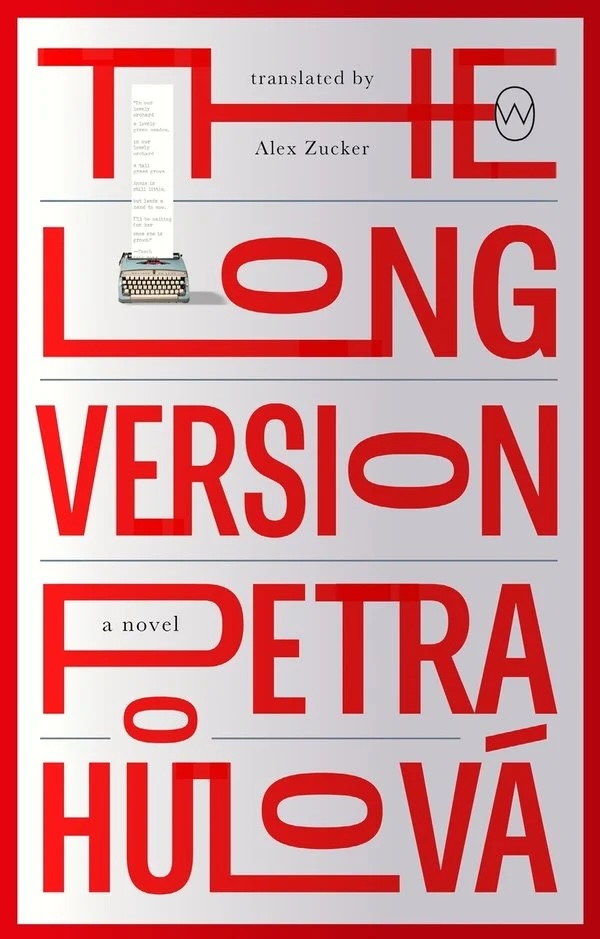
From The Long Version by Petra Hůlová (trans. Alex Zucker). Used with permission of the publisher, World Editions NY LLC. Copyright © 2023 Petra Hůlová. Translation copyright © 2026 Alex Zucker.
__________________________________
The Czech Center New York, in coordination with European Union National Institutes for Culture (EUNIC New York), is presenting the 8th annual European Literature Night (ELN 2026) at the Ukrainian Institute of America on Wednesday, October 28th at 6:00PM ET. ELN 2026 will explore four urgent themes that are currently shaping contemporary European Literature: In the Land of Women, Breaking the Mold, Resilience & What the Earth Reveals, and Europe’s Haunted Century. Free and open to the public, the event will bring together fourteen award-winning authors, each from different European countries, who will be celebrating the English translations of their latest works during an evening of performances, readings, and panel discussions moderated by PEN America. Details for the event can be found here.