At the age of twenty-one, when I was a senior in college majoring in music composition, my friends took to calling me “The Youngest Spy in the World.” I let them. More than that, I leaned into it, wearing the phrase like a second jacket far more stylish than the one I’d given myself: Aspiring Composer, which felt, even then, like the sort of thing you write in pencil until you’ve done something worth the ink.
They were partly mocking me, of course, maybe even a tiny bit jealous of a part-time job I’d recently quit—one I’ll explain in due time with all the necessary theatrics it seems to demand. (Believe me, I’ve tried telling it plainly, but it refuses to cooperate.) But behind the eye rolls and manufactured intrigue, there was something else, a grudging fascination with the idea that one of us might already be living a life with layers—a quiet sub-plot stitched beneath the predictable script of overcrowded lecture halls, overpriced textbooks and overcooked commons food. (The previous Thursday’s entrée was done so aggressively, I didn’t know if I’d eaten fillet of sole or the sole of a Birkenstock.)
The truth is, there really was no way of knowing if I truly was The Youngest Spy in the World. There was no Google. This was the late ’80s in Hartford, Connecticut. Before the internet. Before hostesses stopped asking, “Smoking or non?” Before toothbrushes started looking like sneakers.
As I sat there in our university’s computer lab, putting the finishing touches on my résumé, I debated whether to include the spy gig at all. On the positive side, it suggested I had once worked for a well-known company nestled comfortably within the rarefied world of classical music, the very world I was so desperately trying to elbow my way into after graduation. On the negative side, the job hadn’t lasted long. But then, none of mine ever did. My résumé to this point read less like a career path and more like a series of polite evictions. And worse—far worse— was the matter of the upcoming internship interview at the local classical radio station, where I was hoping, praying, practically vibrating with desperation, to get the job and, God willing, keep it. Because if anyone were to ask about said position listed, I would be obligated, by both conscience and a pathological inability to lie convincingly, to explain that the so-called spy gig had involved, among other things, lap dances. From strippers.
As I typed and retyped the job onto my résumé, I found my finger uncontrollably backspacing each time, like it was embarrassed for me—a tiny, judgmental assistant refusing to let the job be a permanent part of my professional narrative. It seemed to already picture the reactions from folks at the radio station during my interview: brief, frozen smiles followed by the carefully worded “Well, that’s…certainly unique experience”—delivered in the same tone you’d use to compliment a child’s finger painting—right before sliding the résumé into a folder labeled “Absolutely Not.”
The internship interview, arranged for me as a huge favor from the dean of my music school, was at Allegro FM, home to the legendary Bertram Bobker, who’d been the voice of the station for the past forty-some years. Now, in his mid-eighties, the man behind the voice was still completely lucid.
Utterly besotted with Bertram, I was the kind of fan who might as well have had his face on a T-shirt and his quotes tattooed on my forearms. As with EF Hutton, when Bertram spoke, people listened. He had one of those upper-crust Bostonian accents where the “W” and “H” of words like when or why or what were almost individually pronounced—pure butter (which he would have pronounced butter, not budder, like most people do).
The man could make a discussion about strophic interludes, as found in medieval motets, sound interesting. Plus, he was a comic genius. I remember once listening to him on the radio while making the long drive from my parents’ home in New Jersey back to Hartford. He was discussing the difference between classical music and the Classical era. He said: “In addition to the already discussed rococo influence and inventions of the piano and smallpox vaccine, it’s impossible to discuss the Classical era without at least mentioning the Industrial, French, and American Revolutions. Okay, there, I mentioned them.”
I laughed so hard I had to pull off on the side of the highway because my abdomen hurt. Landing this internship and getting to work alongside, or even just breathing the same recycled studio air as, Bertram would be like that moment when a teenaged Bill Clinton got to meet JFK in the Rose Garden, or like when I spotted Mary Tyler Moore at a JCPenney in Paramus and briefly forgot how nouns work.
Mr. Bobker aside, getting this job would finally put me in the world in which I actually wanted to work. True, not as a composer, not yet—that particular fantasy still lived in the margins of my notebooks and the quieter corners of my ambition. But this would put me in proximity. A kind of professional osmosis. I wouldn’t be living the life I’d dreamed of just yet, but I’d be close enough to hear it humming in the next room, waiting, perhaps, for someone like me to knock.
All my previous part-time jobs—the ones I’d just typed onto my résumé—while technically in the music business, were so far from the next room, they might as well have been in a windowless basement three zip codes away, staffed entirely by failed balloon twisters and one guy who thought “Rhapsody in Blue” was a deodorant.
Take one of my freshman-year gigs, for instance—the one involving a music store and a manager who said the job was to play piano during lunch hour to keep customers engaged and shopping. I asked if I could play guitar instead, the instrument I was infinitely more proficient on. He stared at me like I was a typo in a love letter: small but ruinous, and far too late to fix. I nodded. Okay, piano it was then.
Things seemed to be going well for a couple weeks as I did passable renditions of songs like “The Entertainer” or “Heart and Soul.” But then one day, he came to me and said there’d been complaints about my repertoire and demanded I play Beethoven’s “Für Elise” from the time I arrived until the time I left, each rendition in a different key, as if this would somehow trick customers into thinking they were hearing something new. “Modulation equals innovation,” he’d said with the smile of a man who’d long ago surrendered to the elevator music of his own life. I got through it okay in its original key—A Minor—but then butchered it so badly in G# Minor, I was let go before I reached the final chords.
Sophomore year started out more promising when I answered a classified ad to create arrangements for a band leader named Johnny Novak. During the interview, he said he’d pay a hundred dollars per arrangement. As I was already performing the daily calculus of rent, textbooks, groceries, and all the other quietly humiliating expenses that lined up like creditors outside the door of adulthood, I said yes to the gig without even asking what kind of band Johnny led. Desperation, after all, has a way of skipping the fine print. It turned out to be a polka band, led by Johnny himself on what might have been the world’s largest accordion—something I might have found charming if I hadn’t been the one tasked with arranging “Pinkalinko Polka” for an instrument I could barely lift, let alone compose for. And that was before factoring in the horns, the drums, the bass, and the slow, creeping realization that I had absolutely no idea what I was doing. Johnny fired me after only three arrangements and never even paid me for the third, which he deemed unplayable. True, I couldn’t play it. But I really did think he should have had the chops.
The whole experience was so demoralizing that, for months after, I scrolled through the classifieds with all the enthusiasm of someone reading their own obituary. I answered job postings like I was tossing notes into a bottle: half hopeful, half already mourning their disappearance. My pride, once upright and starched, had slumped like an old coat on a hook. And still, somewhere in that collapsing tent of ambition, I kept going because, sentimental as I was, my Sears Discover card’s collections agency had shown no particular empathy for my slowly unraveling artistic experiment.
And then one day I spotted an ad posted by The American Society of Composers, Authors and Publishers, better known as ASCAP, on my music school’s gig board. It was vague in terms of job description. Something like, “Are you a music aficionado capable of beating anyone in a drop-the-needle test?” I don’t recall the wording exactly, but what I do recall is that the ad stated you had to be twenty-one to apply and that they were paying twenty-five dollars per hour. Considering it took me ten hours to cobble together one miserable polka arrangement for Johnny (carry the one, if you must)—and that this gig paid nearly five times what I made in high school pumping gas at Texaco in a paper hat—I was, it’s fair to say, absurdly eager (desperate) to get the job. So, when ASCAP rang me up from their headquarters in NYC and asked me to come in for an interview, I was on a train from Hartford faster than you could say “Pinkalinko Polka.”
Among other things, ASCAP collects royalties for songwriters or composers from any establishment playing their clients’ music: clothing stores, restaurants, bars, malls, you name it. ASCAP has a team of full-time employees whose sole job is to monitor radio station playlists and determine which of their clients are being played most often. Based on some beyond-my-ability-to-comprehend algorithm, the millions of dollars they take in every quarter are distributed to members worldwide, including classical composers, whose earnings are subsidized by artists like Michael Jackson and Madonna.
Of course, I didn’t know any of this before the interview. But the night before, fueled by vending machine coffee and a rising sense of panic, I spent hours in the school’s library cramming every article and vaguely related entry I could find, emerging sometime around 3:00 a.m. with a half-decent understanding of performance rights, a page of scribbled talking points, and the hope that no one would ask me to define a “blanket license” out loud.
I sat across from Susan, an ASCAP human resources representative, in an office so aggressively nondescript it felt almost like a conscious design choice. As she was finishing up a call, I let my gaze wander to the large windows behind her. Just outside was Lincoln Center, its white travertine and glass gleaming like a temple. I couldn’t stop thinking about how close it was. A hundred yards, maybe less, stood between where I sat filling out forms and the stage where genius was allowed to ring out in gold and velvet. And I imagined, with no small amount of longing, my own music someday filling its grand halls. The thought wasn’t just a dream; it was a hunger. A low, persistent ache in my chest. I could almost hear it, the hush before the downbeat, the audience holding its breath, the swell of strings. It was maddening, how near it all was. Like showing up to a life that almost fits, watching it flicker behind the windows, and knowing— quietly, painfully—that it’s not time yet, and no one inside knows you’re the one meant to be there.
My eyes rested on the grand concert posters in their glass cases outside on the street, each advertising something wonderful coming soon. Among them, Mozart’s Symphony No. 31— one of his most famous.
Ah…Mozart.
Still waiting for Susan to finish her call, I remembered the first time I truly heard his music, because there is hearing and there is hearing—the kind that rewires your brain in an instant, turning the world from a thing you merely hear into a thing you actively listen to.
It was freshman year, and Jennifer, my first girlfriend, whom I’d met that fall in a course called Music Theory and Analysis I: Diatonic Harmony, had suggested a weekend trip to Boston. The course title made it sound like a nineteenth-century political uprising, but in practice, it mostly involved Jennifer raising her hand with the brazen confidence of a cliff diver named Helmut.
She was the one I’d eventually exchange both mixtapes and virginities with, though not in that order, and possibly not with equal skill. She had a quiet intelligence, a fondness for car snacks, and the sort of detached composure that made me instinctively sit up straighter, as if I might somehow seem more dateable if I didn’t slouch.
The drive was uneventful in the way most first journeys are: a bit too long and a bit too hopeful, the radio oscillating wildly between heartbreak ballads and Christian rock, as if unsure whether to console or convert us.
At one point during the trip, we found ourselves in Harvard Square, where the air smelled like bookstores and old gum. A movie theater was showing the newly released Miloš Forman film Amadeus. We bought tickets. We took our seats. And somewhere between the wigs and the powdered intrigue, my life cracked open like a fortune cookie with too much truth inside. In one scene especially, where Salieri is reading Mozart’s Serenade No. 10 for Winds in Bb Major, describing the music we’re listening to like he was whispering secrets to God, I didn’t breathe for two minutes. That music, and F. Murray Abraham’s incredible description of it, didn’t just impress me; it unstitched me. Each line of counterpoint, each aching harmonic turn, felt like a direct transmission from some higher dimension. It wasn’t just beautiful; it was devastating in its clarity and purpose.
Emotionally, I was leveled by the time the film ended, tears streaming down my face like threads pulled from a worn garment, as Mozart’s body was dropped, nameless and rain-soaked, into the commoner’s grave, the final note of a life too luminous for such an ordinary end.
Without Jennifer’s help, I would barely have found my way back to the T. My body moved, but my mind was still swimming in those chords, still trapped in the raw awe of it. It was as if something inside me had been exposed—some tender nerve or long-dormant hunger I didn’t know I had. When we returned to the Back Bay where our youth hostel was located, I walked straight to Tower Records and picked up every Mozart album I could afford. I didn’t even hesitate. I needed to chase that sound, to live inside it for as long as I could.
Sitting there at ASCAP, still waiting for Susan, I remembered going back to Hartford after that trip to Boston and sequestering myself in the music library, devouring his scores, one after another, along with biographies, as if I could absorb his genius by sheer proximity.
And then I remembered, unfortunately, just how much the man had managed to accomplish at my age. At the very moment I was interviewing for the ASCAP job, Mozart, by the same age, had already written thirty symphonies, countless sonatas, concertos, and nearly a dozen operas. Operas! Full-length ones! I didn’t know much about opera back then. To my untrained ears, every plot felt like an episode of Three’s Company—a simple misunderstanding stretched to its absolute breaking point, except instead of a chuckle and a commercial break, there was heartbreak, vengeance, and a soprano who could shatter glass. But still, what other teenager could have penned nearly a dozen of those? Had there been Google back then, I suppose I would have looked it up. But again, these were the days before the internet, back when Pluto was still a planet and no one argued about it. Way before customer service call centers started experiencing larger than normal call volumes.
Anyway, here I was, the same age, with almost nothing to show for it, unless you counted a handful of student works performed by equally sleep-deprived musicians on campus, or an evening of original songs I wrote and performed at my grandmother’s nursing home in Florida—an event that had been optimistically advertised in the building’s elevator as “An Unforgettable Night of Song.” In hindsight, a poor choice of words, given that most of the residents forgot it was happening entirely.
My gaze returned to the ad out in front of Lincoln Center for Mozart’s Symphony No. 31. He had written it during what was supposed to be a triumphant job-hunting trip to Paris, except of course, it wasn’t. Not only was there no job and no triumph—just another symphony added to the pile of his already staggering output—but his mother, who accompanied him from Salzburg, became ill on the long journey by horse coach and died shortly after they reached Paris.
I shifted in my chair and cast a hopeful glance at Susan, who was now holding up the universal “one more minute” finger, paired with the kind of smile typically reserved for apologizing to someone you’ve just backed into in a parking lot. Then, in a moment of quiet desperation disguised as composure, I did what any rational person might do when their financial security is hanging by a thread: I lobbied the future for mercy—specifically, for a gentler fate in New York than the one poor Mozart met in Paris.
Finally…she hung up the phone and turned her attention to me, explaining the long history of the organization. She also explained that when establishments like clothing stores or restaurants didn’t pay the yearly music licensing fee, a gun-for-hire, like the job I applying for, was sent in to record and note every song played over the course of an evening. The playlist was then used as evidence to force the establishment to pay up. In many cases, after years of not remitting money owed to ASCAP, the company sued the business owners and took them to court. The playlists and evidence I’d potentially be gathering would often be the deciding factor in helping them win their case. Curiously, the establishments most often delinquent in paying such fees, during the time I worked for them, were strip bars.
“So let me get this straight,” I said, once my eyebrows had returned to their natural habitat. “You’re going to pay me twenty-five dollars an hour to sit there and watch women take off their clothes?” I tried to sound professional, but it came out like someone reading a lottery ticket twice.
Susan smiled tightly. “There are downsides to the job too.”
“Really?”
“These bars are full of truck drivers who can be quite rowdy when they’re drunk. There’s also a lot of cigarette smoke, which can be a problem for some. And the music is very, very loud. Like your ears might be ringing at the end of the night. It’s really not for everyone.”
I hadn’t thought of the cons to that point, blinded as I was by my twenty-one-year-old-ness.
“Also,” she added with an even tighter smile, “so as not to draw attention to yourself, you’re going to have to tip the dancers. Not everyone is comfortable with that. Some of the women who work in these places might even sit on your lap briefly as they wait for tips. It’s a matter of how comfortable you are with this kind of behavior.”
I nodded slowly, as if agreeing to a legally binding contract. Somewhere in the far back of my brain—just past where I stored my social security number and a completely unnecessary index of every Beatles song, including which were written during acid, India, or arguments—I began assembling a reel of what I assumed a night might entail. Women. Sequins. Shimmying. Dollar bills. The whole thing had the charged, terrifying glamour of a shark cage dive. Beautiful creatures circling, glitter in the water, and me, barely legal, barely breathing, clutching a crumpled dollar like it was a weapon—or a prayer.
Susan studied my face as if she were waiting to see whether I’d flinch. Then, with the calm of someone who’d already vetted ten terrified college students this month, she went on. “Sometimes you also have to buy drinks. At some of these places, there’s a two-drink minimum. We’d prefer if those were Cokes or ginger ales so you can focus on the job. You can also buy food, which often counts toward the drink minimum. The tips, the drinks, travel expenses to and from—it’s all reimbursable so long as you keep receipts. Where there are receipts.”
She shot me a look that said I didn’t need receipts for the singles and then offered a Tic Tac like it was sedative. I declined. My breath was fine. It was my bank account that reeked. My roommates had already fronted me money to help cover last month’s rent, their generosity offered with the kind of performative nonchalance that only made it worse. They shrugged as if it were nothing—“Just pay us back whenever”—but the word whenever hung in the air like a deadline disguised as mercy. I hated how grateful I was, and how broke I was, and how quietly both seemed to multiply.
Whether Susan was subtly trying to talk me out of the job or simply preparing me for whatever indignities lay ahead was hard to say. She was smiling. But then, some people smile when they lie. And others smile when they know you’ll say yes. When she finally asked if I needed a moment to think it over, to weigh my options (as if I had any), I told her no. I didn’t hesitate. Of course I didn’t. It was the most money I’d ever be paid for anything, full stop. I should’ve been elated—and part of me was. Another part was dizzy with the thrill of not knowing exactly what I’d just signed up for. But as I shook her hand, a different part, the part that had never set foot inside a strip club, let alone imagined clocking in at one, began to panic quietly in the background. This was happening. To me. On purpose.
__________________________________
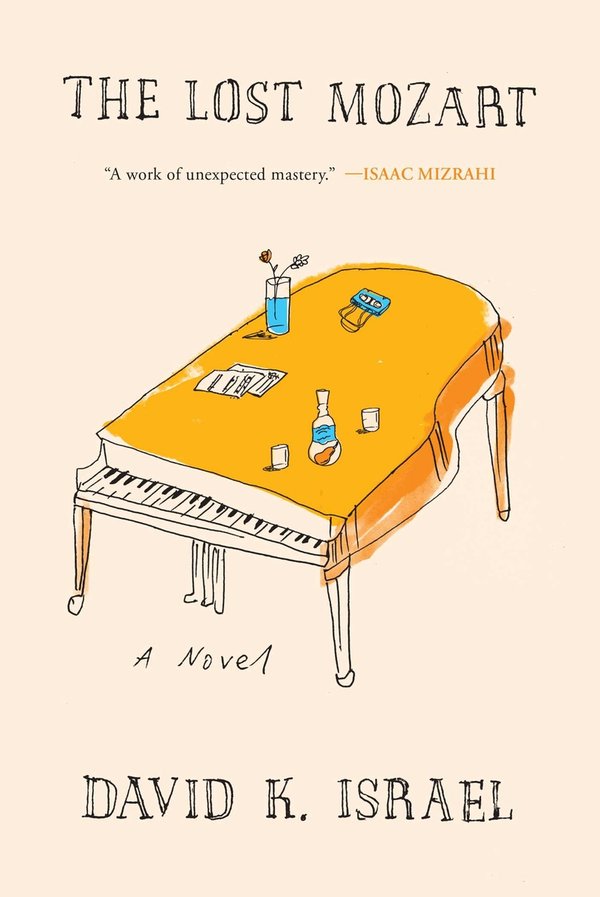
From The Lost Mozart by David K. Israel. Used with permission of the publisher, Regalo Press. Copyright © 2026.