The King of Cheese Has a Long and Famous History
Danielle Callegari on the Historical Significance of Parmigiano Reggiano
The first episode of the first season of the genre-redefining streaming series Chef’s Table on Netflix begins, as one might expect, in Italy. Massimo Bottura, the omnipresent, award-winning, and much-celebrated chef who was then simply famous and now runs a global gastronomic empire, is the star, also as one might expect. What is unexpected, however, is where the story begins: not in Bottura’s wildly successful, three-Michelin-starred restaurant Osteria Francescana, but with an earthquake—a real one, not a metaphor.
In 2012, a powerful quake visited terrible damage on the city of Modena, Bottura’s home and host to his restaurant. We see buildings crumble, sirens wail, and clouds of dust and debris obscure the lens. Then we see the Parmigiano—shelves upon shelves of perfect straw-colored spheres collapsing under the weight of themselves, cascading onto the ground, smashing open to reveal the crags and crevices that only years of aging can achieve, now left exposed and vulnerable. Many millions of euros and hundreds of local jobs hang in the balance.
With swift footwork, Bottura activates his celebrity to focus the world’s attention on the tragedy in Modena. He reimagines the classic, beloved, and easy-to-execute Roman spaghetti cacio e pepe—swapping out the southern dried durum wheat pasta for northern arborio rice, and Laziale pecorino for Emilian Parmigiano Reggiano—to create a new recipe: risotto cacio e pepe. Then, he invites the world to cook rice with cheese. In short order, all the damaged Parmigiano is sold, and thousands of people, within and beyond Italy, are eating it together in solidarity.
Bottura’s success in this case was, of course, largely tied to his ascendent fame and talent for finding ingenious solutions to problems, some obviously gastronomic and others less so. Osteria Francescana was named the best restaurant in the world on the highly regarded San Pellegrino list precisely because it united a spirit of unbridled curiosity and innovation with joyous nostalgia and a deep appreciation for how both personal and cultural memory infuse meaning into food. The menu that started it all featured a dish of uncooked tortellini—tiny jewels of raw dough with gritty, succulent pork filling, set into a broth as though suspended in time—and the “memory” of a mortadella sandwich.
Cheese wields a kind of power over the Italian imagination that cannot be overstated.
For the latter, he first had to commission a cured meat producer to return to a preindustrial style of production, then distilled a mortadella-water from it to make a foam. But most would agree that the headliner was Five Ages of Parmigiano Reggiano: a soufflé, a cream, a mousse, a crisp, an air. Parmigiano at twenty-four months, thirty months, then thirty-six, then forty, then fifty. A riot of textures—with a slow, increasing depth of flavor—like a cave dive, with pauses to adjust to the pressure and the darkness, en route to discovering something never before seen by human eyes. Long before a crisis spotlighted the economic value of this cheese, Bottura had perceived that it stood for something greater than itself.
Cheese wields a kind of power over the Italian imagination that cannot be overstated. It occupies a rare, almost divine space on the peninsula. Even the recipe deemed sacrilegious in Carbonaragate cannot evoke the same dramatic reactions or touch the same sensitivities that surround cheese—a relationship that, like wine and bread, is often inseparable from faith, sometimes quite literally. When reconstructing the Inquisition trial of a sixteenth-century northern Italian miller, historian Carlo Ginzburg encountered a line that would eventually inspire the title of his paradigm-shifting study The Cheese and the Worms.
In this book Ginzburg follows the story of Menocchio, a miller from Friuli, a man of modest means and limited historical impact compared to the major players and large-scale events that typically dominate our explorations of the past. Based on the details of his life, he was not someone we would expect to hear expounding on the metaphysical. Yet as Ginzburg follows Menocchio’s story and discovers his way of perceiving the universe, we realize this humble miller holds a key to unlocking the lived experience of faith practice, one far more relevant to most of us mere mortals.
Despite his apparent “unimportance,” Menocchio finds himself under interrogation by the Inquisition and forced to lay out his understanding of the Christian creation story. Upon hearing his response, his interrogators maintained he was a heretic and a threat to the faithful around him. Indeed his version of the story does not follow Genesis, but instead uses a parallel much more human in its dimensions:
In the beginning this world was nothing, and it was thrashed by the water of the sea like foam, and it curdled like a cheese, from which later great multitudes of worms were born, and these worms became men, of whom the most powerful and wisest was God, to whom the others rendered obedience. . . .
For modern scholars of religious and social history, cheese is not the most exciting part of this discovery. They are more interested in how an average person was affected by the Catholic Reformation and the redefinition of religion on the continent. But for the food historian, this is a marvelous insight into the symbolic role this particular item took on as the Renaissance gave way to the Reformation. Menocchio’s analogy of cheese and worms to explain how the universe was formed is deemed “dangerous” by the inquisitors because it contradicts scripture. Yet their attention also suggests that it might have been influential, potentially because it relied on an item with which everyone would have familiarity, and that all could understand.
Cheese, in this sense, is sometimes like the water we do not hear about in historical sources—so present, so abundant, so commonplace that it does not merit comment. Ricotta, the simplest of cheeses, made by curdling milk and allowing it to set, was almost certainly produced across Italy as far back as antiquity. Yet we find no mention of it in the usual sources. Virgil and his fellow poets, who wrote so eloquently about farming and animal husbandry as Rome rose to power, do not celebrate this fresh cheese made mostly by the poor, for the poor, as it was not suitable for transport and trade.
Late Renaissance artist Vincenzo Campi’s evocative painting I mangiatori di ricotta (The Ricotta Eaters, ca. 1585) offers a glimpse into how ricotta and its eaters were perceived: rough, undisciplined, classless, tasteless. Then again, the haunting shadow of a skull that is hidden in the form of the cheese echoes that vision of Menocchio’s, whose worms crawl out of the coagulated mass as it goes from fermentation to decomposition. The essential, naked qualities of cheese make it a stark mirror for the punctuating marks of our lives. We are formed; we are fresh; we begin to deteriorate; we decompose.
In other forms, cheese has risen to greater heights. Mozzarella has long been held on a pedestal, in particular the mozzarella di bufala of Campania, which has garnered considerable attention and praise. Made with the unctuous 8-percent-fat milk of the water buffalo—animals that may have arrived in the area via the Normans by way of Sicily, or perhaps by the Goths coming from Central Asia—buffalo mozzarella has been produced at least since the twelfth century. Documents from the monastery of San Lorenzo in Capua refer to the tiny balls of fatty milk encased in their own stretchy, tangy skin as mozze.
During the eighteenth century, travelers on the Grand Tour, completing their education in art and architectural history, made an obligatory stop in Paestum. There, buffalo roamed free within the ancient ruins of Magna Graecia in the low, alluvial plains just outside of Naples. The German poet Johann Wolfgang von Goethe, desperate to connect with the grandeur of antiquity and left bitterly disappointed by his visit to Rome, eventually arrived in this once-vibrant center of the extended Greek empire.
Unlike ricotta, Parmigiano Reggiano suffers no historical silence.
In his Italian Journey, he recalls the unsettling experience of encountering the buffalo: “Very early next morning, we drove by rough and often muddy roads towards some beautifully shaped mountains. We crossed brooks and flooded places where we looked into the blood-red savage eyes of buffaloes. They looked like hippopotamuses.” If these quasi-mythical creatures provoked unease, at least among outsiders, their cheese did the opposite. Hovering somewhere between solid and liquid, mozzarella di bufala erupts on the palate with an electric acidity that cuts through its concentrated, velvety curd. It was and remains irresistibly alluring.
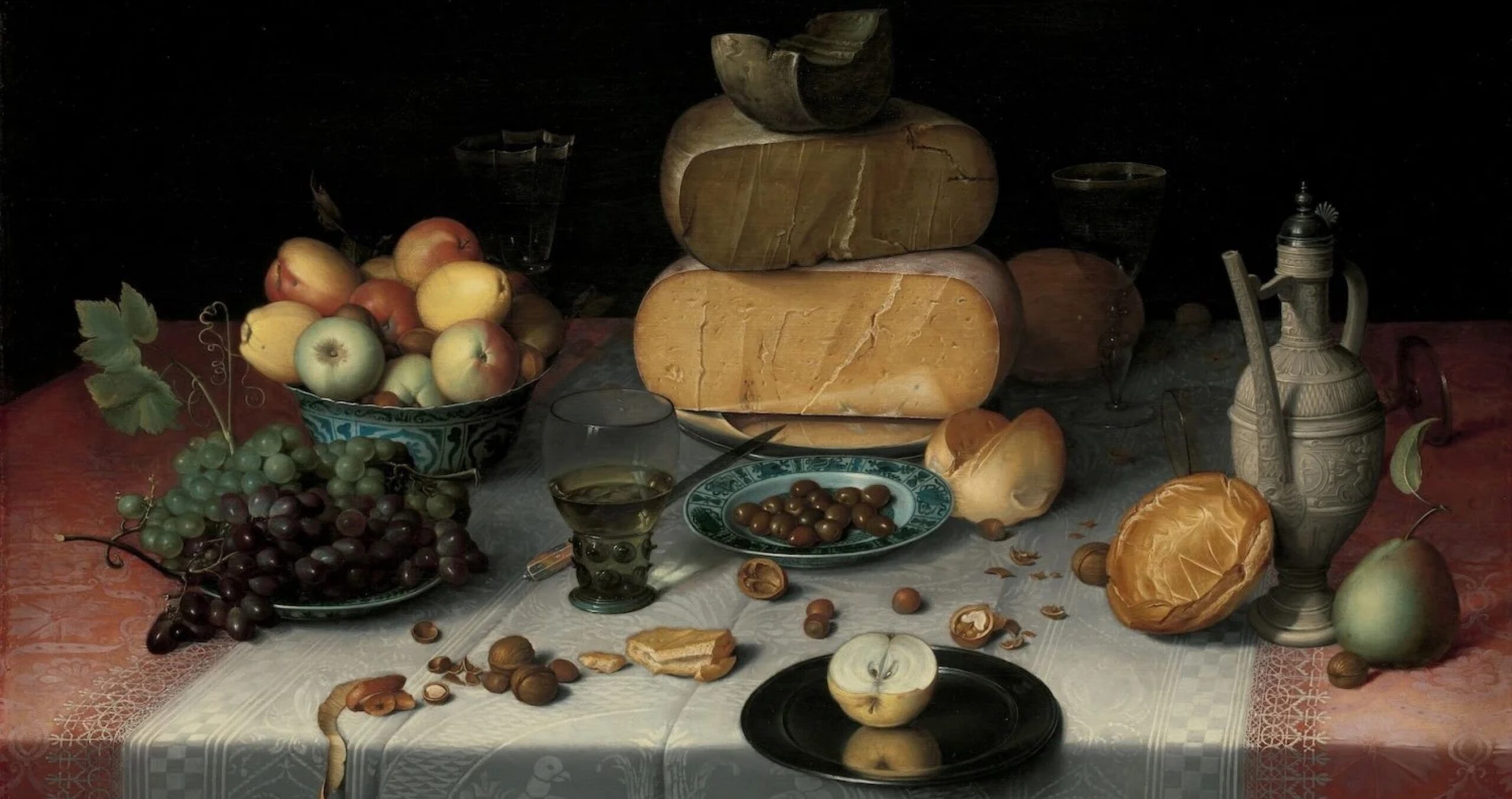
But as the chef Mario Batali insisted, episode after episode on his cooking show, there was and is only one undisputed king of cheese: Parmigiano Reggiano. Named for the cities of Parma and Reggio, near which it originated sometime in the thirteenth century, the cheese owes its birth to a fortunate confluence of natural resources: water, salt, and abundant grazable land. The earliest wheels of Parmigiano Reggiano were apparently much smaller than the car-tire-sized ones that are standard now, but no less coveted.
Unlike ricotta, Parmigiano Reggiano suffers no historical silence. On the contrary, both producers and consumers have long sung its praises, leaving behind a wealth of sources. The author Boccaccio, for one, made it the star of a novella in his Decameron, in which two friends play a trick on a rather gullible acquaintance, luring him into a trap by telling him of a land so gluttonously enticing he can’t resist trying to find it:
The district is called Bengodi, and there they bind the vines with sausages, and a denier will buy a goose and a gosling into the bargain; and on a mountain, all of grated Parmesan cheese, dwell folk that do nought else but make macaroni and raviuoli, and boil them in capon’s broth, and then throw them down to be scrambled for; and hard by flows a rivulet of Vernaccia, the best that ever was drunk, and never a drop of water therein (Decameron 8.3).
Paired with Vernaccia wine, also emerging at this time as a product known for its reliable quality thanks to its relationship to place (aka terroir), Parmigiano was already the stuff of dreams for Boccaccio’s characters, and, we can imagine, for his readers as well. The merchant Francesco Datini, ever with his finger on the foodie pulse, had apparently been warned by his doctor not to eat too much cheese, but he couldn’t resist marzolini (fresh sheep’s cheese) and he was notoriously generous with his sprinkling of Parmigiano on much of his food. By 1389, we even have documentation of Parmigiano being prepared for export from Pisa, confirming its fame had traveled widely enough to generate demand not just across the Italian peninsula, but also in France and North Africa.
However, to call Parmigiano merely famous, even coveted, like so many of the other foods and beverages we’ve discussed as markers of identity and tools for community building, would be to denigrate it. This is because Parmigiano became something far more powerful. In 1542, a nobleman from Piacenza, Giulio Landi, published a treatise entitled La Formaggiata di Sere Stentato in which he listed all the important cheeses of Italy, none of which could hold a candle to Parmigiano:
Because foods garnished with it never offend the palate, rather they are delightfully flavorful . . . without this you cannot make a good lasagna, and without it macaroni don’t even deserve a glance. It is the true sauce for ravioli. A frittata without it is quite poor, and it is the true and real soul of a savory cake. If not incorporated into the stuffing for roasts or boils they aren’t worth a spoonful of water. . . . Finally it is Parmigiano that accompanies all dishes and that is the true refined and tasteful condiment for all human foods.
Landi brings us right to the point and then drives it home: “This noble cheese is beloved of abbots, bishops, archbishops, cardinals and popes, kings and emperors . . . it is an excellent gift to negotiate with people of standing because immediately room is made for you, and doors opened.” That is, Parmigiano had transcended the category of being a cheese; it had become more than a symbol of “Italianness,” embodying an identity that could be inhabited and communicated.
It was, instead, a key weapon in what would become the arsenal of Italian soft power, an armory that found its cornerstone in the Liber de coquina, the cookbook that announced that Italian culinary culture could be wielded to persuade, convince, and effect change in the same way that military strength could. Parmigiano was a sign that not only the culture but the idea of the country itself was beginning to cohere into a tangible political reality. Reading this section of Landi’s treatise through the lens of early modern diplomatic history, the scholar Eric Dursteler observed that the cheese was a genuine tool of diplomacy, asking, “Who knew that a wheel of Parmesan cheese could be so influential?”
Concluding his recollection of the earthquake relief effort in his Chef’s Table episode, Bottura describes the risotto cacio e pepe as a “recipe as a social gesture.” He adds, “My muscles are made of Parmigiano.” Perhaps without fully realizing it, Bottura articulates a critical element of progress here: Food is the strength of Italy, and the power that allows Italy to define its place in the world. It is the offer it brings to the global table, the means for diplomacy and interaction not with other individuals but with other national realities. Here we see Italy beginning to use its products both to define itself and also to present itself to the outside world, and to negotiate with that world to be master of its territory. And this was especially relevant in the sixteenth century, because the world was changing. It was about to become a much bigger place.
__________________________________
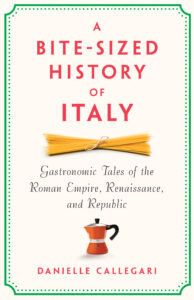
Copyright © 2026 by Danielle Callegari. This excerpt originally appeared in A Bite-Sized History of Italy: Gastronomic Tales of the Roman Empire, Renaissance, and Republic, published by The New Press. Reprinted here with permission.

Danielle Callegari
Danielle Callegari is an associate professor of Italian at Dartmouth College, where she specializes in medieval Italian literature and transhistorical food and beverage studies. Since 2022 she has been a writer at large for Wine Enthusiast, where she reviews the wines of Tuscany and southern Italy. She is also the Communications Director for the Dante Society of America and co-host of Gola, a podcast dedicated to Italian food and beverage culture. In addition to her many contributions to academic and trade publications, she is the author of Dante’s Gluttons (Amsterdam University Press) and A Bite-Sized History of Italy (The New Press). She resides between Hanover, New Hampshire, and Rome, Italy.