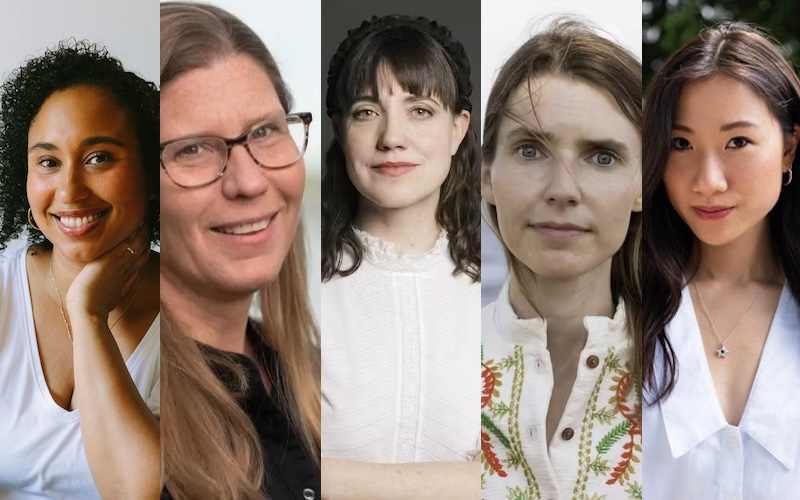
Lit Hub Asks: 5 Authors, 7 Questions, No Wrong Answers
Featuring Naima Coster, Katy Simpson Smith, Stacey Yu and More
The Lit Hub Author Questionnaire is a monthly interview featuring seven questions for five authors with new books. This month we talk to:
Naima Coster (Take What You Can)
Elizabeth Jannuzzi (Sober Mom)
Emily McBride (Queen Mab)
Katy Simpson Smith (The Maltese Version)
Stacey Yu (Kitten)
*
Without summarizing it in any way, what would you say your book is about?
Naima Coster: Intense friendship. Motherlessness. Mother hunger. Desire and appetite. Sex and loyalty. Fraught, failing marriages. Feeling broke, feeling rich. Class envy. Extravagant food and booze. Brooklyn, the South of France. Swimming and the sea.
Elizabeth Jannuzzi: Best places to hide a vodka bottle (behind the Cuisinart, in riding boots). How to implode your life and still make dinner. The reluctant person’s guide to the twelve steps. How to stay married while becoming a different person.
Emily McBride: Foxes, moths, fairies. Parenting in capitalist realism. Street art, academic rivalry, the importance to a person’s mental health of drinking a cup of tea while it’s still hot. Overeating while breastfeeding. Lost family histories.
Katy Simpson Smith: The vast, thorny, erotic gap between thinking you know and actually knowing.
Stacey Yu: The death of childhood; being completely, catastrophically out of place; how good cats smell; mothers; work-ethic-gap relationships; the interpersonal politics of care; surprising, terrible, life-changing mistakes; surprising, giddy, life-changing connections.
*
Without explaining why and without naming other authors or books, can you discuss the various influences on your book?
Elizabeth Jannuzzi: Svedka vodka. The “Sin Will Find You Out” neon sign on 51st Street in Hell’s Kitchen that I’d see in my mid-twenties while on my way home from the bodega with a six-pack and cigarettes under my arm. “My Own Worst Enemy” by Lit. Church basements, aluminum chairs, and coffee in Styrofoam cups. My sponsor’s wisdom. Daffodils blooming along wooden fences in the spring.
Stacey Yu: Works of art that capture the strange, oppressive, and beautiful landscape of childhood, voicey narrators I’d follow anywhere, and books about complex, intimate parent-child relationships where the parent sits like a boulder at the heart of the plot.
Naima Coster: Friendship novels, narratives about women and the outdoors, estrangement, grief, attachment theory, New York City restaurants.
Katy Simpson Smith: White lies. Diacritics. Heather and spurge. The Chicago Transit Authority. Cubist art. Online patient portals. That bestselling author of all time whose mysteries make for very good bedtime read-aloud sessions with one’s partner. Night swimming.
Emily McBride: Various early practitioners of literary Gothic, fairy tales and their retellings, the Victorians of Masterpiece Theatre, the Modernists of my post-motherhood self-improvement audit, living among Catalan writers and their influences, literature in translation, and always trying to keep a three-way balance between the 19th, 20th, and 21st centuries.
*
Without using complete sentences, can you describe what was going on in your life as you wrote this book?
Emily McBride: New baby, bemusement and ambivalence, chaotic short story, back to work.
New baby 2, plotting and planning, back to work, first draft. Global pandemic, second draft, third draft, fourth draft. New baby 3, fifth draft… In between, much hand-wringing, catastrophising, drinking of wine, learning of nursery rhymes.
Naima Coster: Growing and raising babies. Pregnancy loss. Sleep deprivation. Teaching. Putting back together a body changed by birth. Love and more love.
Elizabeth Jannuzzi: The return of my marbles after five years of sobriety. Older and therefore more self-sufficient children. A strong, committed, and supportive relationship with my spouse. A growing confidence in the belief that I had a story and the ability to tell it.
Stacey Yu: Fell in deep, true love, and it still didn’t cure me.
Katy Simpson Smith: Questioning and unquestioning love; a pandemic; some pregnancies.
*
What are some words you despise that have been used to describe your writing by readers and/or reviewers?
Katy Simpson Smith: I mean, “bad”?
Emily McBride: I don’t love “lyrical” or “poetic.” I try to write nice prose, but both those words convey a sort of cryptic word-love that isn’t how I think about writing. I also disagree with things like “harrowing” or “sad.” I think it’s more political than that.
Stacey Yu: “Weird”—I don’t despise it per se, but what does it really mean?
Elizabeth Jannuzzi: “Brave.” I really, really hate that term to describe writing about my disease of alcoholism and my recovery. Would it be brave to tell you about diabetes? Why is it brave if I tell you I go to AA meetings? Please don’t tell people they are brave just for sharing their lives with you.
Naima Coster: Full of questions but not enough answers. I get the impulse to turn to books for understanding—that’s part of why I read and write, too. But isn’t the best we can usually do to look hard at something—genuinely, openly—and wonder?
*
If you could choose a career besides writing (irrespective of schooling requirements and/or talent) what would it be?
Stacey Yu: Clothes designer for babies.
Katy Simpson Smith: I recently got a strong hankering to apply for Harvard’s Divinity School. The course titles! (“American Heretics”? “Sacrifice: Theory and Praxis”? “Animals, Trees, and the Unseen”? “A Poetics of Difficulty”? “Early Christian Demonology”?) I want to think about Big Things and then talk to others about them and maybe even find some common roads toward good. (But if we’re doing it right, maybe that’s what writing is, too.)
Naima Coster: Midwife. Birth is so transformative and terrifying and miraculous. I’d love to accompany other birthing people through it.
Emily McBride: Writing is not a career for me to give up! However, if I were choosing my day job all over again, it would be a) useful and b) bring me into contact with more people from all walks of life (basically for the material).
Elizabeth Jannuzzi: I’ll let you know when my career becomes my writing. Currently, I’m a program director at a nonprofit. Luckily, it’s a nonprofit writing organization, but still…I’m not a career memoirist…yet! But if it’s not writing, then maybe professional photography. My husband says my cell phone photos show great compositional sense!
*
What craft elements do you think are your strong suit, and what would you like to be better at?
Naima Coster: I’m good at writing interiority, getting into a character’s consciousness but also into their embodied experience. I’d like to be better at writing the middles of things.
Stacey Yu: I’m good at voice and turns of phrase, I think. My dialogue needs work. I’m a clumsy speaker. I can’t do voice notes, I sound like I’ve never spoken a full sentence in my life.
Katy Simpson Smith: I’ve always been a sentence person, a cadence person. I’m still struggling with plot, but I like to think this book is my plottiest, knottiest yet!
Elizabeth Jannuzzi: I think my strong suit is sensory detail, putting readers in my body in the scene, then pulling back to show what I was thinking or feeling in that moment, and adding reflection to show transformation. What I struggle with is ending a scene or knowing when to end a story. I could just keep writing about my life to the end of time because the story continues on, and as we say in AA, it’s “progress, not perfection.”
Emily McBride: I think I’m good at editing. I’m decently creative and not afraid to play around with scene structure, sentence length, and point of view. My main goal is to get better at humor. I can do wordplay or chuckly dialogue, but I would like to write a scene that is funny because of what happens in it.
*
How do you contend with the hubris of thinking anyone has or should have any interest in what you have to say about anything?
Elizabeth Jannuzzi: Well, in the rooms of recovery, we are taught that your very specific story will help another alcoholic who is struggling with the same thing. So I tell my story in the hope that someone will read it, think “me too,” and feel less alone. That’s the lofty answer. The more basic answer is that I love personal stories. I want to know your whole deal. Tell me where you’re from, what your parents are like, what motivates you, and what you had for lunch. And if I want to know that about everyone else, I assume people want to know that about me. Grilled cheese, BTW.
Emily McBride: I never think about this!
Naima Coster: My writing process is already so full of self-doubt and criticism that by the time I’m done with a piece, I’m overdue for some feeling of pride.
Katy Simpson Smith: That’s easy; by now, I don’t assume anyone has any interest at all! Every reader is a surprise, a gift, a lagniappe. But I’m hoping to circle back around to hubris at some point.
Stacey Yu: Is it bad to say I’ve never contended with this before? I have many insecurities about writing, but why people should read it isn’t one of them. As a reader, my interest in other people’s work and ideas is essentially endless. I see other readers that way, too. Their interest isn’t a token to be spent on me or somebody else, but rather a more immutable quality that led them to my book and hopefully many more books to come.

Teddy Wayne
Teddy Wayne is the author of the novels The Au Pair, The Winner, The Great Man Theory, Apartment, Loner, The Love Song of Jonny Valentine, and Kapitoil. He is the winner of a Whiting Writers’ Award and an NEA Creative Writing Fellowship as well as a finalist for the Young Lions Fiction Award, PEN/Bingham Prize, and Dayton Literary Peace Prize. A former columnist for the New York Times and McSweeney’s, he is a frequent contributor to The New Yorker.