The International Short Story is Booming
Rabih Alameddine and John Freeman on the Wide Variety of Stories in Their New Anthology
In 2002, a friend asked if I would join him for a San Francisco Symphony concert with David Robinson as guest conductor. They were to play Olivier Messiaen’s Turangalîla Symphonie. I was a bit ambivalent. I knew Messiaen’s work, but not Turangalîla, which I’d tried to listen to a couple of times and wasn’t able to get into it. I don’t do well when listening to something new unless the piece is flagrantly melodic. I need a few listens to begin appreciating difficult music. I remember falling in love as a teenager with Moonlight Sonata at a first listen, whereas it took multiple times to appreciate Hammerklavier. Messiean’s eighty-minute ten-part monstrosity is quite a bit more tough than a late Beethoven sonata, but it included an ondes Martenot, an instrument that produced a most delightfully ethereal music. I hadn’t heard one live before, so I went.
Since this was an offseason concert, the hall wasn’t sold out, probably eighty percent full, and it was not the usual symphony crowd. A few minutes after the concert began, I realized that everyone around me seemed uncomfortable, unable to remain still in their seats. The first couple walked out no more ten minutes in. Not too long after that, at the end of the second movement, more people walked out. After ten movements, the audience had been cut in half. There would be no encore.
I remember I, too, was uncomfortable at first. I didn’t appreciate the first couple of movements. I didn’t understand and felt terribly confused. But at some point, maybe ten minutes into it, everything changed. No, the music didn’t change, didn’t become clearer. I guess I changed. I was transported, dropped from a plane into a sea of feelings. I sat up straight. I didn’t understand and felt no need to.
She said only that the piece was not new, but I heard: Why have you not tended your garden in the last fifty years?
When the concert was over, I walked down to the stage to chat to the ondes Martenot player, who was packing her things. She was European. We talked about the instrument and how it was played. She then asked me why so many people left mid-concert. I suggested that the music might have been a bit difficult for many and too new.
But this was over fifty years old, she said.
It was.
She said only that the piece was not new, but I heard: Why have you not tended your garden in the last fifty years?
I was having lunch with a Turkish friend visiting the US. She complained that she couldn’t open a window in her hotel room, wondering how one could live without fresh air. I told her Americans are afraid of mystery. It was just a quip, but the more we talked, the more I realized it was essentially true. We thrive in predictability. We love thermostats, prefer to shop and eat at the same places no matter where in the US or the world we are. We expect the entire world to speak our language. For the most part, we can’t abide the unknown, or to be more precise, we might like a little bit, but we’re unable to sit with the not-knowing.
This isn’t an entirely American phenomenon, but let’s say, we lead the way.
We invented franchises and we love them, even in our arts.
We have exceptions, of course. We have theater and music organizations that produce the most avant guard pieces. We have the Monks, Thelonious and Meredith. We have dedicated listeners and readers who cherish discovery. Though it seems for the most part, possibly because of the intertwining of art and money in our culture, no opera company can survive without large doses of Puccini and Verdi, no symphony without Mozart, no ballet company without Swan Lake and Nutcracker, and no publishing house without familial realist stories.
A writer friend who was editing The Best American Short Stories one year told me that there was not a story in the two hundred or so that she had to pick from that deviated from realistic fiction and the ubiquitous conflict-solution-epiphany structure. The stories she selected, and the book itself, were magnificent, even if their range was not as wide as she, and I, would have hoped.
I’m not necessarily suggesting that what passes for good American short stories are bad by any means, just that the range and variety are limited, particularly when compared to international writing.
Why is that? Why does it seem that we take less risks?
My friend, John Freeman, and I loved coediting The Penguin Book of the International Short Stories. How could we not when the research for it was reading, reading, and more reading? Some of the things we discovered stunned us, not the least of which was the discovery of writers and stories that we had never heard of. I consider myself a voracious and comprehensive reader, and John much more so. Yet we kept coming across so many surprises, and just as important, stories the likes of which we had never seen before.
We haven’t rejected the entire art of fiction, or many of us haven’t.
When John sent me a book of stories by Can Xue, I was gobsmacked. She broke so many stylistic rules, did things that I usually disliked intensely, but everything worked so well. As I read, I probably sounded like Madeline Kahn as she was being ravished by the monster in Young Frankenstein, “No, no, no, no, ooooooooh sweet mystery of life, at last I found you,” complete with her nasal, soprano voice.
I would love to encounter that feeling more in American stories, what Ada Limón called “startlement.” These days, when I read a great short story by my contemporaries, I can feel joy, admiration, enjoyment, respect, but I’m rarely surprised. I would put up an American short story against anything published around the world and it would stand up. I still yearn to be startled, though, yearn to be dazzled.
Ursula K. Le Guin wrote an essay called “Why Are Americans Afraid of Dragons?,” in which she posited that “a great many Americans are not only antifantasy, but altogether antifiction.” The essay was written in 1974, and obviously many things have changed since–with the recent commercial success of the film adaptation of Lord of the Rings and Game of Thrones, we take dragons a bit more seriously. However, I feel she was right when she suggested that the “rejection of the entire art of fiction is related to several American characteristics: our Puritanism, our work ethic, our profitmindedness, and even our sexual mores.”
We haven’t rejected the entire art of fiction, or many of us haven’t. Yet it seems to me that we need to feel we are getting some tangible value out of reading fiction. When we read a short story, do we expect a return on the time investment? Simple pleasure isn’t enough. A story should have meaning, should take us somewhere specific. We should be able to understand and interpret it, to be able to explain what the story is about in a sentence or two. Otherwise, it has no value.
At one point in the essay, Le Guin states, “Fake realism is the escapist literature of our time.”
–Rabih Alameddine
*
I have my own theories about the American short story, and they have to do with the way creative writing is taught in a culture inseparable from capitalism. In a world where the culture says, if you can’t make a living do it, it’s not worth doing, and graduate school can cost well over six figures, the pressure writers come under to think about the market is subtle but immense. The success of one writer with a certain style of writing stories can implicitly mean: that kind of story worked in the very competitive world of writing and publishing stories.
Also, all writers mimic when they begin. As the editor of a literary magazine on and off for fifteen years, I saw the ripple effect of this economy. The story where the dog dies; the story where one major detail is surreal leading to thoughts on (insert topic); the story set in a rundown setting that wanted the reader feel like they were being given access; the story that used profanity to shake the reader awake.
Read these writers’ best work today and it is impossible to feel you are holding a product. A unit of tale. They are unstable, radical works.
I disagree with my co-editor here, to some degree, because I edited the Penguin Book of the American Short Story, and I think the range of the American story is quite varied if you look back to look forward. Read a story by Toni Cade Bambara, or Ursula Le Guin, or Charles Johnson, or Louise Erdrich, or Raymond Carver, or Jamaica Kincaid, to name just a few of the legends at work in the seventies. The risks they took in orality, in world building, in the tone of irony were immense—but these stories were published in a different time. Look at the films of that decade and you’ll understand there was a comfort in rupture at work. Read these writers’ best work today and it is impossible to feel you are holding a product. A unit of tale. They are unstable, radical works.
I often wonder if the influence of writers in translation in that period, or just before it, had anything to do with the climate of variety. Obviously, the Black Arts movement and Chicano arts movements which were in full swing in the 1960s and 1970s had a major effect on broadening the doorway through which writers came into publications.
But there were translations re-shaping that doorway too. There was a boom of translation from Japanese of short stories in that decade, with collections like Ivan Morris’ Modern Japanese Stories pointing readers to a new postwar canon of Japanese writing, from Kawabata to Mishima. Clarice Lispector’s first story was translated in 1967—the same year Borges’ first story appeared in English, and Cortázar’s collection The End Game was reissued. Lispector’s first collection of stories to be translated landed in 1972.
That was around the same time that Ghassan Kanafani’s mesmerizing classic, Men in the Sun, started to become widely available in Hilary Kilpatrick’s translation, not to mention stories from Yiddish by Singer, from the Polish of Bruno Schulz (posthumously), from the French of Marguerite Duras and Italian of Natalia Ginzburg (both of whom appeared in Donald Bartheleme’s journal Fiction, put out by the City College of New York).
When you step back and look at this cluster of encounters, though they do not illustrate a causality, you can certainly see an expanding set of affinities of the short story. Universities all over were beginning to create ethnic studies programs, to expand their language studies. We live in opposite times, now, with universities, which should be opening students’ minds, under direct assault by the federal government for doing the simple thing of showing their students how the world we live in has been made. For studying a variety of cultures. It is not so much that America doesn’t want to dive into the unknown, but a part of America doesn’t want the rest of us to know what it doesn’t know. What a time.
Happily, the short story is another period of booming expansion. Thanks to several generations of strong translators at work, we have a greater variety and depth of writing in the short story at our fingertips than ever before—especially more writing from Chinese, from Arabic, from Portuguese, and once again Japanese. Even a language like Spanish, which has never suffered for translators in America, has even more brilliant translators at work. The result of this is that you can still, if you want, take a risk as a reader. It’s an open door that means you can get out of the loops of this culture—and enter the language and images and music of other minds.
What do these stories Rabih and I have put together mean? Who knows. Do they really need to mean anything? Do they need to stump for their ability to cross a language barrier? Some of them are simply beautiful, or arresting, or string together images in an unlikely way, some are so clever in how they narrate they seem to have invented a whole new way of narration. Others feel like an account of events. If you take the open door, and take the risk, the need to understand everything sometimes lifts with it, like a burden that is actually a kind of curse, a sort of social conditioning.
Many of the writers we included here seem to have done the same thing as they wrote, and while a number have written politic parables that could easily speak to this week’s news, or that of the last few years, they are not at all limited by it. This is why book banners are so busy, so numerous, and so angry. Nothing is free in the same way as a free reader’s mind.
–John Freeman
__________________________________
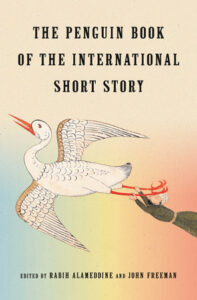
From The Penguin Book of the International Short Story. Used with the permission of the publisher, Penguin Press. Copyright © 2026 by Rabih Alameddine and John Freeman

Rabih Alameddine and John Freeman
Rabih Alameddine is the author of the novels The Wrong End of the Telescope; Angel of History; An Unnecessary Woman; The Hakawati; I, the Divine; Koolaids; the story collection, The Perv; and National Book Award-winning The True True Story of Raja the Gullible and one work of nonfiction, Comforting Myths. He has won the PEN/Faulkner Award for Fiction and received the Dos Passos Prize in 2019 and a Lannan Award in 2021. John Freeman is a writer, anthologist, and host of Alta’s California Book Club, a once-a-month online discussion of a new classic of Golden State literature. He has been an executive editor at Knopf since 2021. Prior to Knopf, he was the president of the National Book Critics Circle, the editor of Granta magazine, a founding executive editor at Literary Hub, and for nearly ten years the editor of Freeman’s, a literary annual of new writing. Books he has edited have won the National Book Award, the National Book Critics Circle Award, the Writers Prize (then the Folio Award), and have been shortlisted for the Booker Prize, the Pulitzer Prize, the Los Angeles Times Book Prize, the Lamba Award and others.