The Fight for Economic Justice and the Pathway Out of Poverty
Nicole Lynn Lewis on How Expanding Educational Opportunities Can Help Eradicate Poverty
More than twenty years ago, I slowly pushed a clattering shopping cart out through the lazy automatic doors of a Williamsburg Food Lion, with no groceries, just my hungry toddler looking up at me while I tried to figure out how we were going to eat that night. The long walk to my white station wagon was measured and surreal. Seconds before, I had stood at the cash register while the cashier told me, after trying my debit card several times, that it had been declined for about twenty dollars’ worth of groceries.
The people in line behind me were annoyed, checking their watches and peering ahead trying to figure out what was taking so long. I quietly told the cashier, “Never mind,” abandoned the food Nerissa and I had just judiciously picked off the shelves, and made my way out to my car while Nerissa inspected her baby doll, telling her she needed to brush her hair when we got home. This was one of the hardest and loneliest nights of my life.
Living in scarcity can be incredibly isolating. You don’t share things because you’re too embarrassed to admit they happened or because no one will fully understand or because, in not talking about them, you think you can protect yourself from their happening again or haunting you. But burying and stifling our experiences doesn’t stop them from impacting us, shaping us, and coloring the lens through which we see the world. This was a lesson I had to learn over time. I was once too scared to tell the grocery store story—not just the slow walk back to our car with an empty cart but the next part, which was the hours that followed—because I thought telling it would disqualify me from something. Maybe I wouldn’t meet the criteria for a scholarship or a promotion or just a chance.
The most difficult part of the story to tell isn’t what happened at the cash register. It’s what happened when we were back in our campus apartment: I made Nerissa some scrambled eggs and found her a lonely stick of string cheese in the refrigerator for dinner. She went to bed happy, her doll’s hair neatly brushed. I went to bed hungry and cried.
The fight for economic justice may feel complicated and full of jargon, conflicting theories, and complex equations, but at its core, it’s quite simple. Tonight, a mother or a father will cry in the dark, feeling completely alone, and we must find a way to make things better in a tangible, game-changing way. Yes, they need canned goods to put in their cabinets and a backpack full of school supplies to strap to their little one’s back, but more than those things, they need us to care—not in a superficial or pitying way, but in an urgent and connected way that translates into large-scale shifts.
They need us to care more about them and their children than we do about stock prices, liquidity ratios, and the discomfort that comes with disrupting the status quo. They need us to care enough to do things differently because we see them not as a problem to be fixed, a project to be completed, or a number in a dataset, but as a person who deserves basic human rights—the right to prosper, the right to learn, the right to work, the right to care for their family, the right to eat well, the right to have choices, and the right to create a home. All of the basic building blocks for a life and a future and a legacy. They need the very best of us. The part that celebrates their humanity, their brilliance, and their potential—all bound up together in ours.
Despite the devastating impacts of poverty, there is no urgency to helping people out of it.
As I write this, some of the most severe wildfires in California’s history are devouring more than thirty-seven thousand acres of land. At least twenty-nine people have died, and more than 10,600 structures have been destroyed, including homes, along with people’s livelihoods. Firefighters are working around the clock to stop the blazes, some traveling from other states and even countries to help. The world is watching, hoping for an end to the destruction, and making donations to assist the many people who have been impacted. There is an understandable urgency in moments like this. People need help. It’s not appropriate to ask if they deserve help or if they should have made better choices to keep themselves out of harm’s way or if they will squander the support they receive, using it for drugs. Asking these questions would just be wrong and heartless.
Poverty is a global crisis felt acutely here on American soil. It impacts every facet of our lives from insufficient access to food, clean water, healthcare, education, and shelter to increased violence and crime to disproportionate impacts of climate change to our inability to compete as a global leader. It is the fourth-highest cause of death in the United States. One in six children under the age of five in the US are poor, the highest rate of any age group.
We could liken it to a tsunami or a wildfire devastating the livelihoods of thirty-seven million people in the US each day. It is urgent. People need help. It’s not appropriate to ask if they deserve help or if they should have made better choices to keep themselves out of harm’s way or if they will squander the support they receive or use it for drugs. Asking these questions would just be wrong and heartless and would ignore the reality that America ignited this blaze. Except we do ask these questions, and we allow the endless and fruitless discourse to delay aid or interventions. So the fire rages on.
Despite the devastating impacts of poverty, there is no urgency to helping people out of it. We don’t see poverty in the way that we see wildfires because poverty disproportionately impacts people of color. It’s more tolerable than a raging wildfire because we have been conditioned to believe that the people who are consumed by poverty, including children, somehow deserve it. This is one of the most horrific designs of racism—its dehumanization of whole communities, making it more palatable to deny people of their basic rights and protections. Race isn’t merely a factor; it is a deadly tool of economic violence.
And it isn’t being wielded just for cruelty’s sake. Activist, author, and cocreator of #BlackLivesMatter Alicia Garza said: “I learned that racism, like most systems of oppression, isn’t about bad people doing terrible things to people who are different from them but instead is a way of maintaining power for certain groups at the expense of others.” Racism and poverty are driven by a desperation to hold on to power, and the underbelly of needing to maintain power is the fear of losing it. That fear keeps the fire burning, stagnates progress, and holds millions of families in the constant paralysis of survival.
It will take a myriad of things to ensure all families have what they deserve to grow and thrive—some of which I’ve outlined in this book. We have to strengthen the safety net, with far-reaching and well-funded supplemental food programs, more affordable and quality housing, accessible healthcare, paid family leave, and expanded, high-quality childcare. We need to increase the minimum wage and create more better-paying jobs. We need comprehensive and affordable public transportation that connects low-income communities to employment and educational opportunities. We need better processes for ensuring funds are funneled to those who need it most, more realistic determinants of need that capture everyone who is truly struggling, and measures that prevent states from stockpiling or bottlenecking dollars. We need to acknowledge that poverty stems from deep-seated, long-standing racism and discrimination and do the hard, uncomfortable work of identifying it in our various systems and uprooting it. Otherwise we will continue to repeat our past mistakes.
A college president championing student-parent inclusion is game-changing, but it doesn’t prevent a professor from penalizing a father for turning in an assignment late because his toddler was sick for a week.
And we must expand educational opportunities so people can grow their skills and enter family-sustaining careers that they’re passionate about and that benefit all of us. It’s the unseen piece of the puzzle. But legislation that ensures parents have access to a postsecondary credential is vital if we want families to climb the ladder, with lasting, generational impacts. The children of these parents will be more likely to go to college and succeed in a career themselves, halting generational cycles of poverty.
This puzzle piece challenges our biases about who deserves to be in a classroom and confronts the notion that women should focus solely on child rearing not their education. It goes against the welfare queen trope so ingrained in our policies and public discourse—that mothers, particularly Black mothers, don’t want to work hard and pursue their education. It opposes the negative stereotypes that fathers, particularly Black and Latino fathers, aren’t engaged in their children’s lives or committed to their own learning. It upends the belief that college should be a place for the privileged few and instead invites institutions to open their doors in ways they never have before.
To make college a viable option for more parents across the country, we’ll need various federal- and state-level policy changes. We’ll also need higher ed institutions to drive their own critical transformations. Nationwide, 40 percent of student parents don’t feel welcome on their campuses, which means many of these environments continue to perpetuate discriminatory and harmful practices, making parents feel out of place, especially Black, Latino, and Indigenous parents.
To start, colleges must know how many of their students are also parents. Just as understanding the magnitude of our country’s housing crisis requires accurate data, each school needs a clear picture of how many of their students are raising children while pursuing their education. Without this data, they’re missing vital information on a significant portion of their student body. Nationally, about 15 percent of students at four-year schools and 30 percent of students at community colleges are parenting. For a community college with forty thousand students, that means twelve thousand of them might be balancing caregiving with their studies.
Next, colleges must examine their policies through a parenting lens. Schools have adopted policies from a higher education system never intended to educate women, students of color, students with low income, first-generation students, and certainly not students with children. Policies requiring freshmen to live in dorms or banning children from campus can make going to college as a parent incredibly difficult and, at times, impossible.
Then, institutions of higher education must go beyond family-inclusive policies to examine their hiring and training practices, ensuring that all faculty and staff are sensitive to the needs of parenting students and understand how to support them. A college president championing student-parent inclusion is game-changing, but it doesn’t prevent a professor from penalizing a father for turning in an assignment late because his toddler was sick for a week.
Finally, colleges and universities must ensure their culture communicates that parents aren’t just tolerated but welcomed and celebrated. Simple things like providing high chairs in the dining halls or images of student parents with their children on the school website can send a powerful message to parents: “You belong here.”
I saw the world differently, and I was reminded of how the world saw me.
Colleges cannot be silent partners in opening doors to prosperity for families. Policymakers working to advance legislation at the state and local level will need allies. We see powerful things happen when key partners join forces. In 2022, a coalition helped California pass AB 2881, which granted student parents priority class registration to accommodate their demanding schedules.
In 2024, a collective effort also helped to get the Greater Accessibility, Information, Notice, and Support (GAINS) for Student Parents Act passed. This act requires all public colleges and universities in California to improve financial aid accessibility for student parents and equips colleges to better identify and support them. In 2023, various groups in Texas came together to successfully advocate for several bills that enhance support for student parents by not only increasing assistance but also codifying their rights, ensuring that all colleges and universities are equipped to meet their unique needs. These legislative wins are possible only when we mobilize to rally support from lawmakers and create spaces where parents feel supported in sharing their powerful lived experiences to drive policy changes.
The pathway out of poverty can only be cleared—and forged—when we all are involved and recognize parents in poverty as capable and worthy. In this work, uniting across sectors and divides and amplifying stories of struggle that the world tells us to bury deep down inside are some of our most formidable superpowers.
That was the last time I pushed an empty grocery cart out to my car in a supermarket parking lot. It wasn’t the last night I struggled, or the last night I cried, but that particular experience never happened to me—to us—again. Still, as fleeting as it was, it changed me. It took a chunk out of me. I saw the world differently, and I was reminded of how the world saw me. It is one of many scars that only I can see, and sometimes, like tracing a darkened scuff on a knee left from a fall years ago, my mind will find it, a whispered memory reminding me that perfection isn’t as interesting as triumph, that love and joy in the face of adversity exhibit the greatest power of all.
So I no longer see it as a flaw or something to be hidden. I’m not afraid to share it. It’s one of my many war wounds, and I am a warrior. Anyone who has come through adversity is. Over the years, my battle scars have taught me that the dream was never to be perfect or to just survive. It was—and is—to understand our experiences as the things that reshape us and to revel in our ability to heal, to evolve, and to get up again.
During a panel discussion at the Connecticut Forum in 2001, author Toni Morrison was asked by an audience member how to survive whole in a world where we’re all victims of something. She answered: “Sometimes you don’t survive whole, you just survive in part. But the grandeur of life is that attempt. It’s not about that solution. It is about being as fearless as one can, and behaving as beautifully as one can under completely impossible circumstances.”
America has its scars and its parts. It is a tapestry of haunting imperfections and defiant joy, ever evolving, ever searching for itself. We trace the scars with our fingers to remember, and we find the courage to stretch new threads tightly on the loom, unsure of what the final arras will be. We won’t live to see it whole, but we are committed to doing our part to get it there—for ourselves, for each other, for the little ones. And perhaps this is the true dream of America, the attempt, in all its beauty, complexity, and grandeur.
__________________________________
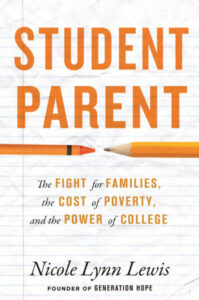
Excerpted from Student Parent: The Fight for Families, the Cost of Poverty, and the Power of College by Nicole Lynn Lewis. Copyright 2026. Excerpted with permission by Beacon Press.

Nicole Lynn Lewis
Nicole Lynn Lewis is a social entrepreneur, the author of Pregnant Girl, and the founder of the nonprofit Generation Hope. As a teen mother, she put herself through the College of William & Mary, starting as a freshman when her daughter was just 3 months old. She has since earned a masters in public policy and honorary degrees from Trinity Washington University and Montgomery College. Her work has earned her a great deal of public recognition, including being named a CNN Hero and winning the Roslyn S. Jaffe Award. She has appeared on CNN, NBC Nightly News, Good Morning America, and many others, and her journey has been covered in the Washington Post, the Baltimore Sun, Teen Vogue, the Chronicle of Higher Education, and others.