The Extremist History Behind a Small American Town
Michael Edison Hayden on the Origins of White Supremacy Group VDARE
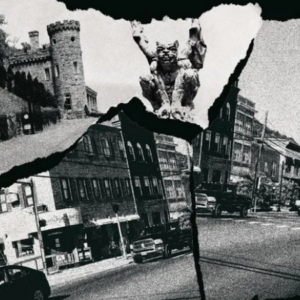
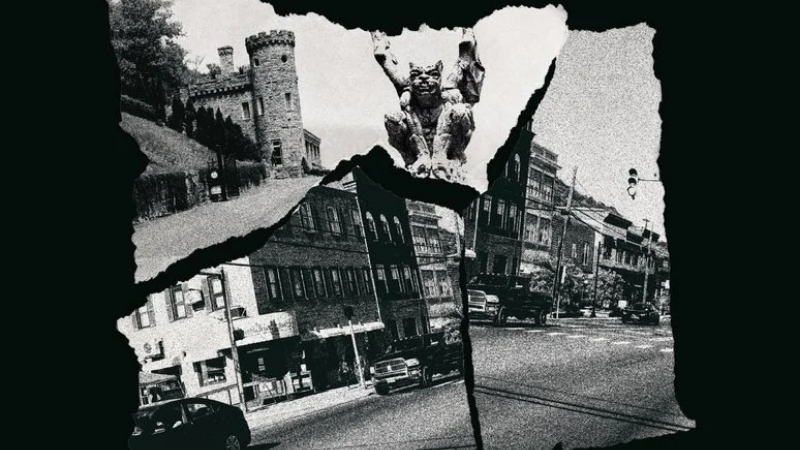
When Trey Johanson drove down the roller-coaster hill that led into town on February 26, 2020, she saw the Berkeley Springs Castle and wondered if the new owners had already arrived.
Tourists and passersby found something haunting about the nineteenth-century sandstone building. Needly trees shot up all around it. Red-eyed gargoyles and a sinewy lion statue guarded it. No walking path existed near its perimeter, underlining the fact that the castle looked down on Berkeley Springs from a position of inaccessible dominance.
Trey, a petite woman in her fifties with wavy, silver hair and pale blue eyes, prided herself on making strangers feel welcome when they walked into Fairfax Coffee House. That’s where she was driving that morning. At the recommendation of her daughter, Trey had bought the red and yellow brick shop from a dentist named Magic Miller in 2017. She had married her third husband, Paul Johanson, two years later.
Russell had quoted Peter as saying, “You know, I personally like living in a white society.”
A worker for The Morgan Messenger hung a bundle of newspapers on the door of Fairfax Coffee House that morning, as they did every Wednesday, and Trey moved the bundle to the counter, preparing to sell the papers for one dollar each. When she pulled the yarn to free the stack, the face of Lydia Brimelow popped out at her on the front page.
The physically towering Brimelow family matriarch was holding up keys to the castle. Her husband, Peter Brimelow, who was years older than Lydia, stood with her. Three young Brimelow daughters surrounded the couple. “Berkeley Castle Has New Owners,” said the headline. Trey then read the photo caption: “Lydia and Peter Brimelow stand at the door of the Berkeley Castle, which they purchased on Valentine’s Day. They are pictured with their three daughters. Photo courtesy of Peter Brimelow.”
Trey’s friend and neighbor—let’s call her “Alicia”—had first told her who the Brimelows were. Lots of people from the town talked about them on Facebook after that. Trey’s husband, Paul, started talking about them too.
Alicia, a middle-aged brunette mom with ruddy cheeks and a warm laugh, had moved to Berkeley Springs from Philly because she wanted a change from city life. She owned a shop adjacent to Fairfax Coffee House that sold multicolored pottery, candles, and lightly perfumed soaps. Alicia had first read about the castle purchase in a blog post authored by a reporter named Russell Mokhiber on Sunday, February 23. She told Trey about it soon after.
“These people are white nationalists,” Alicia had said.
Trey tried to process the news as Alicia explained it. Everything seemed so surreal.
“White nationalists have over a million dollars to just throw down on a castle?” Trey asked.
“Apparently!”
Untethered to a weekly publication schedule, Russell had posted about the Brimelows three days before the Messenger published its own story. And he didn’t embed cute, happy photos of the Brimelows in it. Russell focused on the nonprofit advocacy group they ran. The group was called VDARE.
Russell noted that Peter Brimelow had named VDARE after Virginia Dare. On August 18, 1587, in Roanoke Island, Virginia Dare was the first white child born into an English colony on the land that would become America. VDARE’s founders modeled their organization’s existence around her existence. Peter and his collaborators behaved as if, without their intervention, the memory of that white child was going to be wiped out of history.
Russell had quoted Peter as saying, “You know, I personally like living in a white society.”
In a deep red county in a dead red state, no one could miss the Pride flag she hung up at the front of her shop.
Peter spoke in a thick English accent. Not infrequently, he muttered in it. Trey wondered if this alien Peter Brimelow character had blown in from Connecticut by way of England, with no clear connections to West Virginia, simply because it was a “white society.” Maybe he thought everyone in Morgan County, West Virginia, looked at the world as cynically as he did.
Months earlier, in the fall of 2019, the Ku Klux Klan had dropped off flyers at both Trey’s and Alicia’s shops. The headline at the top of the page read, “The Cost of the Jew’s Open Border Policy.” Underneath it, the authors of the flyer listed a few dubious talking points maligning immigrants. At the bottom of the page there was a Klan logo tagged with the words, “Wake Up White America!!!” Alicia now wondered aloud if those Klan flyers could be connected to the sale of the castle.
“What if they sent the flyers to test us? And since we never did anything in response, VDARE felt it was safe to move here?” Alicia asked Trey.
Trey was skeptical. “Do you really believe that?”
“I’m not ruling anything out,” Alicia said. “All I know is that it happened and then this happened.”
“The Klan wears masks,” Trey said. “These Brimelow people pose in photos with their adorable children.”
When Alicia and Trey first received the Klan flyers, they had discussed launching a public-facing response to them. But Trey stopped short. She claimed that she didn’t have the appetite to engage with whatever was left of the Klan in West Virginia. Then a new, second Klan flyer had arrived at their doors. This one decried the purported evils of queer people.
“I don’t want to give this oxygen,” Trey had told Alicia on the street between their shops, while autumn began a steady roll into winter. “I just don’t think that’s the right play. It might encourage them to do more.”
Trey wanted to speak up for queer people in other ways. She put up a Pride flag at Fairfax Coffee House in June 2019 to celebrate Pride month. Trey then chose to keep the Pride flag flying, making the symbol a big part of Fairfax Coffee House’s branding. In a deep red county in a dead red state, no one could miss the Pride flag she hung up at the front of her shop. Everyone could see it every time they walked through the adjacent Berkeley Springs State Park.
At the time Trey and Alicia discussed what to do about those Klan flyers, I was working as an investigative reporter and spokesperson for the Southern Poverty Law Center (SPLC), a nonprofit civil rights group that built “intelligence” on extremists. I didn’t know who these women were, and I’d never heard of Berkeley Springs, but I knew about VDARE, because the SPLC listed them as a white nationalist hate group. They were one of the most prominent hate groups we listed. When VDARE purchased the castle, Trey’s and Alicia’s lives intersected with mine.
As I told these women weeks later when I traveled to Berkeley Springs for the first time, Peter Brimelow had played a critical role in turning the country into what it became under Donald Trump. Not a Klansman from the era of lynching, but far from a typical conservative of the nineties and aughts, Peter effectively shifted Republicans away from neoconservatism and toward nativism. Eventually, that nativist turn would take America into a series of constitutional crises and to the edge of some American version of fascism. Peter established VDARE as a nonprofit foundation, but reactionaries primarily knew it as a website that published influential propaganda.
It was never the movement—that group of people, including nativists, neo-Nazis, and white nationalists who performed activism in response to the great replacement—that was to blame. It was always others.
While Stephen Miller is often “credited” with shaping Trump’s anti-immigrant, authoritarian persona, VDARE may have influenced Miller’s mind first. I published a series of stories about Miller’s private emails back in November 2019 for the SPLC. The emails showed that Miller read VDARE to reinforce his beliefs.
In his emails, Miller also referenced Jean Raspail’s dystopian novel The Camp of the Saints, a VDARE favorite. In Raspail’s tale, hordes of impoverished and dark-skinned brutes from India descend onto French shores by way of rafts, the first wave of an invasion of the civilized West by the brown-skinned developing world. A beast-man described as the “turd eater” devours feces as food, and a pack of dark men rape a white woman to death. VDARE sold Camp of the Saints online, sometimes as a Christmas gift.
Another French author, Renaud Camus, coined the term “great replacement” in 2010, but it was VDARE that helped launch it into domestic prominence. The theory of the great replacement is that elites, or, depending on who told the story, Jews (not commonly a direct target of VDARE), have invited nonwhite immigrants with inferior bloodlines into white- dominated Western countries to weaken them and absorb more power for themselves. Long before Tucker Carlson brought great replacement talk into prime time on Fox News, VDARE treated the concept as the defining issue of our time. Peter and his collaborators hammered on this idea that whites faced a genocide through immigration with persuasive repetition.
Violent extremists feasted on this great replacement propaganda, using it to justify terror attacks across the West. VDARE, in turn, published apologia about the writings produced by terrorists that killed innocent people, simply because they echoed the great replacement narrative. VDARE did this in August 2019 after twenty-one-year-old Patrick Crusius slaughtered twenty-four people at a Walmart in El Paso, Texas. Crusius had referred to an “invasion” on the southern border in a bigoted screed he authored.
VDARE also linked in their publication to a manifesto authored by Brenton Tarrant, the man who, in March 2019, gunned down fifty-one people in Christchurch, New Zealand, leaving bodies scattered throughout a mosque. The killer titled that manifesto “The Great Replacement.” Peter Brimelow had said that to end such massacres, the West should stop “mass Third World immigration.” It was never the movement—that group of people, including nativists, neo-Nazis, and white nationalists who performed activism in response to the great replacement—that was to blame. It was always others.
__________________________________
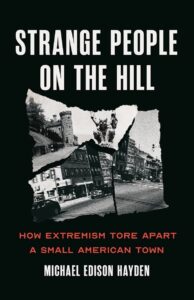
Excerpted from Strange People on the Hill: How Extremism Tore Apart a Small American Town by Michael Edison Hayden, copyright ©2026 by Michael Edison Hayden. Used with permission of Bold Type Books, a division of Hachette Book Group, Inc.
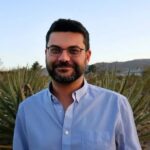
Michael Edison Hayden
Michael Edison Hayden is an investigative reporter and a leading expert on far-right extremism. As a reporter, he broke some of the biggest stories on the radical right over the last decade, and his analyses—featured in outlets like NPR, MSNBC, and CNN—helped shape perspectives on the authoritarian, anti-democracy movement that took over the Republican Party. He resides in New York.