The European Myth of Indigenous “Savages”
David J. Silverman on Race and Religion in the Colonization of Native Americans
Europeans called America a “new world,” but they arrived with strong preconceptions about the people there that would influence their later notions of race. Europeans thought of themselves collectively as Christians, followers of the one true faith, and of Europe as Christendom, despite sometimes violent struggles for dominance between Catholics and Protestants and even between Protestant denominations.
This mindset gave Europeans an unmistakable sense of superiority, but also of some moral obligation to outsiders. Christianity emphasized that all humankind was created and governed by a single omnipotent God and descended from a pair of original parents, Adam and Eve. Furthermore, Christianity was a proselytizing religion, which commanded its followers to bring unbelievers into the fold.
Yet the fact that Native Americans were not Christians but instead animists meant that Europeans viewed them as heathens, pagans, and barbarians, with few claims to the dignity to which Christians were entitled. For all of the Christians’ infighting, they viewed one another as coreligionists deserving of some humanity.
The example during the Middle Ages of the Muslims’ prohibition against holding fellow believers in slavery had convinced Christians to follow suit. Yet Europeans put no such limits on themselves in “just wars” fought against pagans who rejected the offer to submit to Christian rule. Like the conquering Romans who had brought Christianity and civility to the rest of ancient Europe, now it was Western Europe’s turn to spread grace and order throughout the pagan world, by force if necessary.
To Europeans, the binary of civility and savagery paralleled that of Christianity and paganism. Savagery, as Europeans defined it and as they applied it to Indians, had mostly to do with a people’s deficiencies. Europeans imagined that savages lived in a state of near anarchy, without formal laws, government, religious institutions, or multitiered social hierarchies. How could it be otherwise?
To Europeans, savagery was a world without godly discipline, which was to say, the Devil’s kingdom.
After all, the thinking went, savages’ lack of reading and writing meant that they had no books, archives, universities, sacred texts, sophisticated bureaucracies, censuses, tax records, formal laws, and the like. North American Indians did not even possess the wheel, metallurgy, or draft animals. Crude technology and a lack of authority to protect personal property supposedly also meant that savages wanted for permanent homes, fenced-in fields, and other labor-intensive improvements. Savages owned nothing because they could keep nothing in the absence of law and order, or so Europeans presumed.
Therefore, savages had no incentive to work, stored little food, and sometimes went days without eating until they managed to catch something wild. They relocated with the seasons in pursuit of whatever bounty nature offered freely, producing next to nothing and giving little thought to the future. Europeans judged that, among Indians, the men were particularly lazy. When they were not abroad hunting, warring, or trading, Indian men seemed only to lounge about the village smoking and talking while the women did everything else, including tending to the crops. Europeans viewed farming as men’s work. To Europeans, savagery was a world without godly discipline, which was to say, the Devil’s kingdom.
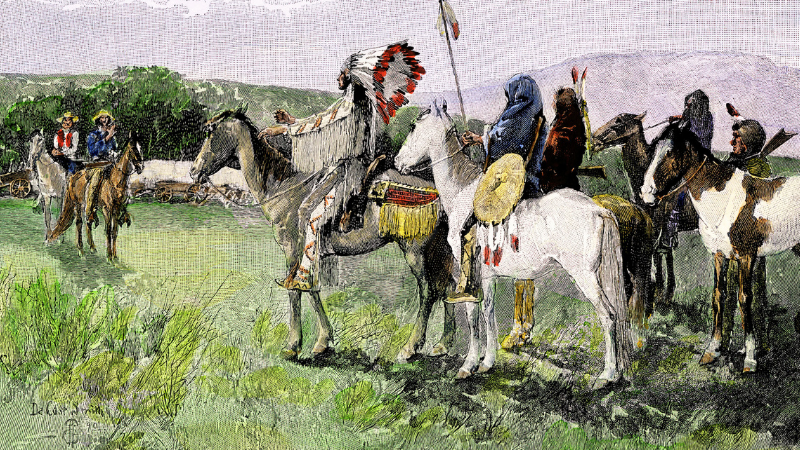
Europeans also contended that savages lacked any notion of sin and had no shame of their bodies, exposing torsos and limbs that civilized people diligently kept covered. In turn, sexual license trumped the values of premarital chastity and monogamous lifelong marriage. Worse still, Europeans believed that savages unrestrained by Christianity openly practiced cannibalism, incest, abortion, infanticide, and wife beating.
Bloodthirsty and brutish, savages were thought to make no distinction between combatants and noncombatants in war, and to torture their captives sadistically. When the Mayflower landed in New England in the winter of 1620 –21, the passengers feared, as William Bradford recounted, that they were in “continual danger of the savage people: who are cruel, barbarous, and most treacherous” and “delight to torment men in the most bloody manner that may be . . .” All this before they had actually met any of the locals.
Early colonists who wrote about Indians through firsthand experience tended to qualify these harsh opinions, at least initially. Figures such as John Smith of Virginia, Edward Winslow of Plymouth colony, and Roger Williams of Rhode Island stressed that Indians had a capacity for European-style living insofar as they exhibited some social stratification, village living, customary law, religious thought, and ethics, even if they still fell short of the civilized mark. Thus, the moral imperative of colonization, to raise pagan savages to Christian civility, and, with it, the economic imperative to appropriate Indian land, had prospects for success.
These observations also served to convince prospective colonists and investors in colonial enterprises that Europeans who migrated to America would not themselves degenerate into savagery. European thinkers widely subscribed to an “environmentalist” view that attributed differences between human societies and even physical appearances to geography and climate, which caused some trepidation in those considering overseas adventures. It reassured them to learn that Native people were not inveterate barbarians but had the potential to improve.
Belief in such visions helped Native people come to terms with the vast uncertainties of early contact.
Some accounts even went so far as to claim that the Indians’ dark complexions were a result of their oiling otherwise light skins and exposure to smoke and the sun, rather than an inherited characteristic. The point was that Europeans who migrated to America did not need to fear turning into dark-hued barbarians but could instead focus on Christianizing and civilizing the Natives.
To some Christian thinkers, the Indians’ very lives, not just the fate of their souls, depended on their converting to Christianity and civility. God, it appeared, punished the Indians with devastating epidemic diseases for their pagan savagery and to make way for Christians. Europeans had no other way of understanding why contagions like smallpox, which had been previously unknown in America, appeared so suddenly among the Indians to such devastating effect. After various plagues in 1616–19, 1622, and 1633–34 swept off massive numbers of southern New England Indians while leaving the newly arrived English relatively unscathed, colonial spokesmen found their explanation in God’s providence.
“For the Natives, they are all near dead of the smallpox,” marveled John Winthrop, governor of the Massachusetts Bay Colony, “so the Lord hath cleared our title to what we possess.” The colonist Thomas Morton agreed that the depopulation had to be “the hand of God” to permit “the English Nation” to settle the land “and erect in it temples to the glory of God.” The catastrophic toll of foreign epidemics on Native America was one of the most significant disasters in modern world history, both for the millions of lives it claimed and for weakening Indian resistance to colonialism. The New England phase of this apocalypse was the earliest example of Euro-Americans interpreting the die-off as evidence that they were chosen and Indians were damned, with land as the prize.
Indians had their own understandings about Europeans that extended partially from prophecies of the arrival of potent strangers. A Powhatan shaman claimed that well before the first colonists landed at Jamestown, the ancestors taught that “bearded men should come and take away their Country and that none of the original Indians be left, within . . . a hundred and fifty” years.
Likewise, when the missionary John Eliot visited the Wampanoags of Cape Cod in the 1640s, one of them remembered that long ago he had dreamt of a man clad in black, like Eliot, carrying a great book, the Bible, preaching that a great spirit would punish the Indians for their sins. Belief in such visions helped Native people come to terms with the vast uncertainties of early contact.
Despite some wariness, Indians were drawn to the Europeans’ material wealth and sophisticated technology. The newcomers dazzled Indians with magnets, magnifying glasses, compasses, and spring clocks that ran by themselves. Mostly, though, Native people focused on the staples of the fur trade: brightly colored cloth, thick wool blankets, iron knives and axes, copper kettles, scissors, thimbles, needles, colored glass bottles, and, of course, firearms. The Indians’ fascination with European goods is evident in the names they first gave to the newcomers: Coat Men, Sword Men, Cloth Makers, Iron People, and Knife Men, but not, for the meantime, Whites. Clearly, the primary importance of these strangers to Indians was in the goods they had to offer.
Indians were no different from Europeans in favoring their own customs and values over others’. Whereas Europeans criticized Indians as lazy, Natives saw themselves as prioritizing community life and Europeans as consumed by endless toil and worry. The Indians’ religion denounced by Europeans as Devil worship was to Native people communion with fellow spirits of a single Creator embodied in animals, plants, elements, cardinal directions, and geologic forms. Europeans denounced Indians as bloodthirsty and cruel, but Indians found European ways of violence, particularly imprisonment, just as repulsive as the Europeans found theirs.
What Europeans criticized as Indian disorder, Indians defined as freedom. Colonists occasionally took Indians on visits to Europe to convince them of Christendom’s superiority, but few of the Natives were impressed and some were outright disgusted. A Mi’kmaq reportedly asked a French Jesuit, “Why now, do men of five or six feet in height need houses which are sixty to eighty?” He preferred his people’s ability to follow seasonal resources to the Europeans’ mundane, sedentary life.
Other Indigenous people were appalled at Europe’s crassly unequal distribution of wealth. A Montagnais (Innu) wondered why the beggars of Paris “did not take the others by the throat and set fire to their houses.” He “thought that [this inequity] was due to a lack of charity, and blamed us greatly, saying that if we had some intelligence, we would set some order in the matter, the remedies being simple.” However impressive Indians found Europeans’ technological achievements, they judged that the cost was a tyranny of church, state, and greed.
__________________________________
From The Chosen and the Damned: Native Americans and the Making of Race in the United States. Used with the permission of the publisher, Bloomsbury Publishing. Copyright © 2026 by David J. Silverman

David J. Silverman
David J Silverman is professor of history at George Washington University, where he specialises in Native American, Colonial American, and American racial history.