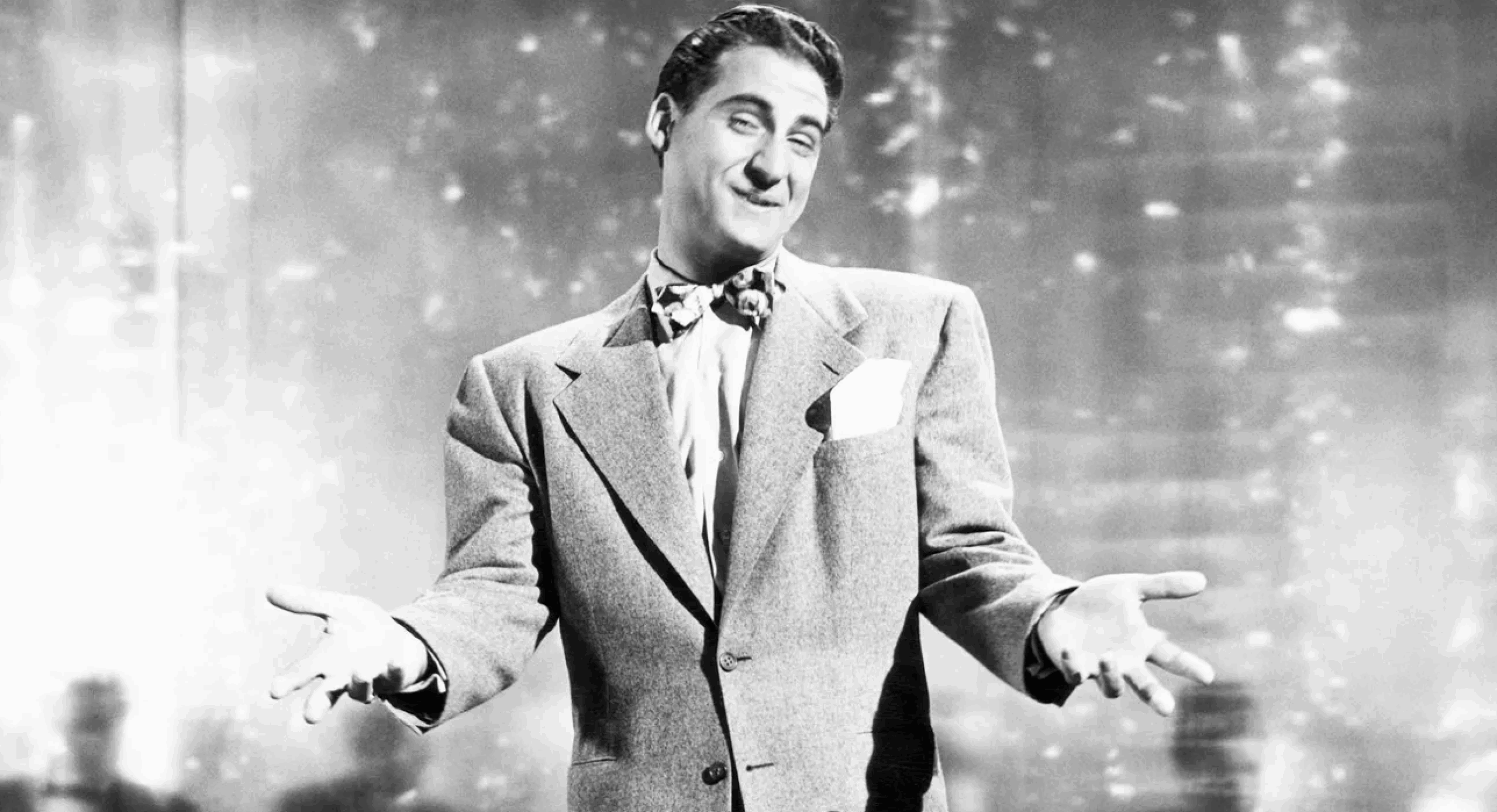
The Enduring Comedy Legacy of Sid Caesar
David Margolick on Keeping Caesar‘s Memory Alive and the Comedians He Inspired
For two good reasons, the best journalists loathe interviewing celebrities. First, you have to get past layers of handlers, often even more arrogant and self-important than their clients. And second, after getting the get, the answers that follow are often scripted and begrudging, superficial and insincere. And the bigger the honcho, the truer that usually is.
But talking to people who worked with or watched Sid Caesar, this was clearly not the case. It certainly didn’t apply to the countless comics and comedy writers Caesar influenced and inspired, people like Conan O’Brian, Billy Crystal, Carol Burnett, Richard Lewis, Al Franken, Judd Apatow, Robert Klein, Richard Kind, Larry Wilmore, and Phil Rosenthal, all of whom I spoke to for my book, When Caesar Was King: How Sid Caesar Reinvented American Comedy.
And it was emphatically untrue of Caesar’s two surviving writers, Mel Brooks and Woody Allen. Talking to them was among those experiences that made working on the book so rewarding. For Brooks and Allen not only talked with me about Caesar, but talked honestly and insightfully. And then they kept on talking.
Why the difference? Here, too, there were two explanations.
The first was gratitude. Brooks knew that Caesar discovered him (living “underneath a hovel,” as Caesar later put it) and then, for nearly a decade, sustained him, tolerated him, protected him, and inspired him. “No Sid Caesar, no Mel Brooks,” Brooks has often said. While considerably shorter, Allen’s tenure left a comparable imprint. Had Caesar looked, Allen told me, he’d have seen himself all over the movies he’d done.
“No Sid Caesar, no Mel Brooks,” Brooks has often said.
And second was a sense of injustice. Both Brooks and Allen believed that Caesar had fallen unfairly into obscurity, and that after everything he’d done for them, setting the record straight about him—about his gifts, his generosity, and his influence—was the least they could do for him.
Sitting in his office in Culver City, Brooks was impressed by what I’d already learned about Caesar, whose two famous programs—Your Show of Shows (1950-54) and Caesar’s Hour (1954-1957) set the standard, then the template, for television comedy for decades to come. But he warned me of the challenge Caesar’s precipitous fall posed for his biographer.
More than anyone else I spoke with, Brooks dissected and then described Caesar’s demise.
“I’m proud of you,” he told me. “You really know, you really understood, the show. Now you’re going to do this book, and people are going to say, ’Gee, this is really good and really interesting. Just one question, David: Who’s Sid Caesar?’ You’re going to get that. ‘Who was Sid Caesar?’”
More than anyone else I spoke with, Brooks dissected and then described Caesar’s demise. He captured how the pressures of putting out a live television show every week for more than eight seasons caught up with and consumed Caesar—how, saddled by the alcohol and tranquilizers which, for a time, had kept him going, television’s first great comedian, the embodiment of strength and power, became its first casualty.
“He was literally—literally—wearing his brain out,” Brooks said. “At the beginning, the second or third year of Your Show of Shows, he didn’t need a script at all. He knew what the premise was and he could get through the sketch. But by the time it was nearly over, you could see the angst. There was a worried look when he was thinking of the next line, the next beat. A lot of the moist gray little cells were drying up.”
Caesar’s colleagues and disciples—and especially Carl Reiner, Larry Gelbart, and Neil Simon—helped create the comic ecosystem on television, Hollywood, and Broadway as Caesar faded. But unlike all of them, in Caesar’s down-and-out years Brooks actually put him to work, giving him bit parts in some of his movies, including a cameo as a caveman in “History of the World, Part I.” Over dim sum and egg drop soup one day during the filming—Caesar, Brooks recalled, was wearing a coat over his caveman pelts—the two of them reflected on Caesar’s strangely truncated career.
“He stopped and he said ‘Mel, what happened? Who was I, what did I do, and tell me what happened. I don’t know what happened,’” Brooks remembered. “And I said ‘what happened is, you lived your life on demand, so you couldn’t see it. You were asked to do things every day and you did them, so you didn’t have time to breathe and say, ‘well, wait a minute. What am I doing?’ You were too busy spending twenty years of your life doing what other people needed from you, making money from you, getting laughs out of you, and because of that, you never stopped and said ‘wait a minute. Stop it all. I want to find out where I am and who I am.’”
Allen, who worked for Caesar on a couple of specials in the late 1950s (one of them he did with Brooks), recalled for me how Caesar was the man he and his friends idolized. “The fact that I got to work with him eventually was for me such a mind-blowing achievement,” he said.
“What Sid had going was a certain literacy,” he explained. “The things they were satirizing were high-end things. There was the ballet, the opera, foreign movies, jazz music. There was no one close to Sid.” Like Brooks, Allen depicted for me Caesar at his most imperial, with his fancy house in Great Neck and—more amazingly!—a phone in his car, the one on which Larry Gelbart once made a call just to say he had. Allen, too, retraced Caesar’s decline into paranoia, like when he brought a loaded gun into the writers room, then started waving it around.
But he could never have anticipated what Caesar said to him that night, just as I could never have anticipated Allen sharing so intimate and revealing a story with me, one which I’m pretty sure he never told another journalist.
Allen, too, had a late encounter with Caesar, going backstage with Dick Cavett after watching Caesar (and Imogene Coca) perform at Michael’s Pub in 1990. Allen knew Caesar liked his work; Reiner had told him so. And he appreciated how Caesar had let him call one of his movies “Bullets Over Broadway,” the name Caesar had given one of his best sketches.
But he could never have anticipated what Caesar said to him that night, just as I could never have anticipated Allen sharing so intimate and revealing a story with me, one which I’m pretty sure he never told another journalist. Hearing it, then anticipating how it would fit into my labor of love of a book, was one of my happiest moments on my glorious journey.
“He said to me, ‘funny that I’m going to be a footnote in your life story,’” Allen recalled for me. “And I thought, what a way to think of it: completely untrue. I’m a footnote in your life story: You’re Sid Caesar, and you’re not appreciating what a genius you were and what an influence you are on everybody. You’re one of the greatest comedians that we’ve ever had.
“But he’d felt that he had come upon harder times and that he had been forgotten to a large degree,“ he went on. “That wasn’t so with those of us who knew him. To me he was always majestic.”
__________________________________
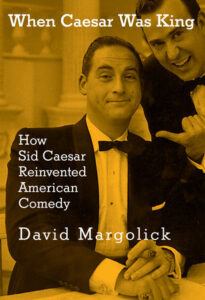
From When Caesar Was King: How Sid Caesar Reinvented American Comedy. Used with the permission of the publisher, Shocken Books. Copyright © 2025 by David Margolick.
David Margolick will introduce a compilation of Sid Caesar’s most iconic sketches at the Film Forum on December 2, 2025. This will be followed by a conversation with Bruce Goldstein, Film Forum’s Repertory Artistic Director with a book signing to follow.

David Margolick
David Margolick long reported on legal affairs for The New York Times, where he wrote the weekly “At the Bar” column and covered, among other stories, the trial of O. J. Simpson. He was then a contributing editor at Vanity Fair. His many books include Beyond Glory: Joe Louis vs. Max Schmeling, and a World on the Brink; Strange Fruit: The Biography of a Song; Dreadful: The Short Life and Gay Times of John Horne Burns; and Elizabeth and Hazel: Two Women of Little Rock. He lives in New York City.