Xiao Sang sat at her desk writing in her diary. She let her thoughts wander at random for a while, chin propped on hand, and then said to herself: “When I go back to that time, I’ll have all kinds of other choices.” “What choices will they be?” a voice inside her asked. “I don’t know, but they will flow forth and show themselves at that time.” She spoke out loud. She blinked. Just now she’d seen some of the scenery from that time: for example, a jade shoehorn, a full weeping willow. “I sat there talking with my loved ones who are dead. At the far end of my vision was a place where a stream curved, where a kingfisher flew toward me, but vanished in an instant.” Her voice reverberated through the room. Then Xiao Sang lowered her head and wrote down the words “jade shoehorn.” Was this her choice? She hadn’t yet returned to that time, so she didn’t know. She merely knew about a few of these striking tableaux. Reading is good labor. She could read certain books a hundred times without boredom.
When Xiao Sang finished writing in her diary, she stood and paced
the room. She felt that she read fiction in order to return to that time. Maybe, in some obscure and fateful way, she had made choices many times before. How could she not have, when everything became so intense? Then a smile appeared on her face—she had been so young back then. Was she that much older now? Maybe, maybe not. She raised her eyes to look at a book with a grayish-white cover on her bookshelf. This book had been her partner over the past few years. The book’s contents were plain to her, as if—as if she were living them herself. The book told about a sanitation worker, in whose time it seemed the city had not had street cleaning trucks. Every day before dawn she used a long bamboo broom to sweep the asphalt, with her head wrapped in a patterned scarf, her face unseen. The broom made a sha sha sha sound. Every time Xiao Sang read up to here she imagined herself as this woman. The asphalt road cooling again in the long night after being scorched by the sun; the mild contact of the broom with the ground . . . Xiao Sang sighed: “How lifelike!” She took that beloved book down and casually turned to a page in the middle. This page depicted a fanatical driver. “The sedan leaped into the air, then violently fell into the thick weeds and slid for a distance . . . The driver went limp, collapsing onto the steering wheel.” It seemed as though the driver had fallen asleep in the wilderness. Xiao Sang liked these types of plots best—a wasteland under the starlit sky, and someone serenely entering another world, with no one knowing . . . Ah! She was slightly excited each time, each time so invested, even though the plot was already familiar. She didn’t know whether other readers felt this way, but for her this is how it was.
Outside her window there was a little girl jumping rope. The swaying of her rope made what was portrayed in the book even more vivid. Xiao Sang sensed how the atmosphere around her captivated her. Sometimes she even liked to read on the street, especially when she was waiting for a ride. Xiao Sang held the stubborn belief that if an author were unable to weave the book’s contents into her everyday life, then it wasn’t a book she needed to read. She loved reading novels on the train the best, while the train moved slowly, stopping and starting as people from all classes chatted in loud voices, in the sleeper cars or gathered playing cards, so that there was noise everywhere. Xiao Sang usually read half-lying on the berth. With one ear she listened to the voices outside the novel, while her other ear listened to the voices inside the novel. At such times her body would feel very content. She could immerse herself for a whole day in this half-attentive reading, aside from the two meals on the train ride. “How lovely!” she would say to herself, once in a while. Unfortunately Xiao Sang had few opportunities for taking the (old-fashioned) train, so most of the time she read at home. Reading fiction at home was good, too, but not as enjoyable as in the sleeper car. Thinking of her most recent business trip on the train, she smiled again. Xiao Sang turned the pages of the book in her hand to the end.
The ending of this book was its best part, still exciting, but gradually returning to a steady state: like a whetstone tracing an arc through the air and then dropping into a secluded lake. Oh, that feeling of happiness passed too soon. Read it again then. A book that can give you a feeling of happiness—a remarkable author! She read it another time, looking through the window to where the little girl was still jumping rope, the jump rope swaying and swaying. She remembered again that scene of taking the train on a rainy day: holding a good book in her hands. Things couldn’t be more sentimental or nostalgic. On the sleeper berth with tears in her eyes—tears, though, of happiness. That book! In the course of reading year after year had passed, while her reading partners had changed—fewer in number now, the four or five books to which she was faithful from start to end.
“Xiao Sang, Xiao Sang!” her friend Xiao Ma rushed in. “I came to tell you, because you’ve been guiding us all. I’ve just read the most brilliant novel. The title is XXXX-XX. I read it all night, and my mind’s still spinning. How can there be such beautiful novels in the world?”
“I read that book, too, fifteen years ago.” A smile floated across Xiao Sang’s face as she fell into recollection. “It was a very good book, written with such tenderness, such quality . . . I can remember reading it by the sports field at school. There were people playing soccer in the distance, and once in a while I’d raise my eyes so the blurry shapes of the players flashed past me. I was so young then. Now you’ve experienced this book, too. Wonderful.”
“Haha, I’d worried that my insights weren’t real. Since you have the same feeling, it shows my good judgment. Have other people in the reading group recommended this novel to you?” She eagerly watched Xiao Sang.
“No, you’re the only one.”
Xiao Ma clapped her hands with excitement and shouted: “I want to be elevated! Elevated!”
She rushed out shouting, probably impatient to get back to enjoying the novel.
Xiao Ma was five or six years younger than her. Xiao Sang murmured: “Ah, youth.” She vividly sensed herself growing older, although this transformation inspired her rather than making her sad. She no longer read the kind of book Xiao Ma was reading. Had she become an elevated reader then? She must have, otherwise Xiao Ma wouldn’t come to her so anxiously seeking confirmation. Next Xiao Sang imagined Xiao Ma’s reading environment—had she read in the study for the whole night, or lying down in the bedroom? Or else under the streetlight by her building? Xiao Sang felt that the streetlight was the most suitable place to read that book: stillness on all sides, a black cat with shining fur slinking around the courtyard, the apricots on the large tree at the entrance glowing in the lamplight. Reading a beautiful book, then urgently running over to tell a friend. What a strong impulse this must be. Xiao Sang was more experienced than her friend, so her passion wasn’t as fervent, and instead was like the whetstone arcing into water. She understood this eagerness, though. Such a memorable scene.
That night for a long time Xiao Sang roamed the city inside the book that she loved. There was a shadow—but it also wasn’t a shadow, because it had an expression—that led her along the way. She and the shadow passed through many outdoor stalls along the side of the road before finally reaching a suburb where there was a deep well.
“Where have I read up to now?” her voice abruptly thundered in the air, startling her.
The shadow suddenly jumped down from the edge into the well, with an extremely natural gesture. Xiao Sang slowly approached the well’s edge and looked down into it, into the pitch-black below. A voice inside her said: “You’ve read up to here.”
Then she joyfully entered a dreamscape.
__________________________________
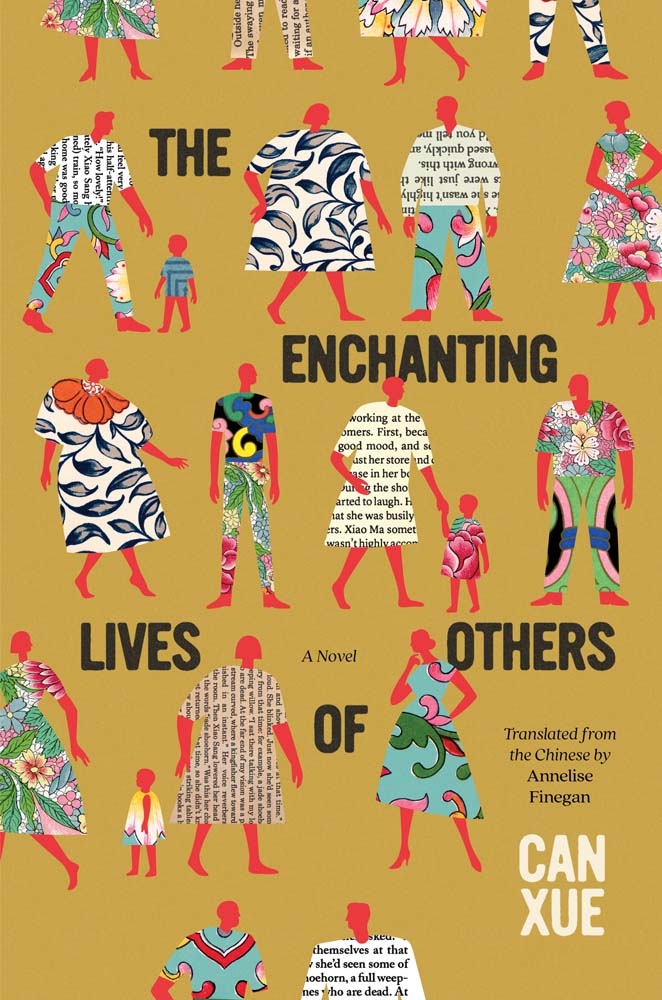
From The Enchanting Lives of Others by Can Xue, translated from the Chinese by Annelise Finegan. Published by Yale University Press in the Margellos World Republic of Letters series in February 2026. Reproduced by permission.