The Book of Michael Silverblatt
Logan Scherer Remembers “the Best Reader in America”
A velvety voice brings good news: the name of a lost Eastern European writer few have heard of, the reappearance of the genius’ brief novel. The voice is joined by a friend, Susan Sontag, who tells the story of finding Leonid Tsypkin’s Summer in Baden-Baden in a bargain book bin on Charing Cross Road in London. “It was the prose of ecstasy,” Sontag says, before describing a man approaching her at the Russian Samovar in New York, demanding to know how she knew of Leonid Tsypkin. The man was the person who first snuck the manuscript out of the Soviet Union in 1981.
A double miracle. “This is an everyday occurrence,” the velvety voice says. “Finding a great book is part of a life spent looking for great books.”
The voice is Michael Silverblatt’s. For 33 years on his weekly syndicated KCRW show, Bookworm, Michael Silverblatt, who died on February 14, was the voice of literary rapture. His interviews with Don DeLillo, Hilton Als, Lydia Davis, William Gass, Jamaica Kincaid, Fran Lebowitz, Ariana Reines, Eileen Myles, Dennis Cooper, and over 1,200 others reach transcendence.
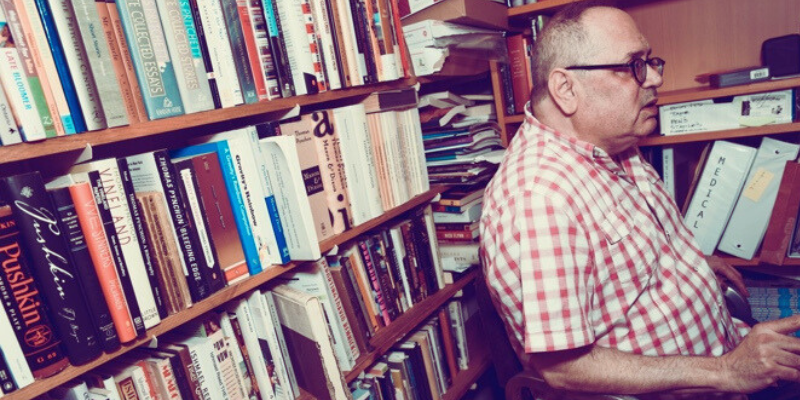
“Ideally, one would never ever read a book that one wouldn’t want to reread,” Sontag told Silverblatt. Silverblatt lived in Sontag’s ideal world: every book he read, he reread. Interviewing David Foster Wallace in 1998 on the occasion of Infinite Jest’s publication, Silverblatt was already halfway through the book for a second time. His goal was to reread a guest’s entire body of work before an interview. In 1997, Orhan Pamuk flew to Los Angeles just to be interviewed for a half hour by Silverblatt; after days of “living with and in Pamuk’s words,” a sleepless Silverblatt finished Pamuk’s The New Life at 5.30 am the morning of their interview. Silverblatt’s collection of books is so vast that he kept a second apartment to contain it.
Susan Sontag and Michael Silverblatt routinely called each other with “secret books”—hidden masterpieces. This was the genesis for their 2002 conversation about Summer in Baden-Baden. When their discussion turns to the reception of Tsypkin’s novel, Susan Sontag mourns the decline of American book-reviewing, the loss of a “support system for spreading the news about books that are really valuable.”
Today, twenty-two years after this episode, that “support system” is nearly gone. But in the world of Silverblatt and Bookworm, the idea that literature has an end (or a beginning), the notion that literature could ever disappear, is unimaginable. He speaks like the humble leader of an early sect disseminating his message among friends. In alternately hushed and ebullient tones, Silverblatt moves from Wyndham Lewis to fractal structure to what Toni Morrison described as the “not quite secular.” For Silverblatt, reading is mysticism. Bookworm is a gospel.
I choose to believe that this style of infinite deference can be real, is real. The monk, the mouse, the greatest reader in America.
Silverblatt’s transformative desert was Buffalo in the late-sixties, where he studied with John Barth, Donald Barthelme, and Dwight McDonald. There he also attended the first seminars Foucault gave in the US.
“People who know the sound of my voice know that my voice is full of the awe that I feel to be in the presence of a writer I truly admire,” Silverblatt said at the beginning of his 2011 interview with Joan Didion about Blue Nights. Didion had already appeared on Bookworm at least four times, but Silverblatt is as awestruck as if for the first time. To be a reader as great as Silverblatt is to be in a constant state of awe.
In a reluctant moment where Silverblatt himself became the interview subject, he describes the sublimity of his awe. He is never not intimidated. Along with Joan Didion, he names Susan Sontag and Norman Mailer as the subjects who intimidated him the most. Sontag would go on to become his very close friend, and Mailer, as a guest, was, for Michael, “a mellow bull in a pasture, with flowers wound around his horns…so sweet…so endearing and funny.” Mailer, who appeared as a guest on multiple episodes of Bookworm, called Silverblatt “the best reader in America.”
Still, Silverblatt had good reasons for fearing Sontag and Mailer. Both came from a world very different from his idea of literature as the highest form of friendship: the contentious world of The Partisan Review, where literary criticism hinged on competition and evisceration. In Write Like a Man: Jewish Masculinity and the New York Intellectuals (whose paperback is forthcoming from Princeton University Press this March), Ronnie Grinberg writes of Norman Mailer, Lionel Trilling, Irving Howe, and other powerful Jewish men of the last century who saw literary criticism as an arena for combat, and equated good writing with argumentative victory.
As the gentle-voiced sage of literary brotherhood, Michael Silverblatt is their anti-inheritor. For Silverblatt, criticism comes from warmth and pleasure. “Bookworm practices the guest-host relationship as the ancients did, where hospitality was the sacred right of any guest,” Alan Felsenthal, the poet who runs The Song Cave, writes in the introduction to Bookworm: Conversations with Michael Silverblatt. Writers “don’t need to be interrogated,” Silverblatt said. “They need to be taken on a beautiful walk or ramble.”
Silverblatt is more a monk than a leader, a Walserian pupil overwhelmed by his own capacity for wonder. He names Robert Walser, along with Kafka and Bruno Schulz, as the models for his radio persona, the masters he calls “those sweet human mice”: “In some of the amazing cowardly forthrightness of those three writers, I found something that might be called humility, a comic style of infinite deference (which couldn’t possibly be real—a real life character would not have that kind of infinite solicitude).”
I choose to believe that this style of infinite deference can be real, is real. The monk, the mouse, the greatest reader in America.
Over the past four years, in the absence of new Bookworm episodes, I’ve lived in the Summer in Baden-Baden episode. Midway through, the conversation, as all conversations about important literature should, turns to Hungarians. Sontag names Imre Kertész’ Fateless as a book that will grab you and refuse to let you go. I was in an empty apartment, learning Hungarian by myself, and the mention of a Hungarian masterpiece felt serendipitous. I wasn’t ready to read it. (Silverblatt’s ninth rule of reading: “There are certain books you’ll find you’re not ready for.”) I didn’t want to step away from the ramble. I preferred remaining in the admiration of two good friends. I wasn’t ready to let go of the possibility for greatness. This year, in another stranger’s apartment, I found Fateless on a bookshelf. It did grab me, and has yet to let me go.

Logan Scherer
Logan Scherer writes from Central Europe.