The Annotated Nightstand: What Rachel Khong is Reading Now, And Next
Featuring Anne Truitt, Simon Critchley, James Hillman, and More
Just as an acclaimed prose writer/musician/actor isn’t necessarily a strong poet, the leap between novel and short story can be quantum. While both are creative gestures of fiction, the size invariably defines its shape (I say this as a deep fan, but someone who couldn’t write fiction if her life depended on it). Rachel Khong, the author of the hit New York Times bestselling novel Real Americans last year, has a new short story collection: My Dear You. Fear not—Khong makes the leap from novel to story with ease. Her short fiction sizzles. Comparing two sisters, Khong describes one as “the family’s toughest cookie” the other “a soft thing, always falling apart”—the former is a “digestif cracker,” the other “oatmeal raisin.”
These stories launch us into circumstances that, while punctured with the fantastical, generally hew close to reality. In one, the nation, riven by racial violence, mandates an injection that makes everyone you see bear your same race and gender identity. In another, a woman works at a factory training elite sex robots how to engage in deep conversation. In the titular story, the afterlife is more tech-forward than you might think. As dark as these descriptions may seem, Khong frequently keeps things light, often flirting with the hilarity of the absurd—as with the woman eaten by a crocodile on the first day of her honeymoon. The sting of her death is eased for us by the fact that she’s still herself, describing her experiences in heaven—but also when she gets the final burn on what made her lunch by calling it “an old crocodile bitch.”
Above all, these stories poignantly interrogate intimacies and what makes them particularly sticky (misogyny; racial, cultural, or income difference, mismatched personalities) or render them entirely impossible. The myriad shapes loneliness takes is the recurring consideration of Khong through her characters and the ways in which they wrestle that painful shapeshifter. In a starred review at Library Journal, Elizabeth Walline states that My Dear You “The 10 thought-provoking stories range from tender to sinister to funny to sad, and they won’t quickly leave readers’ minds.” The verdict? “Khong’s distinctive writing voice shines.”
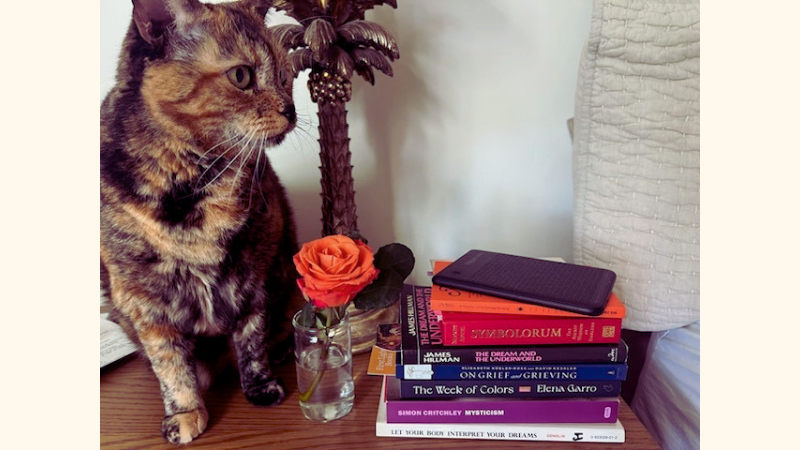
Khong tells us of her to-read pile (photographed with an adorable fuzzy friend): “My bed is a place for dreaming, so my nightstand is a place for books about dreams. I’m usually reading multiple books at once, a mix of fiction and nonfiction. My Kobo contains even more reading material: right now I’m in the middle of Daybook by Anne Truitt.”
*
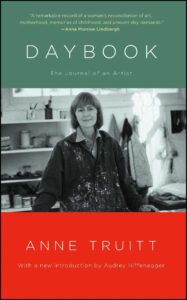
Anne Truitt, Daybook: The Journal of an Artist
Daybook is the first of four collections of the minimalist sculpture artist’s journals. Megan O’Grady writes in the New Yorker of these collections that, in her writing, “Truitt is often pushing to articulate something at the edge of discernment; much of the pleasure of reading them is in experiencing her thoughts still in formation as she sought to illuminate ‘the dark, driving run’ of art-making.” Truitt herself writes, “what I was actually trying to do was to take paintings off the wall, to set color free in three dimensions for its own sake…This was analogous to my feeling for the freedom of my own body and my own being, as if in some mysterious way I felt myself to be color.”
Eugene T. Gendlin, Let Your Body Interpret Your Dreams
Gendlin was an American philosopher who made a mark on psychotherapy, including the notion of “focusing” (tldr: being open to bodily insights, thoughtful attention, among other things). The jacket copy reads that Gendlin “implies, rightly, that there are many ways of interpreting dreams, based on various theoretical approaches, each with its own validity. Yet, what really counts is the dreamer’s somatic response to questions raised or interpretations suggested; the body has the answer.”
Simon Critchley, Mysticism
“Mysticism, Critchley clarifies, is not itself a religion,” writes Emma Eldred Johnson writes at The Chicago Review of Books, “but rather a ‘tendency, a distillation of existing devotional practice, textual interpretation, theological teaching, and conceptual, philosophical reflection.’…He observes that mysticism is performative in the sense that it is a form of expression that not only records the mystic’s experience but also produces experience. Mysticism is something we know about in operatio—through writing.”
Elena Garro, The Week of Colors: Stories (tr. Megan McDowell)
Megan McDowell is one of the most vital translators from Spanish out there—it seems every book she brings into English is solid gold. Kirkus writes in its starred review of this collection, “Originally published in 1964, this collection stands as a seminal work prefiguring the surrealist and magical realist movements that would come to define so much of Latin American literature in the decades to come. However, a contemporary reader coming fresh to Garro’s work will find a voice that feels as vital today as it ever did.”
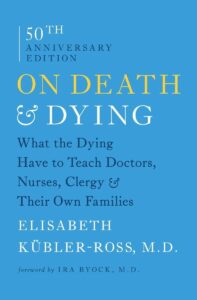
Elisabeth Kübler-Ross, On Grief and Grieving: Finding the Meaning of Grief Through the Five Stages of Loss
Kübler-Ross authored the iconic 1969 book On Death and Dying, which lays out the five stages of grief (aka, the Kübler-Ross model). If you like a Wikipedia wormhole as much as I do, Kübler-Ross’ is a particularly wild tumble. (She was in a fraternal triplet with an identical twin??) The Swiss-born psychiatrist was the first to turn a scrutinizing eye to death and everything that swirls around it: near-death, palliative care, bioethics. “Death with dignity” is due to Kübler-Ross. She worked with people, dying or no, otherwise shoved to society’s margins: those with AIDS, incarcerated people, children. Late in life, Kübler-Ross spoke openly about how she was ready for death—but apparently God was a “damned procrastinator.”
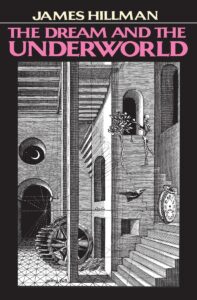
James Hillman, The Dream and the Underworld
Like a cat to her nip, I revel in the old review of this book by Hillman, a psychoanalyst who directed the Jung Institute for a decade. “Dr. Hillman’s book is a goatpath to the black poplars guarding the entrance to Hades,” writes Edgar Levenson in his 1979 New York Times review, going on to explain the book “reflects more literally his attempt to place dreams in the mainstream of myth, and specifically the myth of the underworld.”
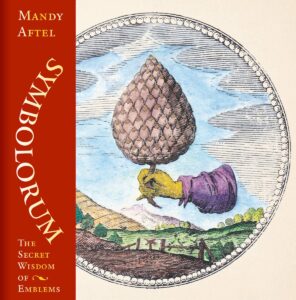
Mandy Aftel, Symbolorum: The Secret Wisdom of Emblems
I love that the publisher of this book quotes a Facebook post highlighting the bookstore offerings at The Philosophical Research Society (an historic locale in Los Angeles). PRS writes, “Mandy Aftel’s Symbolorum revives the Baroque emblem book, a 17th-century form that wove image, motto, and meditation into a single contemplative device. Neither purely literary nor purely visual, emblems were meant to be lived with and studied slowly, sensed intuitively, and returned to over time. In this way, they feel like a long-lost cousin of the tarot, the artist’s book, and the symbolic systems many of us turn to now for meaning-making beyond linear reason.”
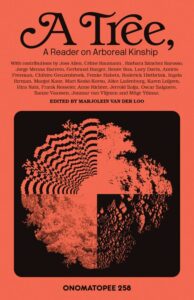
Ed. Marjolein van der Loo, A Tree: A Reader on Arboreal Kinship
A Tree wasn’t merely textual work, as this edited volume with over a dozen writing and visual contributors, but also an art exhibition and event series. This reader is connected to a larger exploration under van der Loo between “folklore and critical research” including with a Bird, by a Woman, on Land, Under a Star, all, it seems, with the aim to disrupt the common notions of engagement with the physical and conceptual. “Like all plants, trees make the world,” the book description states. “Trees are also time tellers.”
Diana Arterian
Diana Arterian is the author of the recent poetry collection Agrippina the Younger (Northwestern UP, 2025), which received the 2026 William Carlos Williams Award from the Poetry Society of America. She is also editor and co-translator of Smoke Drifts (World Poetry Books, 2025), a collection of Nadia Anjuman's poetry. A Poetry Editor at Noemi Press, Diana has received fellowships from the Banff Centre, Millay Arts, and Yaddo. She writes “The Annotated Nightstand” column at Lit Hub and lives in Los Angeles.