The Annotated Nightstand: What Jake Skeets is Reading Now, and Next
Featuring Leslie Marmon Silko, Rex Lee Jim, Joan Naviyuk Kane, And More
Since the 1970s, feral horses and burros have had the legal right to roam freely after decades of poaching. Growing up in Arizona (and as a wannabe horse girl), from a young age the power of the wild horse and burro was something deeply ingrained in many of us. In early May 2018, the region gripped by a drought, the Navajo Nation detailed a terrible discovery: 191 wild horses had died in a ring at a stock pond reduced to mud by lack of rainfall. Desperate for water, the horses trudged into the mire, too weak to extract themselves. (The Navajo Nation posted a photo of the scene—know before you look that it is devastating.) A news article on the deaths quotes Charlie “Snow Bear” Smith, Jr. as he describes coming upon dozens of dead horses and a stranded cow. “It just hits you,” Smith said. “You tear up. You know you don’t have the capability to save them.”
The precarity of these incredible animals is at the heart of Jake Skeets’ new poetry collection, Horses. While reading these lush and powerful poems, I often understandably thought of Skeets’ idea of “Dinétics.” Dinétics gives language to the linkages between poetics, aesthetics, and the Diné notions of—per Esther Belin, with whom Skeets has a conversation here—“how we see the world through relationships.” While this involves relationships between humans, human and nonhuman, nonhuman amongst each other, it is also felt in long-term impacts.
Considering humanity’s treacherous role in climate disaster alongside the centuries-old enterprise of colonial violence, what happened and is happening to the free-roaming horses is emblematic of the larger subsequent horrors for the earth and its keepers. Even that which is normally a resource can become a threat, as in one poem about children who “show us first that mud is baptismal mud can be new skin // but,” Skeets continues, “mud swallows even the most sacred sometimes.” Publishers Weekly writes in its starred review, “This alluring and exacting collection beautifully reflects on the boundaries between people and place.”
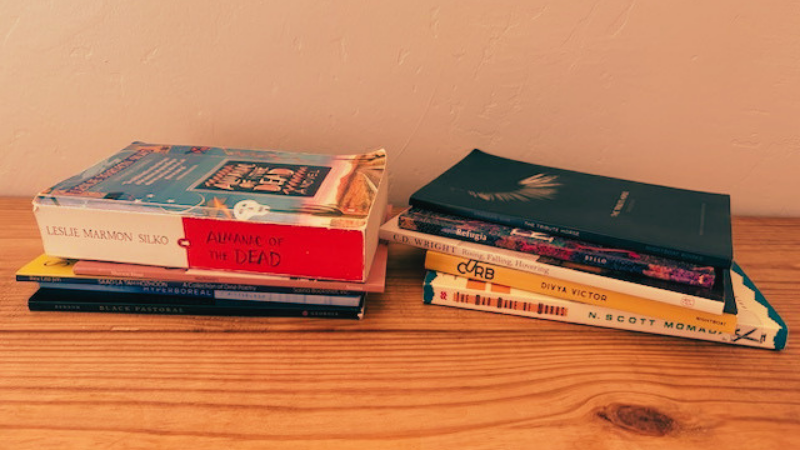
Skeets tells us about his to-read pile: “I keep my books mostly in my campus office, mostly because I’ve been moving almost every year since 2022. There is nothing like packing and unpacking books while you’re sweaty and tired from moving everything else in your life. So I’m constantly moving books back and forth between my home and my office. In one way, this forces me onto my campus office when I prefer often to work from home. In another way, reading becomes even more visceral for me because I carry the weight of these books from desk to table and vice versa.”
*
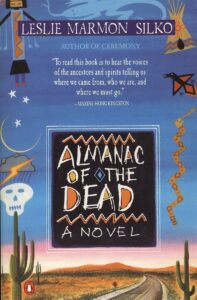
Leslie Marmon Silko, Almanac of the Dead
Lou Cornum wrote here at Lit Hub about this totemic text, “[Silko’s] magnum opus Almanac of the Dead was published in 1991 in the flurry of cultural production surrounding the 500-year anniversary of Columbus’s arrival. Silko’s 700-page story of stories adapts multiple Indigenous prophecies from Pueblo glyphs to the K’iche’ Mayan Popul Vuh to track the fracture lines extending from this event of contact that, like an atomic bomb, has torn apart the land and poisoned the atmosphere, making relations of conquest seemingly inescapable.”
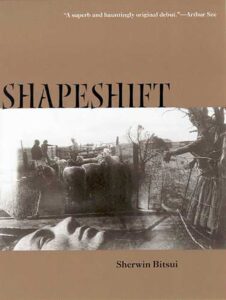
Sherwin Bitsui, Shapeshift
At Institute of American Indian Arts Chronicle, Orlando White quotes Bitsui on his first collection, stating, “in Sherwin’s poetry, listeners and readers alike, experience the heightened sense and mystery of his images. ‘The image is a meeting place where the voice of the poem is as much the participant as the reader or listener is.’” Bitsui goes on: “I am not concerned with where the story comes from. I am more concerned with how the narrative grows outside its skull. Are the windows there so we can look in, or are they there so we can look out?”
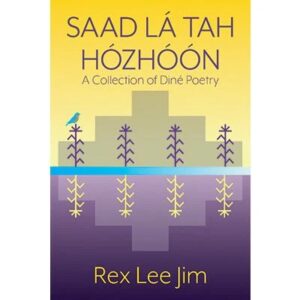
Rex Lee Jim, Saad Lá Tah Hózhóón: A Collection of Diné Poetry
On this collection’s title, Jim explains to the Navajo-Hopi Observer, “You could translate it as ‘Beauty at the tip of words, or balance at the tip of language.’” He continues, “Navajo is beginning to face the loss of language. We’re in real trouble. One way to explore the revitalization of language is through creative expression like writing poetry, making movies…we need to do more to expand the capacity of language, not only writing but also in other difficult subject like chemistry.”
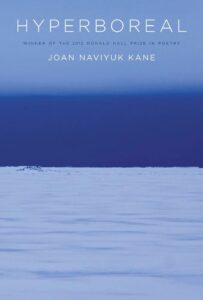
Joan Naviyuk Kane, Hyperboreal
In an interview with the New York Times, Kane explains what being a poet is to her, stating, “It’s a way for me to continue to do the work of all human beings—to try to express a spectrum of complex feelings of joy, sorrow and uncertainty—and, as a mother, to investigate modes of cultural transmission. Poetry is among the oldest art forms across all cultures, but it is deeply embedded in Inupiaq oral traditions, and I hope that as I continue to grow as a writer, I can continue to honor that.”
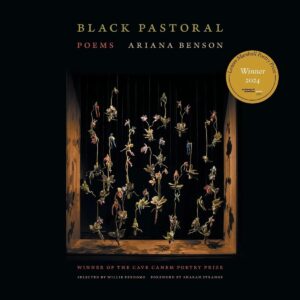
Ariana Benson, Black Pastoral
“Ariana Benson’s debut collection, Black Pastoral, has seeded my psyche with its lush and thorny language,” writes Evie Shockley at Kenyon Review. “Benson is looking, listening, and feeling the world with the intensity of a young Black woman who wants to love it all, even though she knows the danger of opening her heart to beauty so liberally poisoned.”
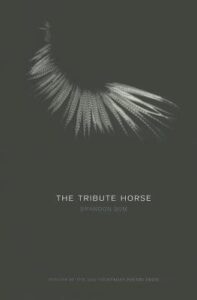
Brandon Som, The Tribute Horse
Ryo Yamaguchi (now of Copper Canyon), describes Som’s Kate Tufts Discovery Award-winning first collection at New Pages as one with “poems that are otherwise far more ethereal or conceptual, comprised of myths, histories, phonetic analyses, readings, and other noumena that are more of the mind than out-of-doors…The poise and pacing of this layout is relaxed, mirroring the poems themselves, in which the lines tend to arrive with a clearing of breath that brings its sonics, its assembly of image, and its conceptual sophistication into satisfying relief.”
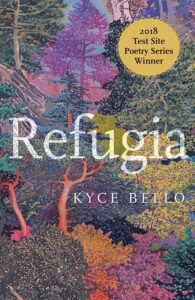
Kyce Bello, Refugia
Bailey Hoffner writes at World Literature Today, “Refugia captures the losses, the quiet rage, and the constant, near-overwhelming wonder of life on this very particular planet in this very particular moment, somehow also managing to make amends with the arriving of our almost certainly unfamiliar future. We’re left to continue marching forward, the ground as uncertain beneath our feet as over the roots of the piñon tree. ‘If it is certainty you’re looking for, / tend the water boiling in the cookpot.’”
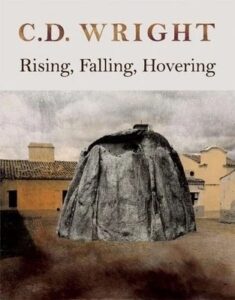
C.D. Wright, Rising, Falling, Hovering
“In her first collection of new lyric poems since 2003, Wright braids some of her most personal and intimate poetry to date with an extended meditation on the consequences of America’s contemporary stance toward other countries,” states Publishers Weekly in its starred review. It goes on: “This book displays a new level of social and personal consciousness for Wright (One Big Self), who characterizes the powerful ambivalence that now accompanies life in America, where injustice may be the price of freedom, and where ‘poetry / doesn’t / protect / you / anymore.’”
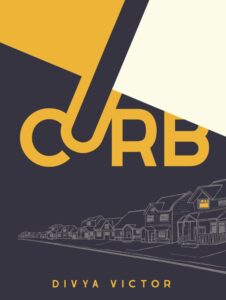
Divya Victor, Curb
Jenny Bhatt says of Victor’s award-winning collection at NPR: “Victor’s painfully vivid and sharp fragments of prose and poetry are loaded with kinesthetic and synesthetic images as well as multilingual alliterations and repetitions. Many of these pages have geographic coordinates at their top-right corners to locate the specific sites of the events being described, and to remind us that reading is a physical act that leaves traces. The carefully-constructed white spaces on Victor’s pages are…much-needed pauses to allow the language, emotions, and thoughts to flow into us.”
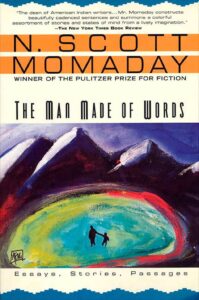
N. Scott Momaday, The Man Made of Words: Essays, Stories, Passages
Hooray for finding an older review! Kirkus writes in its 1997 review of Momaday’s essay collection, “The best pieces in the book, such as a wonderful essay on Navajo place names, combine this ethic with a profound attention to local knowledge and old ways of knowing; echoing Borges, Momaday proclaims that for him paradise is a library, but also ‘a prairie and a plain [and] the place of words in a state of grace.’…To read him is to be in the company of a master wordsmith.”
Diana Arterian
Diana Arterian is the author of the recent poetry collection Agrippina the Younger (Northwestern UP, 2025) and editor and co-translator of Smoke Drifts (World Poetry Books, 2025), a collection of Nadia Anjuman's poetry. A Poetry Editor at Noemi Press, Diana has received fellowships from the Banff Centre, Millay Arts, and Yaddo. She writes “The Annotated Nightstand” column at Lit Hub and lives in Los Angeles.